


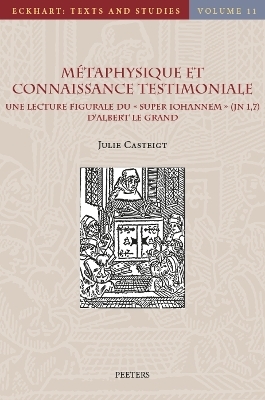
Métaphysique et connaissance testimoniale
Une lecture figurale du Super Iohannem (Jn 1, 7) d'Albert le Grand
Seiten
2019
Peeters Publishers (Verlag)
978-90-429-3610-2 (ISBN)
Peeters Publishers (Verlag)
978-90-429-3610-2 (ISBN)
Cet essai vise à mettre au jour le mode de connaissance du principe
qu’Albert le Grand déploie, dans son commentaire johannique, comme
réponse à l’aporie des philosophes. Il formule celle-ci à propos du
verset Jn 1, 7: «Et, bien qu’en elle-même elle soit
très manifeste, cependant, notre intellect est, par rapport à elle,
comme les yeux de la chauve-souris par rapport à la lumière du soleil».
C’est à partir de la notion de témoignage, dans laquelle il reconnaît la
structure même de l’Évangile de Jean, que le maître de Cologne
développe la connaissance testimoniale comme voie vers le principe,
alternative à la métaphysique. Cette enquête procède à partir des
questions suivantes.
Du point de vue noétique, comment Albert de
Cologne réélabore-t-il la notion de médiation à l’œuvre dans le modèle
péripatéticien qui propose de parvenir au principe selon la gradation
des sciences physique, mathématique et métaphysique? Il reconnaît, dans
la connaissance testimoniale et dans la métaphysique, l’homologie
structurelle de la manuduction: toutes deux commencent par les données
des sens et de l’imagination qui conduisent l’intellect «par la main»
vers le principe divin.
Du point de vue anthropologique, en quoi
la connaissance testimoniale constitue-t-elle le mode de connaissance du
principe adapté à l’intellect humain en tant qu’il est conjoint aux sens
et à l’imagination, et non pas en tant qu’il en est séparé? C’est en ce
qu’elle s’adresse à l’intellect humain, en tant qu’il est humain, que la
connaissance testimoniale diffère de la métaphysique. Elle demeure dans
le milieu, ou la médiation, des images.
Du point de vue
herméneutique, le Docteur universel nomme intelligentia figuralis
le mode d’interprétation spécifique des images du principe. S’agit-il
d’un art ou d’une science?
Du point de vue métaphysique, en
érigeant la notion de témoignage en point focal de sa lecture du
quatrième évangile, Maître Albert élabore de manière spécifique le
concept de médiation dans le contexte johannique. Comment se caractérise
cette spécificité par rapport à ce qu’il développe dans ses commentaires
aristotéliciens et dionysiens, notamment? En retour, la notion
johannique de témoignage est radicalement réinterprétée à la lumière de
la théorie cosmologique gréco-arabe de la médiation qu’est le vase de
lumière. Qu’en ressort-il quant à la lecture albertienne de
l’Évangile de Jean?
Le bénéfice de cet essai philosophique
consiste à étudier la notion de médiation à partir d’une micro-lecture
du verset Jn 1, 7, en mettant en lumière le réseau textuel auquel
elle appartient ainsi que la manière transversale dont cette notion
circule dans toute l’œuvre d’Albert le Grand – dans le corpus
aristotélicien, dionysien, scripturaire – et dans tous les champs de sa
pensée – métaphysique, théologique, ontologique, noétique, physique,
cosmologique, biologique, minéralogique...
This essay sheds light on how Albert the Great in his Johannine
commentary unfolds his response to various aporia of philosophers
on knowing the principle, drawing on John 1:7 (‘And, although in
itself, it is very manifest, yet our intellect is, in relation to it,
like the bat’s eyes in relation to the sunlight’). On the basis of the
notion of witness, in which he recognizes the very structure of the
Gospel of John, the Master of Cologne develops testimonial
knowledge as a way to the principle, an alternative to metaphysics. From
the noetic point of view, this essay asks how Albert of Cologne
redefines the notion of mediation at work in the peripatetic model
according to physical, mathematical and metaphysical sciences. Albert
recognizes in testimonial knowledge and metaphysics the structural
homology of manuduction: both begin with the data of the senses and the
imagination that lead the intellect ‘by the hand’ towards the divine
principle. How from an anthropological point of view does testimonial
knowledge constitute the mode of knowledge of the principle that is
adapted to the human intellect as it is joint to the senses and to
imagination? Testimonial knowledge differs from metaphysical knowledge
insofar as it is addressed to the human intellect. It remains in the
realm of mediation and images. How from a hermeneutical point of view,
the Doctor universalis calls intelligentia figuralis the specific method
of interpreting images of the principle. Is it an art or a science?
By making the notion of testimony a focal point in his reading of
the fourth gospel, Master Albert elaborates in a specific way the
concept of mediation in the Johannine context. How is this specificity
characterized compared to what he develops in his comments on
Aristotelian and Dionysian thinking? On the other hand, the Johannine
notion of testimony is radically reinterpreted in the light of the vase
of light, a Greco-Arabic cosmological theory of mediation.
This
philosophical essay studies the notion of mediation from a micro-reading
of John 1:7, highlighting the textual network to which it
belongs, as well as the transversal way in which this notion circulates
throughout Albert’s work – in the Aristotelian, Dionysian, and
scriptural corpus – and in all the fields of his thought –
metaphysics, theology, ontology, noesis, physics, cosmology, biology,
mineralogy...
qu’Albert le Grand déploie, dans son commentaire johannique, comme
réponse à l’aporie des philosophes. Il formule celle-ci à propos du
verset Jn 1, 7: «Et, bien qu’en elle-même elle soit
très manifeste, cependant, notre intellect est, par rapport à elle,
comme les yeux de la chauve-souris par rapport à la lumière du soleil».
C’est à partir de la notion de témoignage, dans laquelle il reconnaît la
structure même de l’Évangile de Jean, que le maître de Cologne
développe la connaissance testimoniale comme voie vers le principe,
alternative à la métaphysique. Cette enquête procède à partir des
questions suivantes.
Du point de vue noétique, comment Albert de
Cologne réélabore-t-il la notion de médiation à l’œuvre dans le modèle
péripatéticien qui propose de parvenir au principe selon la gradation
des sciences physique, mathématique et métaphysique? Il reconnaît, dans
la connaissance testimoniale et dans la métaphysique, l’homologie
structurelle de la manuduction: toutes deux commencent par les données
des sens et de l’imagination qui conduisent l’intellect «par la main»
vers le principe divin.
Du point de vue anthropologique, en quoi
la connaissance testimoniale constitue-t-elle le mode de connaissance du
principe adapté à l’intellect humain en tant qu’il est conjoint aux sens
et à l’imagination, et non pas en tant qu’il en est séparé? C’est en ce
qu’elle s’adresse à l’intellect humain, en tant qu’il est humain, que la
connaissance testimoniale diffère de la métaphysique. Elle demeure dans
le milieu, ou la médiation, des images.
Du point de vue
herméneutique, le Docteur universel nomme intelligentia figuralis
le mode d’interprétation spécifique des images du principe. S’agit-il
d’un art ou d’une science?
Du point de vue métaphysique, en
érigeant la notion de témoignage en point focal de sa lecture du
quatrième évangile, Maître Albert élabore de manière spécifique le
concept de médiation dans le contexte johannique. Comment se caractérise
cette spécificité par rapport à ce qu’il développe dans ses commentaires
aristotéliciens et dionysiens, notamment? En retour, la notion
johannique de témoignage est radicalement réinterprétée à la lumière de
la théorie cosmologique gréco-arabe de la médiation qu’est le vase de
lumière. Qu’en ressort-il quant à la lecture albertienne de
l’Évangile de Jean?
Le bénéfice de cet essai philosophique
consiste à étudier la notion de médiation à partir d’une micro-lecture
du verset Jn 1, 7, en mettant en lumière le réseau textuel auquel
elle appartient ainsi que la manière transversale dont cette notion
circule dans toute l’œuvre d’Albert le Grand – dans le corpus
aristotélicien, dionysien, scripturaire – et dans tous les champs de sa
pensée – métaphysique, théologique, ontologique, noétique, physique,
cosmologique, biologique, minéralogique...
This essay sheds light on how Albert the Great in his Johannine
commentary unfolds his response to various aporia of philosophers
on knowing the principle, drawing on John 1:7 (‘And, although in
itself, it is very manifest, yet our intellect is, in relation to it,
like the bat’s eyes in relation to the sunlight’). On the basis of the
notion of witness, in which he recognizes the very structure of the
Gospel of John, the Master of Cologne develops testimonial
knowledge as a way to the principle, an alternative to metaphysics. From
the noetic point of view, this essay asks how Albert of Cologne
redefines the notion of mediation at work in the peripatetic model
according to physical, mathematical and metaphysical sciences. Albert
recognizes in testimonial knowledge and metaphysics the structural
homology of manuduction: both begin with the data of the senses and the
imagination that lead the intellect ‘by the hand’ towards the divine
principle. How from an anthropological point of view does testimonial
knowledge constitute the mode of knowledge of the principle that is
adapted to the human intellect as it is joint to the senses and to
imagination? Testimonial knowledge differs from metaphysical knowledge
insofar as it is addressed to the human intellect. It remains in the
realm of mediation and images. How from a hermeneutical point of view,
the Doctor universalis calls intelligentia figuralis the specific method
of interpreting images of the principle. Is it an art or a science?
By making the notion of testimony a focal point in his reading of
the fourth gospel, Master Albert elaborates in a specific way the
concept of mediation in the Johannine context. How is this specificity
characterized compared to what he develops in his comments on
Aristotelian and Dionysian thinking? On the other hand, the Johannine
notion of testimony is radically reinterpreted in the light of the vase
of light, a Greco-Arabic cosmological theory of mediation.
This
philosophical essay studies the notion of mediation from a micro-reading
of John 1:7, highlighting the textual network to which it
belongs, as well as the transversal way in which this notion circulates
throughout Albert’s work – in the Aristotelian, Dionysian, and
scriptural corpus – and in all the fields of his thought –
metaphysics, theology, ontology, noesis, physics, cosmology, biology,
mineralogy...
| Erscheinungsdatum | 17.12.2019 |
|---|---|
| Reihe/Serie | Eckhart: Texts and Studies ; 11 |
| Verlagsort | Leuven |
| Sprache | französisch |
| Gewicht | 1090 g |
| Themenwelt | Geisteswissenschaften ► Philosophie ► Geschichte der Philosophie |
| Geisteswissenschaften ► Philosophie ► Philosophie der Neuzeit | |
| ISBN-10 | 90-429-3610-X / 904293610X |
| ISBN-13 | 978-90-429-3610-2 / 9789042936102 |
| Zustand | Neuware |
| Informationen gemäß Produktsicherheitsverordnung (GPSR) | |
| Haben Sie eine Frage zum Produkt? |
Mehr entdecken
aus dem Bereich
aus dem Bereich
Philosophie in Zeiten des Krieges : eine Biographie
Buch | Softcover (2024)
C.H.Beck (Verlag)
CHF 24,90
oder Das Leben Montaignes in einer Frage und zwanzig Antworten
Buch | Softcover (2023)
C.H.Beck (Verlag)
CHF 27,90


