


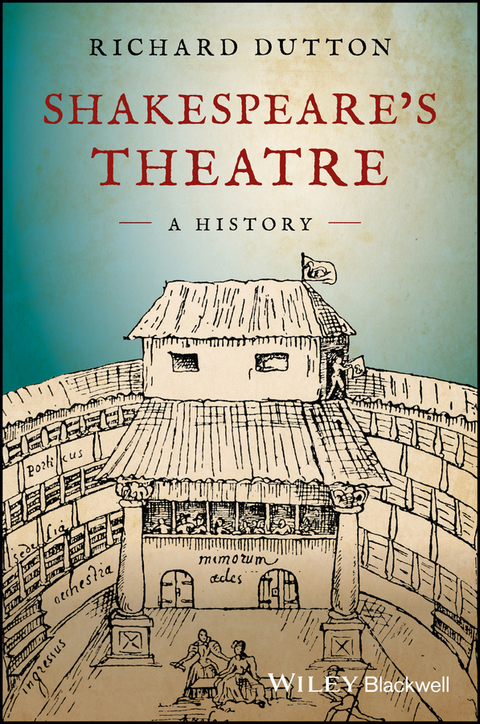
Shakespeare's Theatre: A History examines the theatre spaces used by William Shakespeare, and explores these spaces in relation to the social and political framework of the Elizabethan era. The text journeys from the performing spaces of the provincial inns, guild halls and houses of the gentry of the Bard's early career, to the purpose-built outdoor playhouses of London, including the Globe, the Theatre, and the Curtain, and the royal courts of Elizabeth and James I. The author also discusses the players for whom Shakespeare wrote, and the positioning-or dispositioning-of audience members in relation to the stage.
Widely and deeply researched, this fascinating volume is the first to draw on the most recent archaeological work on the remains of the Rose and the Globe, as well as continuing publications from the Records of Early English Drama project. The book also explores the contentious view that the 'plot' of The Seven Deadly Sins (part II), provides unprecedented insight into the working practices of Shakespeare's company and includes a complete and modernized version of the 'plot'. Throughout, the author relates the practicalities of early modern playing to the evolving systems of aristocratic patronage and royal licensing within which they developed
Insightful and engaging, Shakespeare's Theatre is ideal reading for undergraduates, postgraduates, and scholars of literature and theatre studies.
Richard Dutton is Professor of English at Queen's University, Belfast, and Humanities Distinguished Professor of English (Emeritus) at Ohio State University. His books include, Shakespeare, Court Dramatist (2016) and Ben Jonson, 'Volpone' and the Gunpowder Plot (2008). He is co-editor of the four volume Companion to Shakespeare's Works (with Jean E. Howard, Wiley Blackwell, 2003).
Richard Dutton is Professor of English at Queen's University, Belfast, and Humanities Distinguished Professor of English (Emeritus) at Ohio State University. His books include, Shakespeare, Court Dramatist (2016) and Ben Jonson, 'Volpone' and the Gunpowder Plot (2008). He is co-editor of the four volume Companion to Shakespeare's Works (with Jean E. Howard, Wiley Blackwell, 2003).
Preface
Introduction
Chapter One: The Early Years
Chapter Two : Possible Beginnings
Chapter Three: Shakespeare on the Record and the Stages of 1594: Newington Butts, the Theatre, Greenwich Palace, and Gray's Inn
Chapter Four: The Chamberlain's / King's Men and their Organization
Chapter Five: A Stormy Passage, from the Theatre, via the Curtain, to the Globe
Chapter Six: 'The Great Globe Itself'
Chapter Seven: A New Reign
Chapter Eight: The Blackfriars
Appendix 1 Chamberlain's/King's Men's Plays 1594-1614, other than by Shakespeare
Bibliography
Index
Introduction
Palamon and Arcite was Performed with the Queen Herself Present on the Stage
The following passages all relate to theatrical events staged during Queen Elizabeth’s visit to the university city of Oxford in September of 1566, when William Shakespeare was only two years old. They provide some of the most detailed accounts of any theatricals in the entire era. Although the experiences they record are very different from the Elizabethan theatre with which we are most familiar, as epitomized by the reconstructed “Shakespeare’s Globe” on the south bank of the River Thames, they probably give us an indication of the kind of staging that Shakespeare would have encountered when his plays were performed at the royal court, and indeed (albeit on a less lavish scale) at other grand indoor venues, such as the Inns of Court, the great houses of the nobility and eventually the Blackfriars theatre.
And it will be my contention that some of the social and ideological assumptions that underlie this staging did in fact carry over into the public playhouses, even though the practicalities of outdoor playing made for very different conventions.
Several people left accounts of the royal visit to Oxford and I quote from three of them. The first passage comes from a full but rather solemn Latin commentary by John Bereblock, a Fellow of Exeter College, who first describes how the hall of Christ Church was set up on September 1 to accommodate the Queen and other worthies.1 This was the site of all theatricals on the visit, and it tells us a good deal about the place of theatre in Elizabethan England (and not just at court or in the university colleges) that so much of her entertainment should have been planned in the form of stage shows. Elizabeth did not in fact attend the first play, a Roman history of Marcus Geminus in Latin, being so weary with the day’s business. But, as entries for September 2 and 4 show, Elizabeth did attend Richard Edwardes’s two‐part play, Palamon and Arcite, based on Chaucer’s The Knight’s Tale. These come from a Latin manuscript “Of the Acts Done at Oxford,” compiled by Nicholas Robinson, Bishop of Bangor. Edwardes, the Master of the Children of the Chapel Royal, and author Damon and Pythias, which had pleased the Queen at court, staged the show with students of the university. Later passages are from a rather livelier, but less organized, set of recollections by one of those students, Miles Windsor, of Corpus Christi College.
(1 September, Bereblock) As night was approaching the most elaborate shows were given, which for many, who being at leisure were anticipating them the whole day, were the pinnacle of reward in their distinction. And nothing indeed more precious or more magnificent could be devised than their provision and construction. First there was an elaborate approach (to the hall) by means of a doorway that was open in a large, solid wall and from it, a raised wooden platform placed on posts runs forward by a small [i.e. narrow] and skilful track across transverse steps toward the great hall of the college. It is equipped with a festive garland and an engraved and painted canopy so that by it, without the bustle and disturbance of the pressing crowd, the queen could make her way to the prepared shows with, as it were, an even step. There was the hall with a gilded panelled ceiling, a ceiling both painted and arched within, and you might say that it imitates the size of the ancient Roman palace in its grandeur and pride, and the image of antiquity in its magnificence. In its upper end, which faces west, a great and raised stage is built up, one also elevated by many steps. Along every wall raised steps and platforms have been constructed, benches were atop the same (raised steps and platforms) of many (different) heights, from which distinguished men and ladies might be admired, and the people all around were able to observe on all sides of the plays. Burning lamps, hanging lamps, and candles made a very bright light there. With so many lights arranged in branches and circles and so many torches (or chandeliers) providing flickering light here and there with unequal brightness, the place shone, so that like daylight, (the lights) seemed to sparkle and help the splendor of the shows with the greatest radiance. On either side of the stage, magnificent palaces and most sumptuous houses are constructed for the comedies and masques. A seat had been fixed on high, provided with pillows and tapestries and covered with a golden canopy: (this) place was appointed for the queen, but she, in fact, was not present on this night. 2
(2 September, Robinson) As on the previous night, on this one also this stage was decorated splendidly so that The Knights Tale, as Chaucer calls it, translated from Latin into English speech by Mr Edwardes and other students of the same college, was set forth to the public … After her royal majesty had entered onto the stage and all the entrances were closed, part of a wall by which one goes into the hall – by what chance or for what reason I do not know – fell down and crushed a scholar of St Mary’s Hall and a townsman by the name of Penny. They died there and also another scholar’s leg was broken. And both of a cook’s legs were shattered and his face was cut up, as if by blows, by the fall of stones. Nevertheless, the show was not interrupted but continued to midnight.
(4 September, Robinson) On this night what had remained of the story or tale of Palamon and Arcite was performed with the queen herself present on the stage.3
Much could be said from Bereblock’s account about the magnificence bestowed on Christ Church hall for these events; about the importance attached to them such that they were not suspended despite multiple deaths and injuries on September 2; about the elaborate arrangements to seat the spectators; about the blaze of lights which lasted until midnight, about the “magnificent palaces and most sumptuous houses” on either side of the stage. And I shall address them all in the course of the book. But what I particularly want to draw attention to here is the striking assertion that Edwardes’s play “was performed with the queen herself present on the stage.” Elizabeth was not only a spectator, she was also a performer. And, as Miles Windsor’s account shows, she was not just a passive one.4
Bereblock and others commented on the realism and spectacle of several scenes in Palamon and Arcite, including sound effects to evoke Theseus hunting, when hounds were released in the courtyard outside the hall and students blew horns and hallooed.5 According to Windsor Elizabeth cried out “O excellent … those boys are ready to leap out of [the] window to the hounds.” He also tells of John Dalaper, playing Lord Trevatio, “being out of his part and missing his cue, and offering his service to the ladies, swearing ‘by the mass’ or ‘Got blutt, I am out.’ And like to Master Secretary [William Cecil], whistling up a hornpipe in very good measure. ‘Cod’s pitty,’ saith the Queen, ‘what a knave it ’tis.’ And likewise Master Secretary: ‘Go thy ways, thou art wider out; thou mayst be ’llowed to play the knave in any ground in England.’”6 The scene resembles nothing so much as the bantering with which Theseus and his courtiers respond to “Pyramus and Thisbe” in A Midsummer Night’s Dream.
The original plan was that the two parts of Palamon and Arcite should be staged on successive nights. But, as on the first day of her visit, Elizabeth was so exhausted by the schedule the university had set for her that she could not face the second night; she graciously accepted, however, that it be deferred a further day. So she was present for some of the most spectacular scenes in the second part; the play climaxed with a subterranean fire by which Saturn struck down Arcite in his moment of triumph; and there was a magnificent pyre for his funeral. The latter was so realistic that a spectator tried to stop one of the actors from placing a cloak on it, crying “God’s wounds … what mean ye? Will ye burn the King Edward cloak in the fire?” Edwardes had to intervene to allow the play to resume. But in all important respects the show was a great success.
Elizabeth complimented Edwardes and promised him reward (“she said it did surpass Damon & Pythias, than the which nothing could be better”). She also bantered with him about his principal actors, saying (according to Windsor) of Marbeck, who played Palamon, “I warrant him he dallyeth not in love when he was in love indeed”; and of Banes, playing Arcite, “he was a right martial knight, who had indeed a swarse & manly countenance.”7 She also singled out the boy playing Emilia: “The lady Emilia for gathering her flowers prettily in the garden & singing sweetly in the prime of May received 8 angels for a gracious reward by her Majesty’s commandment.” In similar vein “afterward her Majesty gave unto one John Rainolds, a scholar of Corpus College which was a player in the same play 8 old angels, in reward.” With hindsight this moment can be seen as extremely ironic. That scholar of Corpus Christi would later be Dr John Rainolds, President of his college, one of the translators of the King James Bible – and author of Th’Overthrow of Stage Plays (1599)....
| Erscheint lt. Verlag | 2.1.2018 |
|---|---|
| Sprache | englisch |
| Themenwelt | Geisteswissenschaften ► Sprach- / Literaturwissenschaft ► Anglistik / Amerikanistik |
| Geisteswissenschaften ► Sprach- / Literaturwissenschaft ► Literaturgeschichte | |
| Geisteswissenschaften ► Sprach- / Literaturwissenschaft ► Literaturwissenschaft | |
| Schlagworte | Coventry Guildhall • Elizabethan houses • Englische Literatur / Renaissance • Englische Literatur / Shakespeare • English literary renaissance • English literature • English performance stages • English Studies • English theaters • English theatres • European theatres • Hampton Court • Literary Criticism & History • Literature • Literaturgeschichte • Literaturkritik • Literaturkritik u. -geschichte • Literaturwissenschaft • London playhouses • <p>William Shakespeare • medieval drama • Renaissance Drama • Renaissance English Literature • royal court of James I • Shakespeare • Shakespearean companion • Shakespearean Performances • Shakespearean Studies • shakespeare’s globe • Shakespeare studies • Shakespeare, William • Stratford-upon-Avon • Theater • the bard</p> • the Blackfriars playhouse • The Globe • the royal court of Elizabeth I • The Royal Shakespeare Company • the Swan theatre • the Theatre, the Curtain • the works of Shakespeare |
| ISBN-13 | 9781118939321 / 9781118939321 |
| Informationen gemäß Produktsicherheitsverordnung (GPSR) | |
| Haben Sie eine Frage zum Produkt? |
 EPUB (Adobe DRM)
Kopierschutz: Adobe-DRM
Adobe-DRM ist ein Kopierschutz, der das eBook vor Mißbrauch schützen soll. Dabei wird das eBook bereits beim Download auf Ihre persönliche Adobe-ID autorisiert. Lesen können Sie das eBook dann nur auf den Geräten, welche ebenfalls auf Ihre Adobe-ID registriert sind.
Details zum Adobe-DRM
Dateiformat: EPUB (Electronic Publication)
EPUB ist ein offener Standard für eBooks und eignet sich besonders zur Darstellung von Belletristik und Sachbüchern. Der Fließtext wird dynamisch an die Display- und Schriftgröße angepasst. Auch für mobile Lesegeräte ist EPUB daher gut geeignet.
Systemvoraussetzungen:
PC/Mac: Mit einem PC oder Mac können Sie dieses eBook lesen. Sie benötigen eine
eReader: Dieses eBook kann mit (fast) allen eBook-Readern gelesen werden. Mit dem amazon-Kindle ist es aber nicht kompatibel.
Smartphone/Tablet: Egal ob Apple oder Android, dieses eBook können Sie lesen. Sie benötigen eine
Geräteliste und zusätzliche Hinweise
Buying eBooks from abroad
For tax law reasons we can sell eBooks just within Germany and Switzerland. Regrettably we cannot fulfill eBook-orders from other countries.
aus dem Bereich


