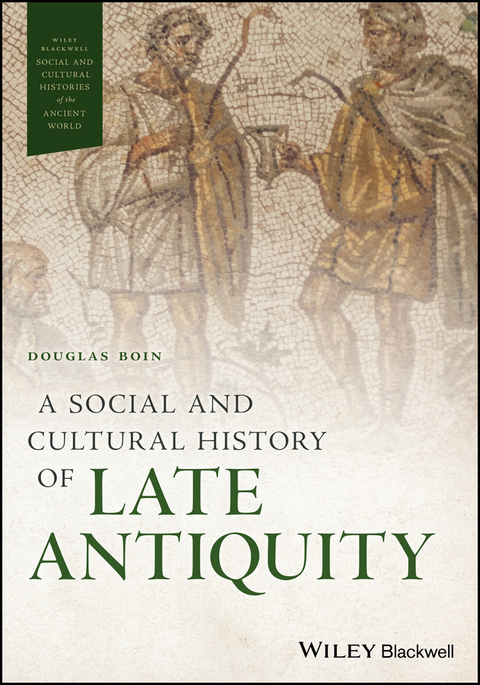
A Social and Cultural History of Late Antiquity (eBook)
John Wiley & Sons (Verlag)
978-1-119-07698-8 (ISBN)
2019 PROSE Award finalist in the Classics category!
A Social and Cultural History of Late Antiquity examines the social and cultural landscape of the Late Antique Mediterranean. The text offers a picture of everyday life as it was lived in the spaces around and between two of the most memorable and towering figures of the time-Constantine and Muhammad. The author captures the period using a wide-lens, including Persian material from the mid third century through Umayyad material of the mid eighth century C.E. The book offers a rich picture of Late Antique life that is not just focused on Rome, Constantinople, or Christianity.
This important resource uses nuanced terms to talk about complex issues and fills a gap in the literature by surveying major themes such as power, gender, community, cities, politics, law, art and architecture, and literary culture. The book is richly illustrated and filled with maps, lists of rulers and key events. A Social and Cultural History of Late Antiquity is an essential guide that:
- Paints a rich picture of daily life in Late Antique that is not simply centered on Rome, Constantinople, or Christianity
- Balances a thematic approach with rigorous attention to chronology
- Stresses the need for appreciating both sources and methods in the study of Late Antique history
- Offers a sophisticated model for investigating daily life and the complexities of individual and group identity in the rapidly changing Mediterranean world
- Includes useful maps, city plans, timelines, and suggestions for further reading
A Social and Cultural History of Late Antiquity offers an examination of everyday life in the era when adherents of three of the major religions of today-Christianity, Judaism, and Islam-faced each other for the first time in the same environment.
Learn more about A Social and Cultural History of Late Antiquity's link to current social issues in Boin's article for the History News Network.
Douglas Boin is Associate Professor in the Department of History at the Saint Louis University in St. Louis, Missouri. He is the author of Ostia in Late Antiquity and Coming Out Christian in the Roman World.
Douglas Boin is Associate Professor in the Department of History at the Saint Louis University in St. Louis, Missouri. He is the author of Ostia in Late Antiquity and Coming Out Christian in the Roman World.
"As a textbook, this book is ambitious. No other book that covers late antiquity is quite like it. The writing style throughout is chatty and encouraging, making this a wonderful guide for any high school Advanced Placement (AP) curriculum or introductory undergraduate history of late antiquity class...Boin aims to make history not just about grand political moments but intimate moments as well. This intimacy comes across from focusing on people--fairly ordinary people or, at least, those generally unknown to non-specialists." - Dr. Nicola Denzey Lewis, Chair of Women's Studies in Religion, Claremont Graduate University for Reading Religion
"Generous boxed texts cover specific points for classroom discussion on general themes...A penultimate chapter on South Asia and China in the 6th and 7th centuries, and a final chapter reflecting on the rise of Islam provides a welcome broadening of the canvas. The volume has been thoughtfully assembled, is presented in manageable chunks and is tidily illustrated." - Andrew Merrills, University of Leicester for Medieval Archaeology
"There are two main reasons that this book will make a wise choice as an assigned text. First, as textbooks go, it is a pleasure to read. Each chapter is fairly brief (around twenty pages) and--refraining from the tedium of running through most of what can be said on a topic--focuses on a few pieces of archaeological or literary evidence in an attempt to tease out what these ancient fragments tell us.... Second, the focus on these few bits of evidence in each chapter also helpfully demonstrates the difficulty of interpreting a literary text or a clay pot, as well as the rewards in the attempt." - Edmon L. Gallagher for Review of Biblical Literature
Preface: The Magic of History
History can be wondrous to watch, like beholding the act of an entrancing magician. With the right story, a compelling drama, and a dash of showmanship, people and periods long removed from us can dance almost inexplicably before our eyes. History, after all, is a performance of the past, though not everyone tells it the same way. That’s why the discipline of history is still thriving. As specialists challenge each other with the discovery of new documents and overlooked clues force researchers to reassess the events that led to a war or an invasion, historians dust off material that can seem trite and familiar and dazzle audiences by turning it into something unexpected and new.
This book is a manual for teaching some of the basics of the craft of history. It’s also an extended investigation into the secret behind what I like to think of as one of the world’s most famous illusions: the “vanishing of Rome.” Since that pivotal moment in the late fifth century CE – 476 CE – when the city of Rome was cut off from its own empire, many amateurs and professionals have puzzled and argued over the details of what happened. Centuries later, they still don’t agree. Some say Rome’s civilization disappeared, that the empire “fell” at just that precise moment in time. Others insist that Rome was already slowly being transformed – a few would even try to claim on a deep, spiritual level – with regions of the old empire moving to a new “Byzantine” state in the years before, during, and after 476 CE. Whatever explanation one prefers, in books that tell the story of the ancient Mediterranean, there routinely comes a point where something once great and majestic, the awesome world of Rome, vanishes. This book shows how that trick is done.
The people of the ancient Mediterranean knew something about magic and illusions. Consider this story of a visit to Athens, written in ancient Greek. It’s dated to the end of the second century or the middle of the third century CE and alleges to be written by a farmer in Classical Greece. It’s a skilled literary act, crafted by a smart author during a time when Romans governed Greece, Latin was the language of the state, and many people still had a fondness for Pericles’ city.
In it, a farmer loads up his trusty donkey “with figs and fruit cakes” to join a dear friend in Athens. The two men are planning to go to the theater, and the thought of catching a show in the city, famous for its drama, excites the narrator:
Most of the shows I don’t recall, for I’m a poor hand at remembering and telling such things. But I can tell you that one thing I saw made me almost speechless with astonishment.
A man came forward and, setting down a three‐legged table, placed three little cups on it. Then under these cups he hid some little round white pebbles, such as we find on the banks of rapid streams. At one moment he would hide them one under each cup; and at another moment (I don’t know how) he would show them all under a single cup. Then he would make them entirely disappear from under the cups and exhibit them between his lips. Then he would swallow them, and, drawing forward the spectators who stood near him, would take one pebble from a man’s nose, another from a man’s ear, and the third from a man’s head! After picking them up, he would make them disappear from sight again. A very light‐fingered gentleman…!
I hope no creature like him ever gets on to my farm, though. No one would ever catch him. He would steal everything in the house and make off with all the goods.
(Alciphron, Letters 2.17, LCL trans. by A. Benner and F. Fobes [1949], pp. 110–112)
Alciphron, the author of this Greek text, is not a household name. In fact, historians know next to nothing about him. But do you recognize the act he’s describing? It’s a classic of magic, performed by almost every magician from Harry Houdini to David Copperfield.
One of the most recent teams to perform the cups and balls, as it is known, was the iconoclastic duo Penn and Teller. In their signature style, they used clear plastic cups. Members of their guild were not amused. Can you guess why? They broke one of the first rules of their trade: People on the other side of the curtain are not supposed to know how the magic works. But does knowing the moves really make an act any less enjoyable? I don’t think it does. Seeing an act for the first time, then taking it apart, dissecting the sleight of hand, is the first step in learning how to do it for yourself. The same is true for the practice of history. That’s why I wrote this book.
While it is undeniably entertaining to sit back and watch someone else put on a show, history as a discipline will only continue to grow and thrive when people in the audience realize it’s more than an act to cheer on, admire, and applaud. History is something people do, and that’s why, in addition to appreciating good stagecraft, I believe everyone should know how to do a simple trick or two. What better illusion to practice with than the “vanishing” of Rome?
The challenge is that many people, at the outset, will already think they know what happened to Rome in Late Antiquity. It seems to be a trick so basic anyone would be able to retell it, or at least parts of it, if they were asked. Here’s how one observer might describe it.
In the third century, the Roman Empire suffered a debilitating mix of political, military, economic, and spiritual crises that nearly tore its society apart. In the fourth century, its leaders managed to stabilize the state by embracing a new, spiritual faith, Christianity. By then, many Romans, itching for change, may even have been pushed in new pious directions by Constantine’s conversion to Christianity. Soon, the emperor transferred the capital from Rome to Constantinople – a move that created the Byzantine Empire. A century later, when packs of frightening barbarians invaded western Europe, Rome finally crumbled. And although Byzantine emperors would belatedly strategize how to recapture parts of lost Europe and North Africa, their efforts would prove too late. The Roman Empire was gone.
This book takes its readers back stage to point out the strings, mirrors, and trapdoors that make this rather elegant historical illusion work. For even though the city of Rome did disappear from its own empire in 476 CE, at the time our book closes – in the eighth century CE – the Roman Empire itself will still, surprisingly, be standing. In order to understand how and why that happened, the pace with which history is performed has to be slowed down so that we can study each move, see every manipulation. That’s what we’ll do together in the next fourteen chapters.
A Note to Advanced Readers
This book is designed around case studies, questions, sources, and above all, problems of interpretation. But its structure largely unfolds in chronological order. This choice was deliberate. Some social and cultural histories become too muddled – overwhelming readers who have no prior familiarity with the subject matter – when they jump between times and places too casually. By trying to survey the entire history of a large topic in one small chapter – say, the history of cities, death, gender, or law – beginners are presented with a sweeping story that moves from one subject to the next without ever really being presented with a sequence of key events. This book takes a different approach.
Although structured around traditional social and cultural topics, like the household, law, and the family it starts at an earlier point in time and ends at a later one. Thus, the examples and case studies that appear in the earlier chapters are drawn from the third and fourth centuries CE whereas the material privileged in the latter chapters comes from the fifth, sixth, and seventh centuries CE. In this way, my hope is that readers who pick up this book gain a deep, nuanced appreciation for how to think about complex historical topics. By choosing not to frame my discussion of topics in usual, or expected, ways – there are no chapters here on “Church and State,” “Byzantine Art and Architecture,” or even the intriguing cultural phenomenon called “Religion” – what I hope to accomplish is that readers, from beginners to specialists, will realize that complex topics from the pre‐modern world cannot and should not be shoehorned into artificial boxes.
One last note. Because this book lacks any formal conclusion, I would like to provide a commentary on one of the last lines of the book which a reader will encounter. It is the last of four questions in the final chapter, but it is the most important question that guided me as I was thinking about this subject matter. The question is this: “From a historical perspective, would you say that individuals and communities who hold monotheistic beliefs (‘belief in one God’) are fundamentally unable to live in a pluralistic society?” If there is one theme that unites the people and places of the proto‐global world of Late Antiquity and if there is one topic which can inspire and motivate our own interest in their past lives, I can think of no better one than that which lies at the heart of this question. For the study of how people of different faiths and...
| Erscheint lt. Verlag | 18.12.2017 |
|---|---|
| Reihe/Serie | Wiley Blackwell Social and Cultural Histories of the Ancient World |
| Wiley-Blackwell Social and Cultural Histories of the Ancient World | Wiley-Blackwell Social and Cultural Histories of the Ancient World |
| Sprache | englisch |
| Themenwelt | Geschichte ► Allgemeine Geschichte ► Vor- und Frühgeschichte |
| Geschichte ► Allgemeine Geschichte ► Altertum / Antike | |
| Geschichte ► Allgemeine Geschichte ► Mittelalter | |
| Geschichte ► Teilgebiete der Geschichte ► Kulturgeschichte | |
| Geschichte ► Teilgebiete der Geschichte ► Sozialgeschichte | |
| Schlagworte | Altertum • Ancient & Classical History • Ancient Culture • Antike • Antike u. klassische Geschichte • architecture in late antiquity • art in late antiquity • borderlands in late antiquity • cities in late antiquity • Classical Studies • community in late antiquity • Constantine in late antiquity • everyday life in late antiquity • gender in late antiquity • Geschichte • Geschichte des Altertums u. der klassischen Antike • group identity in late antiquity</p> • guide to cultural history of late antiquity • History • Humanistische Studien • individual identity in late antiquity • investigating daily life in late antiquity • Klassisches Altertum • law in late antiquity • life in Persia in late antiquity • literature in late antiquity • <p>Guide to social history of late antiquity • Muhammad in late antiquity • politics in late antiquity • reference to late antiquity history • study of Late Antique history |
| ISBN-10 | 1-119-07698-6 / 1119076986 |
| ISBN-13 | 978-1-119-07698-8 / 9781119076988 |
| Informationen gemäß Produktsicherheitsverordnung (GPSR) | |
| Haben Sie eine Frage zum Produkt? |
 EPUB (Adobe DRM)
Kopierschutz: Adobe-DRM
Adobe-DRM ist ein Kopierschutz, der das eBook vor Mißbrauch schützen soll. Dabei wird das eBook bereits beim Download auf Ihre persönliche Adobe-ID autorisiert. Lesen können Sie das eBook dann nur auf den Geräten, welche ebenfalls auf Ihre Adobe-ID registriert sind.
Details zum Adobe-DRM
Dateiformat: EPUB (Electronic Publication)
EPUB ist ein offener Standard für eBooks und eignet sich besonders zur Darstellung von Belletristik und Sachbüchern. Der Fließtext wird dynamisch an die Display- und Schriftgröße angepasst. Auch für mobile Lesegeräte ist EPUB daher gut geeignet.
Systemvoraussetzungen:
PC/Mac: Mit einem PC oder Mac können Sie dieses eBook lesen. Sie benötigen eine
eReader: Dieses eBook kann mit (fast) allen eBook-Readern gelesen werden. Mit dem amazon-Kindle ist es aber nicht kompatibel.
Smartphone/Tablet: Egal ob Apple oder Android, dieses eBook können Sie lesen. Sie benötigen eine
Geräteliste und zusätzliche Hinweise
Buying eBooks from abroad
For tax law reasons we can sell eBooks just within Germany and Switzerland. Regrettably we cannot fulfill eBook-orders from other countries.
aus dem Bereich