


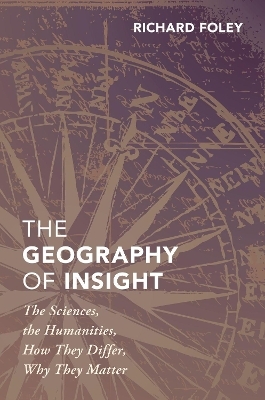
The Geography of Insight
The Sciences, the Humanities, How they Differ, Why They Matter
Seiten
2018
Oxford University Press Inc (Verlag)
978-0-19-086512-2 (ISBN)
Oxford University Press Inc (Verlag)
978-0-19-086512-2 (ISBN)
The Geography of Insight argues that the issues of the humanities and sciences are different in kind and that inquiries into these issues also have different characteristics as do the resulting insights. These differences constitute an intellectual geography of the humanities and sciences: a mapping of key features of the two domains.
The humanities and the sciences face challenging times, each in their own way. The humanities suffer shrinking enrollments and budgets, and are perceived by some as irrelevant in a changing economy. The sciences face a political climate that disrespects academic expertise and challenges settled debates. Meanwhile age-old disputes about their spheres of knowledge continue: does scientific knowledge subsume that of the humanities? Are their forms of knowledge complementary, or ultimately at odds?
Richard Foley, a philosopher of knowledge and the former Dean of Arts and Sciences at New York University, here provides a concise and accessible overview of what the overarching goals of these disciplines are, relative to one another, and what kind of knowledge they aim to produce. His fundamental argument is that the sciences aim at insights that ideally are not limited to particular locations or times and are also perspective-free and wholly descriptive, whereas the humanities appropriately seek insights about specific locations and times, with the insights being perspective-based and having evaluative as well as descriptive elements. He also finds these two spheres of knowledge to be complementary in the search for understanding of our world and the human condition. The ultimate goal of Foley's investigation however is an eloquent defense and celebration of the culture of academic research. In an era of sound-bites and tweet-length falsehoods, this culture values and supports long-term intellectual achievements for the good of humanity--produced with hard work, dedication, and patience. The Geography of Insight is essential reading for readers both inside and outside of the academy.
The humanities and the sciences face challenging times, each in their own way. The humanities suffer shrinking enrollments and budgets, and are perceived by some as irrelevant in a changing economy. The sciences face a political climate that disrespects academic expertise and challenges settled debates. Meanwhile age-old disputes about their spheres of knowledge continue: does scientific knowledge subsume that of the humanities? Are their forms of knowledge complementary, or ultimately at odds?
Richard Foley, a philosopher of knowledge and the former Dean of Arts and Sciences at New York University, here provides a concise and accessible overview of what the overarching goals of these disciplines are, relative to one another, and what kind of knowledge they aim to produce. His fundamental argument is that the sciences aim at insights that ideally are not limited to particular locations or times and are also perspective-free and wholly descriptive, whereas the humanities appropriately seek insights about specific locations and times, with the insights being perspective-based and having evaluative as well as descriptive elements. He also finds these two spheres of knowledge to be complementary in the search for understanding of our world and the human condition. The ultimate goal of Foley's investigation however is an eloquent defense and celebration of the culture of academic research. In an era of sound-bites and tweet-length falsehoods, this culture values and supports long-term intellectual achievements for the good of humanity--produced with hard work, dedication, and patience. The Geography of Insight is essential reading for readers both inside and outside of the academy.
Richard Foley is Professor of Philosophy and former Dean of Arts and Sciences and Vice Chancellor for Strategic Planning at New York University. Previously he was Dean of Arts and Sciences and Dean of the Graduate School at Rutgers University, and prior to that, the chair of the Philosophy Department at the University of Notre Dame.
Preface
Part 1: The Humanities and Sciences are Different
Part 2: The Distinctions
Indexical vs. Non-Indexical
Perspectival vs. Non-Perspectival
Prescriptive vs. Descriptive
Individual vs. Collective
Part 3: Secondary Differences
An Endpoint to Inquiry
Intellectual Progress
Intellectual Authority
Simplicity and Complexity
Involvement with Mentality
Part 4: Related Topics
Philosophy, the Humanities, the Sciences
Conclusion
| Erscheinungsdatum | 10.07.2018 |
|---|---|
| Verlagsort | New York |
| Sprache | englisch |
| Maße | 231 x 152 mm |
| Gewicht | 386 g |
| Themenwelt | Geisteswissenschaften ► Geschichte |
| Geisteswissenschaften ► Philosophie | |
| ISBN-10 | 0-19-086512-1 / 0190865121 |
| ISBN-13 | 978-0-19-086512-2 / 9780190865122 |
| Zustand | Neuware |
| Informationen gemäß Produktsicherheitsverordnung (GPSR) | |
| Haben Sie eine Frage zum Produkt? |
Mehr entdecken
aus dem Bereich



aus dem Bereich
eine kleine Soziologie des Heavy Metal
Buch | Softcover (2023)
Kohlhammer (Verlag)
CHF 29,90


