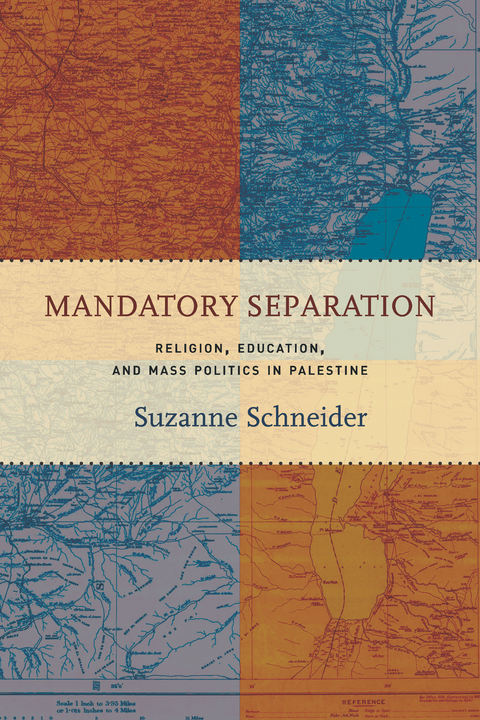
Mandatory Separation (eBook)
280 Seiten
Stanford University Press (Verlag)
9781503604520 (ISBN)
Suzanne Schneider is the Director of Operations and a Core Faculty member at the Brooklyn Institute for Social Research.
Contents and AbstractsIntroduction: The Politics of Denial chapter abstractThe Introduction offers a summary of the book's major arguments and situates its theoretical interventions within the fields of history and religious studies. By drawing on the work of Bruno Latour, it introduces the concept of a "politics of denial" as a means with which to understand colonial approaches to education and other realms of policy planning. In addition, the Introduction provides some basic contextual information about the events and actors that informed the history of Mandate Palestine, including the Balfour Declaration, the League of Nations Permanent Mandate Commission, the Zionist movement and Arab national resistance, and the Department of Education. It also introduces other administrative bodies, including the Supreme Muslim Council, the Jewish Agency, and the Va'ad Leumi, that were involved in educational affairs and provides a summary of each chapter.1Religious Education in the Modern Age chapter abstractChapter 1 surveys the secularization of Jewish and Islamic communal education and situates these practices within the historical development of new forms of public schooling. By distinguishing between the transmission of sacred knowledge and modern systemic schooling, it highlights the novelty of "religious education" as a site for the production and disciplining of moral and political subjects. This chapter argues that grappling with this history requires us to bear in mind three overlapping developments and considerations: the modern conceptualization of "religion" as a set of beliefs and practices segregated from other realms of human experience (e.g., politics, commerce, and culture); the political nature of modern education as a tool for character formation and civil training; and the rise of new type of mass politics in Palestine that linked religious education to national identity.2Educational Modernity in Palestine chapter abstractChapter 2 outlines key aspects of the Government of Palestine's administrative apparatus and its policies related to the provision of education. Although British officials strove to immunize Palestine's schools against the destructive influence of politics, it argues that such rhetoric served to mask the inherently political nature of modern schooling and elide over the very real consequences of policies that supposedly guided pedagogic need. This chapter details that rather than insulate Palestine's schools from the surrounding tumult, the provision of education during the Mandate period contributed to the division of Palestine into competing Arab and Jewish spheres, each with its own national language, public school system, and administrative machinery.3Education and Community under Sectarian Rule chapter abstractChapter 3 examines both the sectarian management of education in Palestine and the tensions present within this form of governance. Based on an analysis of debates surrounding the Palestine Education Ordinance of 1933, this chapter argues that the Mandatory government created a category of exception for religious schools and those managed by religious communities. This administrative structure functioned to the advantage of schools managed by the Zionist Organization and, later, the Va'ad Leumi, which were given a large degree of autonomy based on their dual status as both public and religious entities. Conversely, linking educational autonomy to religious community weakened Palestinian attempts to create a national school system that united children from different confessional backgrounds.4New Schooling for an "Old" Order chapter abstractChapter 4 examines how the Department of Education of the Government of Palestine attempted to reform "old-fashioned" Islamic and Jewish schools (ederim and katātīb), highlighting certain common assumptions about the purpose of education and the role of religious instruction in combating nationalist passions. By examining the government's preference for rural education biased toward agriculture within the Arab-Muslim community and the simultaneous attempts to introduce "practical" subjects into Jewish schools in the Old Yishuv, this chapter uncovers points of conceptual overlap that drove colonial educational policy. In both instances, it argues that the Government of Palestine linked the preservation of tradition to the introduction of novel curricula and pedagogic practices.5The Boundaries of Religious Knowledge chapter abstractChapter 5 compares the curriculum for Islamic education within Palestine's Arab Public System with that developed in private, nationalist schools. It argues that the government curricula envisioned Islam as chiefly concerned with individual moral fashioning and therefore promoted a narrow view of religion that was distinguished from communal, political, or material concerns. In contrast, based on a case study of the Palestinian educator Muhammad 'Izzat Darwaza and the educational program he pioneered at al-Najah National School in Nablus, this chapter argues that even leaders associated with certain features of secular modernity in Palestine did not acquiesce to the separation of Islam from political activism. This chapter also includes an analysis of many textbooks for Islamic education published during the interwar period and traces their attempt to link Islamic precepts to social utility.6Border Clashes chapter abstractChapter 6 examines debates over Judaism and religious instruction within Palestine's Zionist schools. Reviewing the deliberations of the Committee to Clarify the Question of Religious Education alongside aspects of school curricula, it argues that Zionist education was deeply invested in creating a synthetic form of modern Jewish identity freed from the restrictions of Europe's secular political order. The chapter also examines the attitudes of the Government of Palestine, particularly those of Education Director Jerome Farrell, toward Zionist schools. It highlights the ways in which the Zionist aspiration to fuse the religious and the secular, and the personal and the communal clashed with a British colonial view of education, politics, and religion each residing in its own discrete sphere.Conclusion: The Invisible Cross chapter abstractThe Conclusion to this study takes up the Government of Palestine's treatment of Christian schools as an exemplary site for seeing the politics of denial at work. It argues that British administrators tended to view Christian schools as neutral entities that stood aloof from contemporary political agitations and to regard their unique mode of moral fashioning as unproblematically universal—in contrast to the particularistic identities that both Jewish and Arab educators were accused of cultivating. It concludes with an argument regarding the flexibility of religious texts, traditions, and social practices and some theoretical observations about how a historically grounded approach to religion can nuance contemporary discussions regarding religious radicalism in both Jewish and Islamic contexts.
| Erscheint lt. Verlag | 27.2.2018 |
|---|---|
| Zusatzinfo | 6 halftones, 1 table |
| Sprache | englisch |
| Themenwelt | Geschichte ► Allgemeine Geschichte ► Neuzeit (bis 1918) |
| Geisteswissenschaften ► Geschichte ► Regional- / Ländergeschichte | |
| Geisteswissenschaften ► Religion / Theologie ► Judentum | |
| Schlagworte | British colonialism • Islamic Education • Jewish Education • mass politics • Nationalism • Palestine • Religious education • Secularism • Zionism |
| ISBN-13 | 9781503604520 / 9781503604520 |
| Informationen gemäß Produktsicherheitsverordnung (GPSR) | |
| Haben Sie eine Frage zum Produkt? |
 EPUB (Adobe DRM)
Kopierschutz: Adobe-DRM
Adobe-DRM ist ein Kopierschutz, der das eBook vor Mißbrauch schützen soll. Dabei wird das eBook bereits beim Download auf Ihre persönliche Adobe-ID autorisiert. Lesen können Sie das eBook dann nur auf den Geräten, welche ebenfalls auf Ihre Adobe-ID registriert sind.
Details zum Adobe-DRM
Dateiformat: EPUB (Electronic Publication)
EPUB ist ein offener Standard für eBooks und eignet sich besonders zur Darstellung von Belletristik und Sachbüchern. Der Fließtext wird dynamisch an die Display- und Schriftgröße angepasst. Auch für mobile Lesegeräte ist EPUB daher gut geeignet.
Systemvoraussetzungen:
PC/Mac: Mit einem PC oder Mac können Sie dieses eBook lesen. Sie benötigen eine
eReader: Dieses eBook kann mit (fast) allen eBook-Readern gelesen werden. Mit dem amazon-Kindle ist es aber nicht kompatibel.
Smartphone/Tablet: Egal ob Apple oder Android, dieses eBook können Sie lesen. Sie benötigen eine
Geräteliste und zusätzliche Hinweise
Buying eBooks from abroad
For tax law reasons we can sell eBooks just within Germany and Switzerland. Regrettably we cannot fulfill eBook-orders from other countries.
aus dem Bereich