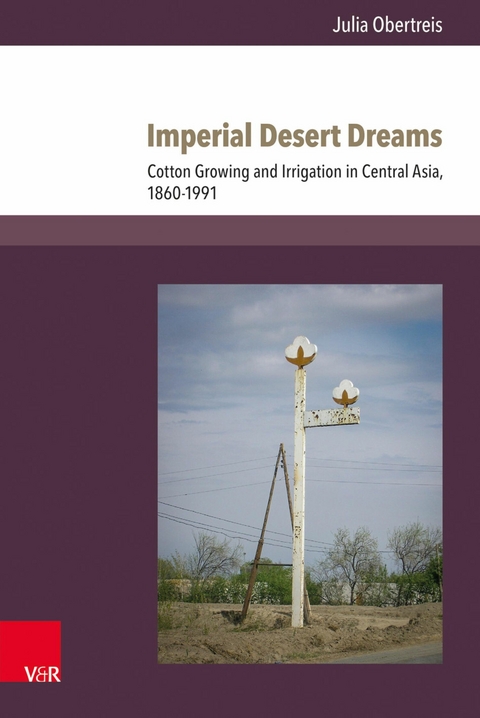
Imperial Desert Dreams (eBook)
536 Seiten
Vandenhoeck & Ruprecht Unipress (Verlag)
978-3-8470-0786-9 (ISBN)
Prof. Dr. Obertreis ist Inhaberin des Lehrstuhls für Neuere und Neueste Geschichte mit dem Schwerpunkt der Geschichte Osteuropas an der Friedrich-Alexander-Universität Erlangen-Nürnberg.
Prof. Dr. Obertreis ist Inhaberin des Lehrstuhls für Neuere und Neueste Geschichte mit dem Schwerpunkt der Geschichte Osteuropas an der Friedrich-Alexander-Universität Erlangen-Nürnberg.
Title Page 4
Copyright 5
Table of Contents 8
Body 12
Acknowledgements 12
Introduction 16
People, Geography, and Agriculture 26
Concepts, Approaches, and Questions 34
Sources, Languages, and Transliteration 48
I. Russian Colonial Rule in Turkestan, 1860–1917 50
The Motivation for the Conquest 52
The “Blossoming Oases” 57
A Cotton Fever 61
Local “Customs” and Local Knowledge 66
Engineers' Fantasies 77
The Ancient Riverbed of the Amu Darya 82
The Opening Up of the Hungry Steppe 86
The “Obituary List” of Failures and Moral Superiority 90
The Striving for “Cotton Autonomy” 97
The Legal Framework and Scepticism about “Capitalism” 104
The Ministry of Agriculture and the Turkestan Agricultural Society 116
The Taming of Nature through Infrastructure, 1910–1914 122
The First World War 131
Conclusion 133
II. Soviet Nation-Building and Stalinism, 1917–1944 140
The Advent of the Bolsheviks 141
Georgii K. Rizenkampf and his Cotton and Irrigation Program 148
“National Delimitation” and the “Land-Water Reform” 157
The Collectivization of Agriculture and the First Five-Year Plan 164
The Attack on “Bourgeois Specialists” 172
Haste, Coercion, and Incentives: Cotton Growing in the 1930s 179
Progressive Methods in Agriculture and the Experience of the Peasants 189
Terror 198
Stagnation in Irrigation Construction and Management 202
Scientific Institutes and the Training of (Indigenous) Specialists 207
“People's Construction” 214
The All-Union Agricultural Exhibition of 1939 and the Republics' National Designs 223
The Second World War 231
Conclusion 237
III. High Modernism in Central Asia, 1945–1969 246
Stalinism and Cotton Growing after the War 249
Agricultural Politics after Stalin 253
The Educational Boom and the Training of Indigenous Experts 265
The Hungry Steppe: a Microstudy 274
The New Zone 281
The Memoirs of the “Hungrysteppers” 287
Akop Sarkisov and the Recruitment of Cadres 290
Leadership Styles in the “Hungry Steppe Construction Trust” 302
Personal Networks: from Yangier to Tashkent to Moscow 305
Central Asians and the Druzhba narodov 315
“Teachers and Educators” 320
The “River of Happiness” – the Karakum Canal 322
The Drainage Problem 330
The Backwardness of the Others 335
“Engineerization”, “Chemicalization”, and “Mechanization” 340
Local Knowledge 357
“Irrational” Water Usage: the 1960s 360
Conclusion 367
IV. A Time of Crisis, 1970–1991 372
The Water Crisis 375
The Diversion of Siberian Rivers as a Solution to the Problem 383
The Cotton Crisis 388
The Individual Experience 391
Nature Protection and De-Stalinization 393
The Society for the Protection of Nature 398
An Ecocritique Emerges 401
The Cotton Scandal 411
Politics and Opposition during Perestroika 418
Debates in the Press and Environmental Scandals: Health 427
The Diversion Debate 429
The Vodniki under Fire 434
The Reaction of the Authorities 443
The Growth of Ethnic Conflict 447
Chemicals in Agriculture 448
Cotton and National Pride 451
A Feeling of Loss and Despair 455
Conclusion 458
Conclusion 464
High Modernism 464
Continuities between the Tsarist and Soviet Periods 471
Indigenization and the Cotton Contract 474
The Crisis of Soviet Modernity and Environmental Aspects 479
Central Asia Post-Soviet 483
Glossary 492
List of Maps and Illustrations 496
Bibliography 500
Index 528
| Erscheint lt. Verlag | 11.12.2017 |
|---|---|
| Reihe/Serie | Kultur- und Sozialgeschichte Osteuropas / Cultural and Social History of Eastern Europe |
| Kultur- und Sozialgeschichte Osteuropas / Cultural and Social History of Eastern Europe | |
| Kultur- und Sozialgeschichte Osteuropas / Cultural and Social History of Eastern Europe. | Kultur- und Sozialgeschichte Osteuropas / Cultural and Social History of Eastern Europe. |
| Zusatzinfo | mit 38 Abbildungen |
| Verlagsort | Göttingen |
| Sprache | englisch |
| Themenwelt | Geschichte ► Teilgebiete der Geschichte ► Kulturgeschichte |
| Schlagworte | Agrargeschichte • Geschichte • Ökologie • Sowjetuinion • Zentralasien |
| ISBN-10 | 3-8470-0786-6 / 3847007866 |
| ISBN-13 | 978-3-8470-0786-9 / 9783847007869 |
| Informationen gemäß Produktsicherheitsverordnung (GPSR) | |
| Haben Sie eine Frage zum Produkt? |
 PDF (Ohne DRM)
Digital Rights Management: ohne DRM
Dieses eBook enthält kein DRM oder Kopierschutz. Eine Weitergabe an Dritte ist jedoch rechtlich nicht zulässig, weil Sie beim Kauf nur die Rechte an der persönlichen Nutzung erwerben.
Dateiformat: PDF (Portable Document Format)
Mit einem festen Seitenlayout eignet sich die PDF besonders für Fachbücher mit Spalten, Tabellen und Abbildungen. Eine PDF kann auf fast allen Geräten angezeigt werden, ist aber für kleine Displays (Smartphone, eReader) nur eingeschränkt geeignet.
Systemvoraussetzungen:
PC/Mac: Mit einem PC oder Mac können Sie dieses eBook lesen. Sie benötigen dafür einen PDF-Viewer - z.B. den Adobe Reader oder Adobe Digital Editions.
eReader: Dieses eBook kann mit (fast) allen eBook-Readern gelesen werden. Mit dem amazon-Kindle ist es aber nicht kompatibel.
Smartphone/Tablet: Egal ob Apple oder Android, dieses eBook können Sie lesen. Sie benötigen dafür einen PDF-Viewer - z.B. die kostenlose Adobe Digital Editions-App.
Buying eBooks from abroad
For tax law reasons we can sell eBooks just within Germany and Switzerland. Regrettably we cannot fulfill eBook-orders from other countries.
aus dem Bereich