


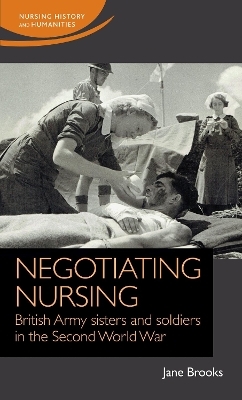
Negotiating Nursing
British Army Sisters and Soldiers in the Second World War
Seiten
2018
Manchester University Press (Verlag)
978-1-5261-1906-3 (ISBN)
Manchester University Press (Verlag)
978-1-5261-1906-3 (ISBN)
The mobility of the Second World War, brought on by ‘technological advances in destructive capabilities’ needed new type of medical service. Success meant that expert care was needed near the frontline. -- .
Negotiating Nursing explores how the Queen Alexandra's Imperial Military Nursing Service (Q.A.s) salvaged their soldier-patients within the sensitive gender negotiations of what should and could constitute nursing work and where that work could occur. The book argues that the Q.A.s, an entirely female force during the Second World War, were essential to recovering men from the battlefield and for the war, despite concerns about women’s presence on the frontline. Using personal testimony the book maps the developments in nurses’ work as they created a legitimate space for themselves in war zones and established their position as the expert at the bedside. Yet, despite the acknowledgement of nurses’ vital role in the medical service, their position was gendered. As the women of Britain were returned to the home post-war, it was the military nurses’ womanhood that stymied their considerable skills from being transferred to the new welfare state.
An electronic edition of this book is freely available under a Creative Commons (CC BY-NC-ND) licence. -- .
Negotiating Nursing explores how the Queen Alexandra's Imperial Military Nursing Service (Q.A.s) salvaged their soldier-patients within the sensitive gender negotiations of what should and could constitute nursing work and where that work could occur. The book argues that the Q.A.s, an entirely female force during the Second World War, were essential to recovering men from the battlefield and for the war, despite concerns about women’s presence on the frontline. Using personal testimony the book maps the developments in nurses’ work as they created a legitimate space for themselves in war zones and established their position as the expert at the bedside. Yet, despite the acknowledgement of nurses’ vital role in the medical service, their position was gendered. As the women of Britain were returned to the home post-war, it was the military nurses’ womanhood that stymied their considerable skills from being transferred to the new welfare state.
An electronic edition of this book is freely available under a Creative Commons (CC BY-NC-ND) licence. -- .
Jane Brooks is a Senior Lecturer in the Division of Nursing, Midwifery and Social Work at the University of Manchester -- .
Introduction: Nursing work and nurses’ space in the Second World War: a gendered construction
1. Salvaging soldiers, comforting men
2. Challenging nursing spaces
3. Nursing presence
4. Negotiating the boundaries of nursing practice
5. Reasserting work, space and gender boundaries at the end of the Second World War
Concluding remarks
Index -- .
| Erscheinungsdatum | 08.01.2019 |
|---|---|
| Reihe/Serie | Nursing History and Humanities |
| Zusatzinfo | 12 black & white illustrations |
| Verlagsort | Manchester |
| Sprache | englisch |
| Maße | 138 x 216 mm |
| Gewicht | 440 g |
| Themenwelt | Geschichte ► Allgemeine Geschichte ► 1918 bis 1945 |
| Geschichte ► Teilgebiete der Geschichte ► Kulturgeschichte | |
| Geschichte ► Teilgebiete der Geschichte ► Militärgeschichte | |
| Medizin / Pharmazie ► Pflege | |
| Studium ► Querschnittsbereiche ► Geschichte / Ethik der Medizin | |
| ISBN-10 | 1-5261-1906-4 / 1526119064 |
| ISBN-13 | 978-1-5261-1906-3 / 9781526119063 |
| Zustand | Neuware |
| Informationen gemäß Produktsicherheitsverordnung (GPSR) | |
| Haben Sie eine Frage zum Produkt? |
Mehr entdecken
aus dem Bereich



aus dem Bereich
Deutschland 1933 bis 1945
Buch | Hardcover (2025)
S. Fischer (Verlag)
CHF 47,60
ein Psychologe erlebt das Konzentrationslager
Buch | Hardcover (2024)
Kösel (Verlag)
CHF 30,80


