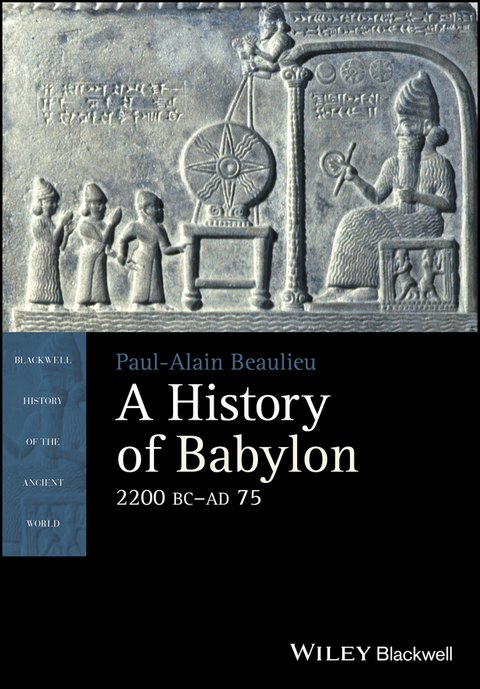
A History of Babylon, 2200 BC - AD 75 (eBook)
John Wiley & Sons (Verlag)
978-1-119-45911-8 (ISBN)
Provides a new narrative history of the ancient world, from the beginnings of civilization in the ancient Near East and Egypt to the fall of Constantinople
Written by an expert in the field, this book presents a narrative history of Babylon from the time of its First Dynasty (1880-1595) until the last centuries of the city's existence during the Hellenistic and Parthian periods (ca. 331-75 AD). Unlike other texts on Ancient Near Eastern and Mesopotamian history, it offers a unique focus on Babylon and Babylonia, while still providing readers with an awareness of the interaction with other states and peoples. Organized chronologically, it places the various socio-economic and cultural developments and institutions in their historical context. The book also gives religious and intellectual developments more respectable coverage than books that have come before it.
A History of Babylon, 2200 BC - AD 75 teaches readers about the most important phase in the development of Mesopotamian culture. The book offers in-depth chapter coverage on the Sumero-Addadian Background, the rise of Babylon, the decline of the first dynasty, Kassite ascendancy, the second dynasty of Isin, Arameans and Chaldeans, the Assyrian century, the imperial heyday, and Babylon under foreign rule.
- Focuses on Babylon and Babylonia
- Written by a highly regarded Assyriologist
- Part of the very successful Histories of the Ancient World series
- An excellent resource for students, instructors, and scholars
A History of Babylon, 2200 BC - AD 75 is a profound text that will be ideal for upper-level undergraduate and graduate courses on Ancient Near Eastern and Mesopotamian history and scholars of the subject.
Paul-Alain Beaulieu, PhD, is Professor of Assyriology at the University of Toronto. He is the author of several articles and books on the history and culture of Babylonia, as well as the greater spectrum of Mesopotamian history. He has been teaching Assyriology and Ancient Near Eastern History for more than twenty years.
Provides a new narrative history of the ancient world, from the beginnings of civilization in the ancient Near East and Egypt to the fall of Constantinople Written by an expert in the field, this book presents a narrative history of Babylon from the time of its First Dynasty (1880-1595) until the last centuries of the city s existence during the Hellenistic and Parthian periods (ca. 331-75 AD). Unlike other texts on Ancient Near Eastern and Mesopotamian history, it offers a unique focus on Babylon and Babylonia, while still providing readers with an awareness of the interaction with other states and peoples. Organized chronologically, it places the various socio-economic and cultural developments and institutions in their historical context. The book also gives religious and intellectual developments more respectable coverage than books that have come before it. A History of Babylon, 2200 BC AD 75 teaches readers about the most important phase in the development of Mesopotamian culture. The book offers in-depth chapter coverage on the Sumero-Addadian Background, the rise of Babylon, the decline of the first dynasty, Kassite ascendancy, the second dynasty of Isin, Arameans and Chaldeans, the Assyrian century, the imperial heyday, and Babylon under foreign rule. Focuses on Babylon and Babylonia Written by a highly regarded Assyriologist Part of the very successful Histories of the Ancient World series An excellent resource for students, instructors, and scholars A History of Babylon, 2200 BC - AD 75 is a profound text that will be ideal for upper-level undergraduate and graduate courses on Ancient Near Eastern and Mesopotamian history and scholars of the subject.
Paul-Alain Beaulieu, PhD, is Professor of Assyriology at the University of Toronto. He is the author of several articles and books on the history and culture of Babylonia, as well as the greater spectrum of Mesopotamian history. He has been teaching Assyriology and Ancient Near Eastern History for more than twenty years.
1
Introductory Concerns
The name Babylon still evokes ambivalent images. Symbol of corruption and depravity in the Judeo‐Christian tradition, depicted in the Bible as arrogant imperial city, home to ruthless despots and doomed to destruction by the prophets of Israel, Babylon never fully reclaimed in the modern perception her legitimate status as one of the longest lived, and intellectually most creative civilizations of the ancient world. Indeed, if Babylon still casts its long shadow over our lives, it is not solely as epitome of moral decadence. Fundamental elements of time reckoning, such as the division of the hour into sixty minutes and the minute into sixty seconds, ultimately originate in the Babylonian sexagesimal system which used a base sixty rather than the base ten of our decimal system. The same Babylonian methods still survive in the division of the circle into 360 degrees. Many essential features of astrology, such as the practice of casting horoscopes and the division of the zodiac into twelve signs, began with the scientific and religious speculations of Babylonian astronomers. One must count as the most enduring contribution of Babylon to world civilization the development of an elaborate predictive mathematical astronomy which ranks as the earliest documented science in history. And indeed, the achievements of Babylonian scientists received ample recognition in antiquity, especially from the Greeks.
Beyond this legacy, the civilization of Babylon has emerged in a far more complex light since historians began more than a century and a half ago to study the rich epigraphic and material remains discovered in the soil of Iraq. Excavations have uncovered cities crowded with houses, temples, military compounds, and palaces. Many buildings have yielded spectacular textual finds amounting to tens of thousands of clay tablets inscribed in cuneiform, the writing system invented by the Sumerians five thousand years ago and inherited by the Babylonians. These are the sources on which we rely to reconstruct the history of Babylon. Before modern excavations began little information was available on the civilizations of the ancient Near East. Those civilizations had vanished almost without a trace, obliterated from the collective memory of humankind. Babylon, for instance, was known mainly from the Bible. However, if the Bible contains some genuine historical material, such as the capture of Jerusalem by Nebuchadnezzar at the beginning of the sixth century and the deportation of Judeans to Babylonia, much that it preserves ranks either as historical romance, exemplified by the saga of Babylon’s fall in the Book of Daniel, or as legend, first and foremost the tale of the Tower of Babel in Genesis. Some ancient Greek writers gave accounts of Babylonian history, but these must also be handled with caution. Herodotus probably never visited Babylon, as almost everything he writes on the city has been contradicted by cuneiform sources and archaeological excavations. The material found in the writings of Ctesias, a Greek physician who spent part of his life at the Persian court, ranks even lower. Ctesias became the most influential propagator of the legend of Semiramis, the Assyrian queen whom he credits with the foundation of Babylon (Figure 1.1). There is no basis for this tale, as for almost every alleged historical fact reported by Ctesias concerning Assyria and Babylon.
Figure 1.1 Semiramis. This imaginary portrait of the Assyrian queen who allegedly built Babylon was executed about 1639–40 for a portfolio of “World Marvels” (Les Merveilles du Monde) published by the French engraver Pierre Mariette. The Semiramis legend enjoyed wide currency as fact until the decipherment of cuneiform in the modern era revealed its shaky historical foundations.
Source: The Metropolitan Museum of Art, NYC (MMA 53.601.112), Public Domain.
Among the Greeks, however, Ptolemy stands out as an exception. Hailed as the greatest scientist of the ancient world, Ptolemy lived in Alexandria in the second century of our era. His Almagest summed up ancient astronomical knowledge and remained the ultimate reference on astral science and cosmology until the Renaissance. Remarkably, Ptolemy quotes in detail a number of Babylonian astronomical observations, the earliest one being an eclipse of the moon which occurred in the first year of the Babylonian king Marduk‐apla‐iddina II, on March 19/20, 721. He also used for astronomical dating a list of kings who reigned in Babylon from the accession of Nabonassar. Known as the Ptolemaic Canon (Canon of Ptolemy), this list formed the essential chronological backbone for ancient Near Eastern history until the modern era. Other material was preserved in the writings of Berossus, a Babylonian priest who lived at the beginning of the third century at a time when Babylonia had become a province of the Seleucid Empire. Berossus wrote in Greek a compendium on Babylonian history and culture and dedicated it to the Seleucid ruler Antiochus I (281–261). The work, entitled Babyloniaka, has not survived in its original form and is known from quotations found in the writings of ancient authors. Berossus recorded little information that we can consider reliable as historical facts except for the period of the Babylonian empire in the sixth century.
Thus, very little of the history of Babylon was known until the rediscovery and decipherment of cuneiform texts: a chronology from the mid‐eighth century onwards with names of rulers, and scattered historical facts about the Babylonian Empire and the fate of Babylon under Persian and Greek rule. This is not much if we consider that Babylon is already mentioned in cuneiform documents from the last centuries of the third millennium and rose to prominence as dominant political and cultural center of ancient Iraq under Hammu‐rabi (1792–1750). To write a history of Babylon one therefore depends almost entirely on cuneiform texts, and this is the subject to which we must now turn our attention.
1.1 Assyriology and the Writing of History
Assyriology is the academic discipline devoted to the study of the ancient civilizations of Iraq. It emerged a century and a half ago in the wake of the decipherment of cuneiform. The word originally referred to the study of Assyria, where excavations first started and initial discoveries of cuneiform texts occurred. Soon, however, digs began in the south of Iraq, revealing to the world the civilizations of Babylon and its predecessors, the Sumerians and Akkadians, but by then the term Assyriology had already become entrenched. From its inception Assyriology developed the strong philological orientation that still characterizes it today. The study of the Sumerian and Akkadian languages can absorb the energies of apprentice Assyriologists for many years, not to mention the added onus of mastering the writing system. Basically this does not seem so different from learning any other set of languages, but Assyriologists must also penetrate the world of a very distant and vanished civilization, entirely depending on the point of view of ancient scribes to do so. Therefore, Assyriology has defined itself primarily as the study of an ancient textual and intellectual tradition.
Historians rely on textual sources, but Assyriologists do not study archives neatly filed in a monastery, state ministry, or national library, accumulated through uninterrupted tradition until now. The recovery of textual sources from ancient Iraq is the direct outcome of the rise of archaeology in modern times. Cuneiform texts represent material remains of ancient human activity like every other artifact unearthed in an excavation, be it a piece of pottery, of jewelry, remnants of textiles, animal bones, or architectural structures. Analysis of the context in which cuneiform tablets are discovered provides crucial information bearing on their interpretation. It is therefore all the more deplorable that so many cuneiform tablets have come to light without proper recording of their find spots, often as the result of illicit digs. The contribution of archaeology is evidently not limited to recording the find spots of cuneiform tablets. Archaeology has long developed into an autonomous discipline which draws on a wide range of technical and scientific fields and is informed by a variety of theoretical approaches. Ancient Iraq has also left a rich visual record which tells us a story that often seems very different from the textual evidence. The interpretation of this record falls within the purview of art history. Archaeology and art history constitute separate humanistic fields but they also belong, like philology, to the auxiliary sciences of history, and all three disciplines must necessarily be integrated into historical research although no one can hope nowadays to master all of them. The present book is written from the point of view of an Assyriologist and relies mainly on the philological interpretation of cuneiform sources, but also integrates some of the findings of archaeology and art history.
1.1.1 Cuneiform Texts as Historical Sources
Interpreting cuneiform documents presents a number of challenges. The sources discussed in the present book are written for the most part in Babylonian, a branch of Akkadian, the ancient Semitic language spoken in Iraq. As the result of more than a century of philological and linguistic research, Babylonian is now surprisingly well known for an extinct language, but many uncertainties remain. Problems of vocabulary, for instance, can sometimes impede historical research. What...
| Erscheint lt. Verlag | 6.12.2017 |
|---|---|
| Reihe/Serie | Blackwell History of the Ancient World |
| Blackwell History of the Ancient World | Blackwell History of the Ancient World |
| Sprache | englisch |
| Themenwelt | Geschichte ► Allgemeine Geschichte ► Vor- und Frühgeschichte |
| Geschichte ► Allgemeine Geschichte ► Altertum / Antike | |
| Geisteswissenschaften ► Geschichte ► Regional- / Ländergeschichte | |
| Schlagworte | Ancient & Classical History • Ancient Assyria • Ancient history • Ancient Mesopotamia • ancient Mesopotamian culture • Ancient Mesopotamian History • ancient Mesopotamian society • Ancient Near Eastern History • Antike u. klassische Geschichte • Assyria • Assyriology • Babylon • Babylon during the Hellenistic period • Babylon during the Parthian period • Babylonia • Babylonian Dynasty (1880-1595) • Babylonian history • Babylonian studies • Bible studies • biblical history • Classical Studies • Humanistische Studien • Isin dynasty • Sumero-Akkadian society • the Arameans • the Chaldeans • The Hellenistic period • the Parthian period • the rise of Babylon |
| ISBN-10 | 1-119-45911-7 / 1119459117 |
| ISBN-13 | 978-1-119-45911-8 / 9781119459118 |
| Informationen gemäß Produktsicherheitsverordnung (GPSR) | |
| Haben Sie eine Frage zum Produkt? |
 EPUB (Adobe DRM)
Kopierschutz: Adobe-DRM
Adobe-DRM ist ein Kopierschutz, der das eBook vor Mißbrauch schützen soll. Dabei wird das eBook bereits beim Download auf Ihre persönliche Adobe-ID autorisiert. Lesen können Sie das eBook dann nur auf den Geräten, welche ebenfalls auf Ihre Adobe-ID registriert sind.
Details zum Adobe-DRM
Dateiformat: EPUB (Electronic Publication)
EPUB ist ein offener Standard für eBooks und eignet sich besonders zur Darstellung von Belletristik und Sachbüchern. Der Fließtext wird dynamisch an die Display- und Schriftgröße angepasst. Auch für mobile Lesegeräte ist EPUB daher gut geeignet.
Systemvoraussetzungen:
PC/Mac: Mit einem PC oder Mac können Sie dieses eBook lesen. Sie benötigen eine
eReader: Dieses eBook kann mit (fast) allen eBook-Readern gelesen werden. Mit dem amazon-Kindle ist es aber nicht kompatibel.
Smartphone/Tablet: Egal ob Apple oder Android, dieses eBook können Sie lesen. Sie benötigen eine
Geräteliste und zusätzliche Hinweise
Buying eBooks from abroad
For tax law reasons we can sell eBooks just within Germany and Switzerland. Regrettably we cannot fulfill eBook-orders from other countries.
aus dem Bereich