


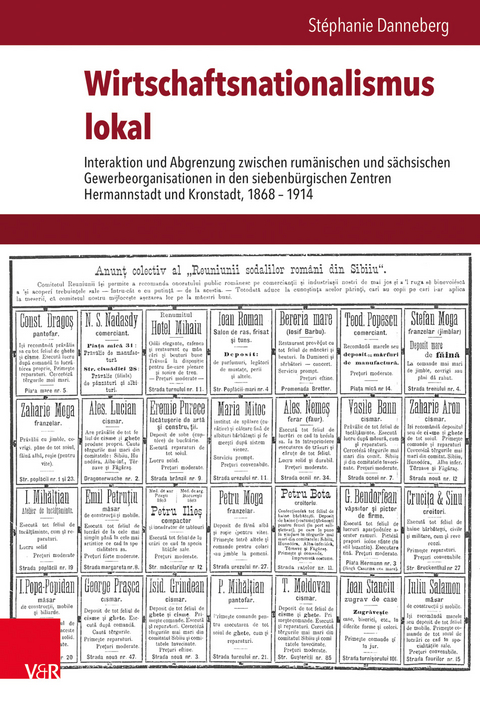
Wirtschaftsnationalismus lokal
Interaktion und Abgrenzung zwischen rumänischen und sächsischen Gewerbeorganisationen in den siebenbürgischen Zentren Hermannstadt und Kronstadt, 1868–1914
Seiten
2018
Vandenhoeck & Ruprecht (Verlag)
978-3-525-37065-0 (ISBN)
Vandenhoeck & Ruprecht (Verlag)
978-3-525-37065-0 (ISBN)
Die mikrogeschichtliche Studie beleuchtet das Zusammenleben in der multiethnischen Region Siebenbürgen.
The thesis analyses how, on the local level, Transylvanian Saxons and Romanians acted economic-nationalistically in the Habsburg Monarchy during the Austro-Hungarian Compromise period (1868–1914). The Saxons and Romanians were just like other political non-dominant ethnic groups inside the Habsburg Empire economically self-organized along national lines: within trade-associations, cooperatives and independent banks. The thesis asks for the arrangement of the relationship between Transylvanian Saxons and Romanians, always closely linked to the relationship between these »nationalities« and the Magyar »titular nation« in the Transylvanian centers Sibiu/Hermannstadt and Brasov/Kronstadt.The study makes an important contribution to both East-Central European economic nationalism and to the understanding of the relationship between the different population groups in ethnically, linguistically and religiously heterogeneous Transylvania. To what extent did defensive behaviours to the policy of magyarization or the effort involved in the compensation for the Budapest’s economic policy that was perceived as insufficient, effect exchanges between Transylvanian Saxons and Romanians? Were there any fields or situations in which the economic welfare or sociability united population groups that were otherwise separated by ethnicity? Danneberg’s micro-historical study which critically examines the coexistence in the multi-ethnic Transylvania is impressive.
The thesis analyses how, on the local level, Transylvanian Saxons and Romanians acted economic-nationalistically in the Habsburg Monarchy during the Austro-Hungarian Compromise period (1868–1914). The Saxons and Romanians were just like other political non-dominant ethnic groups inside the Habsburg Empire economically self-organized along national lines: within trade-associations, cooperatives and independent banks. The thesis asks for the arrangement of the relationship between Transylvanian Saxons and Romanians, always closely linked to the relationship between these »nationalities« and the Magyar »titular nation« in the Transylvanian centers Sibiu/Hermannstadt and Brasov/Kronstadt.The study makes an important contribution to both East-Central European economic nationalism and to the understanding of the relationship between the different population groups in ethnically, linguistically and religiously heterogeneous Transylvania. To what extent did defensive behaviours to the policy of magyarization or the effort involved in the compensation for the Budapest’s economic policy that was perceived as insufficient, effect exchanges between Transylvanian Saxons and Romanians? Were there any fields or situations in which the economic welfare or sociability united population groups that were otherwise separated by ethnicity? Danneberg’s micro-historical study which critically examines the coexistence in the multi-ethnic Transylvania is impressive.
Dr. des. Stéphanie Danneberg ist Historikerin und Politikwissenschaftlerin und lebt in München. Von 2014 bis 2017 war sie am Institut für deutsche Kultur und Geschichte Südosteuropas e. V. in München tätig.
Martin Schulze Wessel ist Professor für die Geschichte Ost- und Südosteuropas an der Universität München und leitet das Collegium Carolinum.
Ulf Brunnbauer ist Professor für Geschichte Südost- und Osteuropas an der Universität Regensburg, Regensburger Sprecher der Graduiertenschule für Ost- und Südosteuropastudien und geschäftsführender Direktor des Instituts für Ost- und Südosteuropaforschung (IOS), Regensburg.
| Erscheinungsdatum | 27.08.2018 |
|---|---|
| Reihe/Serie | Schnittstellen ; Band 010 |
| Mitarbeit |
Herausgeber (Serie): Martin Schulze Wessel, Ulf Brunnbauer |
| Zusatzinfo | mit 3 Abb., 1 Diagramm u. 26 Tab. |
| Verlagsort | Göttingen |
| Sprache | deutsch |
| Maße | 160 x 237 mm |
| Gewicht | 769 g |
| Themenwelt | Geschichte ► Allgemeine Geschichte ► Neuzeit (bis 1918) |
| Geisteswissenschaften ► Geschichte ► Regional- / Ländergeschichte | |
| Schlagworte | Ethnizität • Habsburger Monarchie • Heterogenität • Interessenkonflikt • Kooperation • Magyaren • Wirtschaftsentwicklung |
| ISBN-10 | 3-525-37065-2 / 3525370652 |
| ISBN-13 | 978-3-525-37065-0 / 9783525370650 |
| Zustand | Neuware |
| Informationen gemäß Produktsicherheitsverordnung (GPSR) | |
| Haben Sie eine Frage zum Produkt? |
Mehr entdecken
aus dem Bereich

aus dem Bereich
Geschichte einer wilden Handlung
Buch | Hardcover (2024)
C.H.Beck (Verlag)
CHF 47,60


