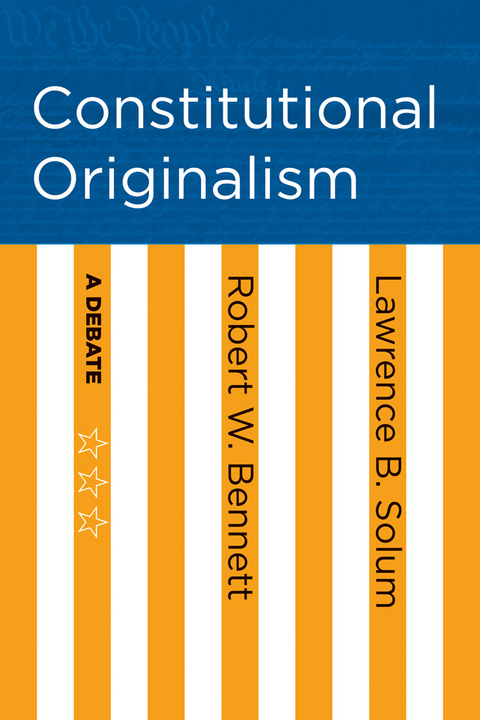
Constitutional Originalism (eBook)
224 Seiten
Cornell University Press (Verlag)
978-0-8014-6111-8 (ISBN)
Elucidates the debate between constitutional originalism and the "living constitution" approach.
Problems of constitutional interpretation have many faces, but much of the contemporary discussion has focused on what has come to be called "originalism." The core of originalism is the belief that fidelity to the original understanding of the Constitution should constrain contemporary judges. As originalist thinking has evolved, it has become clear that there is a family of originalist theories, some emphasizing the intent of the framers, while others focus on the original public meaning of the constitutional text. This idea has enjoyed a modern resurgence, in good part in reaction to the assumption of more sweeping power by the judiciary, operating in the name of constitutional interpretation. Those arguing for a "living Constitution" that keeps up with a changing world and changing values have resisted originalism. This difference in legal philosophy and jurisprudence has, since the 1970s, spilled over into party politics and the partisan wrangling over court appointments from appellate courts to the Supreme Court.
In Constitutional Originalism, Robert W. Bennett and Lawrence B. Solum elucidate the two sides of this debate and mediate between them in order to separate differences that are real from those that are only apparent. In a thorough exploration of the range of contemporary views on originalism, the authors articulate and defend sharply contrasting positions. Solum brings learning from the philosophy of language to his argument in favor of originalism, and Bennett highlights interpretational problems in the dispute-resolution context, describing instances in which a living Constitution is a more feasible and productive position. The book explores those contrasting positions, to be sure, but also uncovers important points of agreement for the interpretational enterprise. This provocative and absorbing book ends with a bibliographic essay that points to landmark works in the field and helps lay readers and students orient themselves within the literature of the debate.
Problems of constitutional interpretation have many faces, but much of the contemporary discussion has focused on what has come to be called "originalism." The core of originalism is the belief that fidelity to the original understanding of the Constitution should constrain contemporary judges. As originalist thinking has evolved, it has become clear that there is a family of originalist theories, some emphasizing the intent of the framers, while others focus on the original public meaning of the constitutional text. This idea has enjoyed a modern resurgence, in good part in reaction to the assumption of more sweeping power by the judiciary, operating in the name of constitutional interpretation. Those arguing for a "living Constitution" that keeps up with a changing world and changing values have resisted originalism. This difference in legal philosophy and jurisprudence has, since the 1970s, spilled over into party politics and the partisan wrangling over court appointments from appellate courts to the Supreme Court.
In Constitutional Originalism, Robert W. Bennett and Lawrence B. Solum elucidate the two sides of this debate and mediate between them in order to separate differences that are real from those that are only apparent. In a thorough exploration of the range of contemporary views on originalism, the authors articulate and defend sharply contrasting positions. Solum brings learning from the philosophy of language to his argument in favor of originalism, and Bennett highlights interpretational problems in the dispute-resolution context, describing instances in which a living Constitution is a more feasible and productive position. The book explores those contrasting positions, to be sure, but also uncovers important points of agreement for the interpretational enterprise. This provocative and absorbing book ends with a bibliographic essay that points to landmark works in the field and helps lay readers and students orient themselves within the literature of the debate.
Robert W. Bennett is Nathaniel L. Nathanson Professor of Law at Northwestern University and former dean of the school. He is the author of Talking It Through: Puzzles of American Democracy, also from Cornell, and Taming the Electoral College. Lawrence B. Solum is John E. Cribbet Professor of Law, Professor of Philosophy, and Associate Dean for Faculty and Research at the University of Illinois College of Law. He has written widely in jurisprudence and constitutional theory. His recent articles have appeared in the Harvard Law Review, the Virginia Law Review, and elsewhere. He is also the principal author of the Legal Theory Blog.
PrefaceWe Are All Originalists Now
Lawrence B. Solum
What Is Originalism?
Should We Be Originalists?
Originalism and Living ConstitutionalismOriginalism and the Living American Constitution
Robert W. Bennett
Originalism and Living Constitutionalism
Wrestling with the Troubles of Originalism
Implications for Living Constitutionalism
Living with a Living Constitution
The Failure of Originalism as RestraintLiving with Originalism
A Response by Lawrence B. Solum
Can Original Meaning Constrain?
The Levels-of-Generality Pseudoproblem
The Role of Values in Constitutional Construction
Dead Hands
Transitions and Precedent
Original Intent Revisited
Originalism and PoliticsAre We All Living Constitutionalists Now?
A Response by Robert W. Bennett
The Interpretive Role of Nonoriginalism in Solum's Scheme
Extent of Liveliness in Solum's Constitutional Law and Bennett’s
Normative Choices in Interpretation
Ordinary or Technical Meaning
The Limits of Constraint Based on LanguageNotes
Suggested Readings
Index
| Erscheint lt. Verlag | 6.6.2011 |
|---|---|
| Verlagsort | Ithaca |
| Sprache | englisch |
| Maße | 150 x 150 mm |
| Gewicht | 28 g |
| Themenwelt | Geisteswissenschaften ► Geschichte ► Regional- / Ländergeschichte |
| Geschichte ► Teilgebiete der Geschichte ► Militärgeschichte | |
| Recht / Steuern ► Allgemeines / Lexika | |
| Recht / Steuern ► EU / Internationales Recht | |
| Recht / Steuern ► Öffentliches Recht | |
| Recht / Steuern ► Rechtsgeschichte | |
| Sozialwissenschaften ► Politik / Verwaltung ► Staat / Verwaltung | |
| Schlagworte | original understanding of the Constitution, tradition, consistency, living constitution, constitutional interpretation, judicial precedent, judicial interpretation |
| ISBN-10 | 0-8014-6111-1 / 0801461111 |
| ISBN-13 | 978-0-8014-6111-8 / 9780801461118 |
| Informationen gemäß Produktsicherheitsverordnung (GPSR) | |
| Haben Sie eine Frage zum Produkt? |
 EPUB (Adobe DRM)
Kopierschutz: Adobe-DRM
Adobe-DRM ist ein Kopierschutz, der das eBook vor Mißbrauch schützen soll. Dabei wird das eBook bereits beim Download auf Ihre persönliche Adobe-ID autorisiert. Lesen können Sie das eBook dann nur auf den Geräten, welche ebenfalls auf Ihre Adobe-ID registriert sind.
Details zum Adobe-DRM
Dateiformat: EPUB (Electronic Publication)
EPUB ist ein offener Standard für eBooks und eignet sich besonders zur Darstellung von Belletristik und Sachbüchern. Der Fließtext wird dynamisch an die Display- und Schriftgröße angepasst. Auch für mobile Lesegeräte ist EPUB daher gut geeignet.
Systemvoraussetzungen:
PC/Mac: Mit einem PC oder Mac können Sie dieses eBook lesen. Sie benötigen eine
eReader: Dieses eBook kann mit (fast) allen eBook-Readern gelesen werden. Mit dem amazon-Kindle ist es aber nicht kompatibel.
Smartphone/Tablet: Egal ob Apple oder Android, dieses eBook können Sie lesen. Sie benötigen eine
Geräteliste und zusätzliche Hinweise
Buying eBooks from abroad
For tax law reasons we can sell eBooks just within Germany and Switzerland. Regrettably we cannot fulfill eBook-orders from other countries.
aus dem Bereich