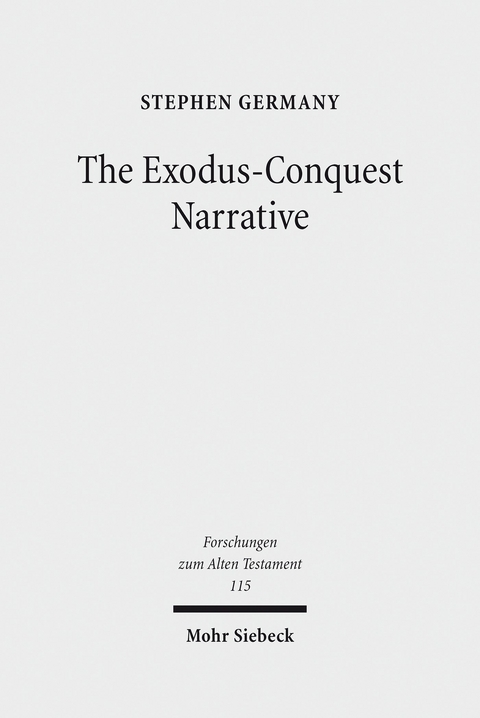
The Exodus-Conquest Narrative (eBook)
529 Seiten
Mohr Siebeck (Verlag)
9783161555824 (ISBN)
Born 1985; 2016 PhD in Hebrew Bible from Emory University.
Cover 1
Preface 8
Table of Contents 10
Chapter 1: Introduction 16
1. Contextualization of the Problem 16
2. Methodology 21
Chapter 2: Out of Egypt (Exod 1–12) 26
1. Pharaoh’s Oppression of the Israelites (Exod 1) 26
1.1. Literary-critical analysis 26
1.2. Macrocontextual analysis 28
1.3. Synthesis 31
2. Moses’ Birth and Flight from Egypt (Exod 2:1-15ab?) 32
2.1. Literary-critical analysis 32
2.2. Macrocontextual analysis 33
2.3. Synthesis 35
3. Moses in Midian (Exod 2:15b?–4:31) 36
3.1. Literary-critical analysis 36
3.2. Macrocontextual analysis 43
3.3. Synthesis 48
4. The First Encounter with Pharaoh (Exod 5:1–6:1) 51
4.1. Literary-critical analysis 51
4.2. Macrocontextual analysis 52
4.3. Synthesis 53
5. A Second Commissioning of Moses (Exod 6:2–7:7) 54
5.1. Literary-critical analysis 54
5.2. Macrocontextual analysis 54
5.3. Synthesis 57
6. The Plagues and the Departure from Egypt (Exod 7:8–12:51) 58
6.1. Literary-critical analysis 58
6.2. Macrocontextual analysis 70
6.3. Synthesis 78
7. Result 84
Chapter 3: Into the Wilderness (Exod 13–18) 86
1. The Itinerary Notices in Exodus and Numbers 86
2. The Miracle at the Sea (Exod 13:17–14:31) 91
2.1. Literary-critical analysis 91
2.2. Macrocontextual analysis 96
2.3. Synthesis 103
3. The Song at the Sea and the Song of Miriam (Exod 15:1-21) 106
3.1. Literary-critical analysis 106
3.2. Macrocontextual analysis 106
3.3. Synthesis 109
4. Marah and Elim (Exod 15:22-27) 110
4.1. Literary-critical analysis 110
4.2. Macrocontextual analysis 111
4.3. Synthesis 112
5. Quails and Manna (Exod 16) 113
5.1. Literary-critical analysis 113
5.2. Macrocontextual analysis 114
5.3. Synthesis 117
6. Water from a Rock (Exod 17:1?b-7) 118
6.1. Literary-critical analysis 118
6.2. Macrocontextual analysis 119
6.3. Synthesis 120
7. The War with Amalek (Exod 17:8-16) 121
7.1. Literary-critical analysis 121
7.2. Macrocontextual analysis 121
7.3. Synthesis 123
8. Jethro (Exod 18) 123
8.1. Literary-critical analysis 123
8.2. Macrocontextual analysis 125
8.3. Synthesis 126
9. Result 127
Chapter 4: The Revelation of the Law at Sinai (Exod 19–24 // Deut 5:1–6:3) 128
1. Exod 19–24 128
1.1. Literary-critical analysis 128
1.2. Macrocontextual analysis 136
1.2.1. The theophany texts 136
1.2.2. The narratives relating to the law 141
1.2.3. The theophany without the law (Scenario 1) 144
1.2.4. The law without the theophany (Scenario 2) 145
1.2.5. Law and theophany together (Scenario 3) 147
1.3. Synthesis 150
2. Deut 5:1–6:3 154
2.1. Literary-critical analysis 154
2.2. Synthesis 158
3. Comparison of Exod 19–24 and Deut 5:1–6:3 159
4. Result 162
Chapter 5: The Golden Calf and Its Aftermath (Exod 32–34 // Deut 9:7–10:11) 164
1. Exod 32–34 165
1.1. Literary-critical analysis 165
1.2. Macrocontextual analysis 179
1.3. Synthesis 190
2. Deut 9:7–10:11 195
2.1. Literary-critical analysis 195
2.2. Synthesis 199
3. Comparison of Exod 32–34 and Deut 9:7–10:11 201
4. Result 208
Chapter 6: From Sinai to Kadesh (Num 10–19) 209
1. The People’s Departure (Num 10:29-36) 209
1.1. Literary-critical analysis 209
1.2. Macrocontextual analysis 210
1.3. Synthesis 212
2. Further Complaints in the Wilderness (Num 11) 212
2.1. Literary-critical analysis 212
2.2. Macrocontextual analysis 215
2.3. Synthesis 217
3. The Complaint of Miriam and Aaron against Moses (Num 12) 219
3.1. Literary-critical analysis 219
3.2. Macrocontextual analysis 219
3.3. Synthesis 220
4. The Story of the Spies (Num 13–14) 221
4.1. Literary-critical analysis of Num 13–14 222
4.2. Macrocontextual analysis of Num 13–14 226
4.3. Synthesis 228
4.4. Literary-critical analysis of Deut 1:19-46 231
4.5. Comparison of Num 13–14 and Deut 1:19-46 233
4.6. Result 238
5. Dathan, Abiram, the 250 Men, and Korah (Num 16–17) 239
5.1. Literary-critical analysis 239
5.2. Macrocontextual analysis 246
5.3. Synthesis 248
6. Result 250
Chapter 7: From Kadesh to the Plains of Moab (Num 20–21 // Deut 1–3) 251
1. Priestly Material in Num 20–21 251
2. Israel’s Detour around Edom (Num 20:14-21) 253
2.1. Literary-critical analysis 253
2.2. Macrocontextual analysis 255
2.3. Synthesis 256
3. The Defeat of Sihon and Og (Num 21:21-35) 256
3.1. Literary-critical analysis 256
3.2. Macrocontextual analysis 258
3.3. Synthesis 260
4. The Mosaic Retrospective in Deut 1–3* 261
4.1. Literary-critical analysis 261
4.2. Macrocontextual analysis 272
4.3. Synthesis 273
5. Jephthah’s Speech in Judg 11:12-28 277
6. The Relationship among the Parallel Accounts 279
6.1. Comparison of individual motifs 280
6.2. Synthesis 287
7. The Itinerary Reports (Num 20:1, 22 21:4a, 10-20
7.1. Literary-critical analysis 292
7.2. Macrocontextual analysis 296
7.3. Synthesis 300
8. Result 303
Chapter 8: Balaam (Num 22–24) 304
1. Literary-Critical Analysis 304
2. Macrocontextual Analysis 311
2.1. The first oracle (Num 23:7-10) 312
2.2. The second oracle (Num 23:18b-24) 312
2.3. The third oracle (Num 24:3-9) 315
2.4. The fourth through seventh oracles (Num 24:15-24) 319
2.5. The prose narrative 319
3. Synthesis 325
Chapter 9: Preparations for Conquest (Josh 1–5) 329
1. Instructions prior to Entering the Land (Josh 1) 329
1.1. Literary-critical analysis 329
1.2. Macrocontextual analysis 330
1.3. Synthesis 332
2. Rahab and the Spies (Josh 2) 333
2.1. Literary-critical analysis 333
2.2. Macrocontextual analysis 334
2.3. Synthesis 336
3. The Crossing of the Jordan (Josh 3–4) 337
3.1. Literary-critical analysis 337
3.2. Macrocontextual analysis 343
3.3. Synthesis 348
4. A Bookend to the Exodus (Josh 5) 353
4.1. Literary-critical analysis 353
4.2. Macrocontextual analysis 354
4.3. Synthesis 358
5. Result 360
Chapter 10: The Conquest of Jericho and Ai (Josh 6–8) 361
1. The Conquest of Jericho (Josh 6) 361
1.1. Literary-critical analysis 361
1.2. Macrocontextual analysis 369
1.3. Synthesis 377
2. Achan’s Sin (Josh 7) 380
2.1. Literary-critical analysis 380
2.2. Macrocontextual analysis 385
2.3. Synthesis 390
3. The Conquest of Ai (Josh 8) 393
3.1. Literary-critical analysis of Josh 8 393
Excursus: The manuscript evidence for Josh 8:10-13 398
3.2. Macrocontextual analysis of Josh 8 407
3.3. Literary-critical analysis of Judg 20 412
3.4. Comparison of Josh 8 and Judg 20 418
3.5. Synthesis 422
4. Result 426
Chapter 11: The Conquest of the Remainder of the Land (Josh 9–12) 427
1. The Gibeonite Accord (Josh 9) 427
1.1. Literary-critical analysis 427
1.2. Macrocontextual analysis 431
1.3. Synthesis 434
2. The Conquest of the South (Josh 10) 436
2.1. Literary-critical analysis 436
2.2. Macrocontextual analysis 445
2.3. Synthesis 447
3. The Conquest of the North (Josh 11) 450
3.1. Literary-critical analysis 450
3.2. Macrocontextual analysis 452
3.3. Synthesis 455
4. The List of Conquered Cities (Josh 12) 456
4.1. Literary-critical analysis 456
4.2. Macrocontextual analysis 456
4.3. Synthesis 458
5. Result 459
Chapter 12: Conclusion 462
1. The Theoretical Problem and a Proposed Solution 462
2. Synthesis and Evaluation of the Results 463
2.1. The earliest exodus-conquest narrative 463
2.2. Pre-priestly expansions to the exodus-conquest narrative 467
3. Implications for the Formation of the Hexateuch 469
Bibliography 472
Index of Ancient Sources 502
Index of Modern Authors 519
Subject Index 526
Index of Geographical Names 529
| Erscheint lt. Verlag | 1.11.2017 |
|---|---|
| Sprache | englisch |
| Themenwelt | Geisteswissenschaften ► Religion / Theologie ► Christentum |
| Geisteswissenschaften ► Religion / Theologie ► Judentum | |
| ISBN-13 | 9783161555824 / 9783161555824 |
| Informationen gemäß Produktsicherheitsverordnung (GPSR) | |
| Haben Sie eine Frage zum Produkt? |
 PDF (Adobe DRM)
Größe: 3,9 MB
Kopierschutz: Adobe-DRM
Adobe-DRM ist ein Kopierschutz, der das eBook vor Mißbrauch schützen soll. Dabei wird das eBook bereits beim Download auf Ihre persönliche Adobe-ID autorisiert. Lesen können Sie das eBook dann nur auf den Geräten, welche ebenfalls auf Ihre Adobe-ID registriert sind.
Details zum Adobe-DRM
Dateiformat: PDF (Portable Document Format)
Mit einem festen Seitenlayout eignet sich die PDF besonders für Fachbücher mit Spalten, Tabellen und Abbildungen. Eine PDF kann auf fast allen Geräten angezeigt werden, ist aber für kleine Displays (Smartphone, eReader) nur eingeschränkt geeignet.
Systemvoraussetzungen:
PC/Mac: Mit einem PC oder Mac können Sie dieses eBook lesen. Sie benötigen eine
eReader: Dieses eBook kann mit (fast) allen eBook-Readern gelesen werden. Mit dem amazon-Kindle ist es aber nicht kompatibel.
Smartphone/Tablet: Egal ob Apple oder Android, dieses eBook können Sie lesen. Sie benötigen eine
Geräteliste und zusätzliche Hinweise
Buying eBooks from abroad
For tax law reasons we can sell eBooks just within Germany and Switzerland. Regrettably we cannot fulfill eBook-orders from other countries.
aus dem Bereich