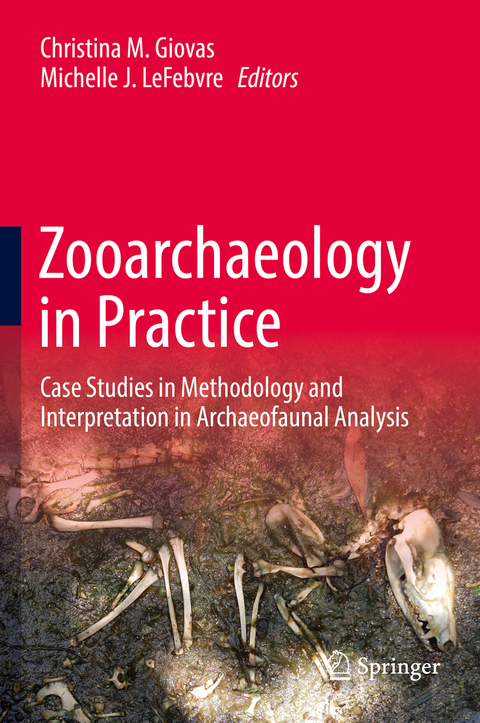
Zooarchaeology in Practice (eBook)
XIII, 331 Seiten
Springer International Publishing (Verlag)
978-3-319-64763-0 (ISBN)
Zooarchaeology in Practice advances the methodological discussion beyond its present strictures by addressing the development of analytically sound practices through a collection of seminal essays authored by leading figures in the field. Offering a level of depth and breadth not readily found in the available literature, this volume examines how zooarchaeological data and interpretation are shaped by its method of practice, exploring the impact of these effects at all levels of zooarchaeological investigation.
Employing a geographically and taxonomically diverse set of case studies, contributing authors provide instructive approaches to problems in traditional and emerging areas of methodological concern. Readers, from specialists to students, will gain an extensive, sophisticated look at important disciplinary issues, sure to provoke critical reflection on the nature and importance of sound methodology. With implications for how archaeologists reconstruct human behavior and paleoecology, and broader relevance to fields such as paleontology and conservation biology, Zooarchaeology in Practice makes an enduring contribution to the methodological advancement of the discipline.
Christina M. Giovas (Ph.D., University of Washington) is a Lecturer in Archaeology at the University of Queensland. Her research focuses on prehistoric fisheries, animal translocations, and the human paleoecology of island and coastal settings, particularly the Caribbean and Oceania. She has conducted fieldwork in the Lesser Antilles, Polynesia, France, and the Great Lakes and the Pacific Northwest regions of North America. Dr. Giovas is Associate Editor for the Journal of Island and Coastal Archaeology and serves on the Board of the International Association for Caribbean Archaeology. She joins the faculty of the Department of Archaeology at Simon Fraser University in 2018.
Michelle J. LeFebvre (Ph.D., University of Florida) is a Postdoctoral Research Associate in Biodiversity Informatics at the Florida Museum of Natural History (FLMNH), Gainesville. With a focus in Caribbean and Southeastern U.S. archaeology, she uses zooarchaeological, biochemical, and archaeological datasets to investigate how animal exploitation, manipulation (e.g., translocation, management), and consumption articulate with patterns of human interaction, village aggregation, and social hierarchy. She is also focused on the mechanics and facilitation of open access zooarchaeological data, and its integration within open biodiversity networks.
Christina M. Giovas (Ph.D., University of Washington) is a Lecturer in Archaeology at the University of Queensland. Her research focuses on prehistoric fisheries, animal translocations, and the human paleoecology of island and coastal settings, particularly the Caribbean and Oceania. She has conducted fieldwork in the Lesser Antilles, Polynesia, France, and the Great Lakes and the Pacific Northwest regions of North America. Dr. Giovas is Associate Editor for the Journal of Island and Coastal Archaeology and serves on the Board of the International Association for Caribbean Archaeology. She joins the faculty of the Department of Archaeology at Simon Fraser University in 2018. Michelle J. LeFebvre (Ph.D., University of Florida) is a Postdoctoral Research Associate in Biodiversity Informatics at the Florida Museum of Natural History (FLMNH), Gainesville. With a focus in Caribbean and Southeastern U.S. archaeology, she uses zooarchaeological, biochemical, and archaeological datasets to investigate how animal exploitation, manipulation (e.g., translocation, management), and consumption articulate with patterns of human interaction, village aggregation, and social hierarchy. She is also focused on the mechanics and facilitation of open access zooarchaeological data, and its integration within open biodiversity networks.
1: Methods, Methodology, and Zooarchaeology in Practice (Christina M. Giovas and Michelle J. LeFebvre).- Part I: Identification and Quantification.- 2: The History of MNI in North American Zooarchaeology (R. Lee Lyman).- 3: Contemporary Challenges in Zooarchaeological Specimen Identification (Michelle J. LeFebvre and Ashley E. Sharpe).- 4: Impact of Analytic Protocols on Archaeofish Abundance, Richness, and Similarity: A Caribbean-Pacific Crossover Study (Christina M. Giovas).- Part II: Beyond Quantification: Taphonomy, Fragmentation, and Assemblage Size.- 5: Bone Taphonomy in Deep Urban Stratigraphy: Case Studies from York, United Kingdom (Clare Rainsford and Terry O’Connor) .- 6: Low-Survival Skeletal Elements Track Attrition, Not Carcass Transport Behavior in Quaternary Large Mammal Assemblages (J. Tyler Faith and Jessica C. Thompson).- 7: Influence of Bone Survivorship on Taxonomic Abundance Measures (Jacob L. Fisher).- 8: Shell Fragmentation Beyond Screen-Size and the Reconstruction of Intra-Site Settlement Patterns: A Case Study from the West Coast of South Africa (Antonieta Jerardino).- 9: The Value in Studying Large Faunal Collections Using Traditional Zooarchaeological Methods: A Case Study from Anglo-Saxon England (Pam Crabtree).- Part III: Isotopic and Biomolecular Techniques.- 10: Molluscs and Paleoenvironmental Reconstruction in Island and Coastal Settings: Variability, Seasonality, and Sampling (Catherine F. West, Meghan Burchell, and C. Fred T. Andrus).- 11: Ancient DNA in Zooarchaeology: New Methods, New Questions and Settling Old Debates in Pacific Commensal Studies (Lisa Matisoo-Smith).- 12: Zooarchaeology by Mass Spectrometry (ZooMS) Collagen Fingerprinting for the Species Identification of Archaeological Bone Fragments (Michael Buckley).- Part IV: Toward Practical Applications and Broader Syntheses.- 13: Coming to Terms with Imperfection: Comparative Studies and the Search for Grazing Impacts in Seventeenth Century New Mexico (Emily Lena Jones).- 14: Zooarchaeology Method and Practice in Classical Archaeology: Interdisciplinary Pathways Forward (Michael MacKinnon).- 15: Assessing California Mussel (Mytilus californianus) Size Changes Through Deep Time: A Case Study from San Miguel Island, California (Todd J. Braje, Hannah Haas, and Breana Campbell).- 16: Concluding Remarks (Umberto Albarella).
| Erscheint lt. Verlag | 24.11.2017 |
|---|---|
| Zusatzinfo | XIII, 331 p. 51 illus., 19 illus. in color. |
| Verlagsort | Cham |
| Sprache | englisch |
| Themenwelt | Geschichte ► Allgemeine Geschichte ► Altertum / Antike |
| Schlagworte | analysis beyond quantification • biomolecular and isotopic techniques • bone Taphonomy in Deep Urban Stratigraphy • experimental approaches within zooarchaeology • identification in Zooarchaeology • persistent Issues of Method and Practice in Zooarchaeology • restricted Element Analysis in Archaeofish Studies • zooarchaeological research designs |
| ISBN-10 | 3-319-64763-6 / 3319647636 |
| ISBN-13 | 978-3-319-64763-0 / 9783319647630 |
| Informationen gemäß Produktsicherheitsverordnung (GPSR) | |
| Haben Sie eine Frage zum Produkt? |
 PDF (Wasserzeichen)
DRM: Digitales Wasserzeichen
Dieses eBook enthält ein digitales Wasserzeichen und ist damit für Sie personalisiert. Bei einer missbräuchlichen Weitergabe des eBooks an Dritte ist eine Rückverfolgung an die Quelle möglich.
Dateiformat: PDF (Portable Document Format)
Mit einem festen Seitenlayout eignet sich die PDF besonders für Fachbücher mit Spalten, Tabellen und Abbildungen. Eine PDF kann auf fast allen Geräten angezeigt werden, ist aber für kleine Displays (Smartphone, eReader) nur eingeschränkt geeignet.
Systemvoraussetzungen:
PC/Mac: Mit einem PC oder Mac können Sie dieses eBook lesen. Sie benötigen dafür einen PDF-Viewer - z.B. den Adobe Reader oder Adobe Digital Editions.
eReader: Dieses eBook kann mit (fast) allen eBook-Readern gelesen werden. Mit dem amazon-Kindle ist es aber nicht kompatibel.
Smartphone/Tablet: Egal ob Apple oder Android, dieses eBook können Sie lesen. Sie benötigen dafür einen PDF-Viewer - z.B. die kostenlose Adobe Digital Editions-App.
Buying eBooks from abroad
For tax law reasons we can sell eBooks just within Germany and Switzerland. Regrettably we cannot fulfill eBook-orders from other countries.
aus dem Bereich