


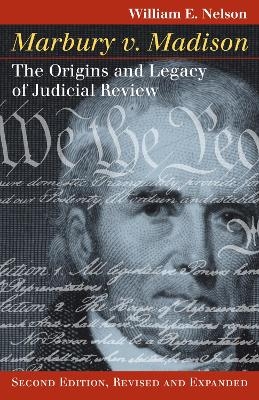
Marbury V. Madison
The Origins and Legacy of Judicial Review
Seiten
2018
|
Second Edition
University Press of Kansas (Verlag)
978-0-7006-2640-3 (ISBN)
University Press of Kansas (Verlag)
978-0-7006-2640-3 (ISBN)
Relates the story behind Marbury v Madison and explains why it is a foundational case for understanding the US Supreme Court. Nelson reveals how John Marshall deftly avoided a dangerous political confrontation between the executive and judicial branches by upholding the rule of law, and how he managed to shore up the Court's prestige and power rather than have it serve partisan political agendas.
On the surface, the case itself seems a minor one at best. William Marbury, a last-minute judicial appointee of outgoing Federalist president John Adams, demanded redress from the Supreme Court when his commission was not delivered. But Chief Justice John Marshall could clearly see the danger his demand posed for a weak court filled with Federalist judges. Wary of the Court’s standing with the new Republican administration of Thomas Jefferson, Marshall hit upon a solution that was both principled and pragmatic. He determined that while Marbury was justified in his suit, the law on which his claim was based was in conflict with the Constitution. It was the first time that the Court struck down an act of Congress as unconstitutional, thus establishing the doctrine of judicial review that designates the Court as chief interpreter of the Constitution.Nelson relates the story behind Marbury and explains why it is a foundational case for understanding the Supreme Court. He reveals how Marshall deftly avoided a dangerous political confrontation between the executive and judicial branches by upholding the rule of law. Nelson also shows how Marshall managed to shore up the Court’s prestige and power rather than have it serve partisan political agendas.
On the surface, the case itself seems a minor one at best. William Marbury, a last-minute judicial appointee of outgoing Federalist president John Adams, demanded redress from the Supreme Court when his commission was not delivered. But Chief Justice John Marshall could clearly see the danger his demand posed for a weak court filled with Federalist judges. Wary of the Court’s standing with the new Republican administration of Thomas Jefferson, Marshall hit upon a solution that was both principled and pragmatic. He determined that while Marbury was justified in his suit, the law on which his claim was based was in conflict with the Constitution. It was the first time that the Court struck down an act of Congress as unconstitutional, thus establishing the doctrine of judicial review that designates the Court as chief interpreter of the Constitution.Nelson relates the story behind Marbury and explains why it is a foundational case for understanding the Supreme Court. He reveals how Marshall deftly avoided a dangerous political confrontation between the executive and judicial branches by upholding the rule of law. Nelson also shows how Marshall managed to shore up the Court’s prestige and power rather than have it serve partisan political agendas.
William E. Nelson is the Judge Edward Weinfeld Professor of Law at the New York University School of Law.
| Erscheinungsdatum | 10.07.2018 |
|---|---|
| Verlagsort | Kansas |
| Sprache | englisch |
| Maße | 139 x 215 mm |
| Gewicht | 260 g |
| Themenwelt | Geisteswissenschaften ► Geschichte ► Regional- / Ländergeschichte |
| Recht / Steuern ► EU / Internationales Recht | |
| Recht / Steuern ► Öffentliches Recht | |
| ISBN-10 | 0-7006-2640-9 / 0700626409 |
| ISBN-13 | 978-0-7006-2640-3 / 9780700626403 |
| Zustand | Neuware |
| Informationen gemäß Produktsicherheitsverordnung (GPSR) | |
| Haben Sie eine Frage zum Produkt? |
Mehr entdecken
aus dem Bereich


aus dem Bereich
die Geschichte meiner Urgroßmutter
Buch | Hardcover (2025)
C.H.Beck (Verlag)
CHF 32,15
Träume und Macht : eine Biografie
Buch | Hardcover (2025)
C.H.Beck (Verlag)
CHF 61,60


