


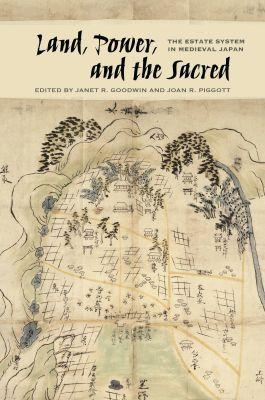
Land, Power, and the Sacred
The Estate System in Medieval Japan
Seiten
2018
University of Hawai'i Press (Verlag)
978-0-8248-7293-9 (ISBN)
University of Hawai'i Press (Verlag)
978-0-8248-7293-9 (ISBN)
- Titel z.Zt. nicht lieferbar
- Versandkostenfrei
- Auch auf Rechnung
- Artikel merken
From the tenth to sixteenth centuries, landed estates served as sites of de facto government, trade network nodes, developing agricultural technology, and centres of religious practice in Japan. This volume examines the system from three perspectives: the land itself; the power derived from and exerted over the land; and the religious institutions and individuals involved in landholding practices.
Landed estates (shoen) produced much of the material wealth supporting all levels of late classical and medieval Japanese society. During the tenth through sixteenth centuries, estates served as sites of de facto government, trade network nodes, developing agricultural technology, and centers of religious practice and ritual. Although mostly farmland, many yielded nonagricultural products, including lumber, salt, fish, and silk, and provided livelihoods for craftsmen, seafarers, peddlers, and performers, as well as for cultivators. By the twelfth century, an estate “system” permeated much of the Japanese archipelago. This volume examines the system from three perspectives: the land itself; the power derived from and exerted over the land; and the religion institutions and individuals that were involved in landholding practices.
Chapters by Japanese and Western scholars explore how the estate system arose, developed, and eventually collapsed. Several investigate a single estate or focus on agricultural techniques, while others survey estates in broad contexts such as economic change and maritime trade. Other chapters look at how we learn about estates by inspecting documents, landscape features, archaeological remains, and extant buildings and images; how representatives of every social stratum worked together to make the land productive and, conversely, how cooperative arrangements failed and rivals battled one another, making conflict as well as collaboration a hallmark of the system. On a more personal level, we follow the monk Chogen’s restoration of Obe Estate and his installation of a famous Amida triad in a temple he built on the premises; the strategies of royal ladies Josaimon’in, Hachijoin, and Kokamon’in as they strove to keep their landholdings viable; and the murder of estate official Gorozaemon, whose own neighbors killed him as a result of a much larger dispute between two powerful warrior families.
Land, Power, and the Sacred represents a significant expansion and revision of our knowledge of medieval Japanese estates. A range of readers will welcome the primary source research and comparative perspectives it offers; those who do not specialize in Japanese medieval history but recognize the value of teaching the history of estates will find a chapter devoted to the topic invaluable.
Landed estates (shoen) produced much of the material wealth supporting all levels of late classical and medieval Japanese society. During the tenth through sixteenth centuries, estates served as sites of de facto government, trade network nodes, developing agricultural technology, and centers of religious practice and ritual. Although mostly farmland, many yielded nonagricultural products, including lumber, salt, fish, and silk, and provided livelihoods for craftsmen, seafarers, peddlers, and performers, as well as for cultivators. By the twelfth century, an estate “system” permeated much of the Japanese archipelago. This volume examines the system from three perspectives: the land itself; the power derived from and exerted over the land; and the religion institutions and individuals that were involved in landholding practices.
Chapters by Japanese and Western scholars explore how the estate system arose, developed, and eventually collapsed. Several investigate a single estate or focus on agricultural techniques, while others survey estates in broad contexts such as economic change and maritime trade. Other chapters look at how we learn about estates by inspecting documents, landscape features, archaeological remains, and extant buildings and images; how representatives of every social stratum worked together to make the land productive and, conversely, how cooperative arrangements failed and rivals battled one another, making conflict as well as collaboration a hallmark of the system. On a more personal level, we follow the monk Chogen’s restoration of Obe Estate and his installation of a famous Amida triad in a temple he built on the premises; the strategies of royal ladies Josaimon’in, Hachijoin, and Kokamon’in as they strove to keep their landholdings viable; and the murder of estate official Gorozaemon, whose own neighbors killed him as a result of a much larger dispute between two powerful warrior families.
Land, Power, and the Sacred represents a significant expansion and revision of our knowledge of medieval Japanese estates. A range of readers will welcome the primary source research and comparative perspectives it offers; those who do not specialize in Japanese medieval history but recognize the value of teaching the history of estates will find a chapter devoted to the topic invaluable.
Janet R. Goodwin was a founding faculty member of the University of Aizu in Aizu-Wakamatsu, Japan. Now retired, she is research associate at the East Asian Study Center, University of Southern California. Joan R. Piggott is Gordon L. MacDonald Professor of History and director of the Project for Premodern Japan Studies at the University of Southern California, Los Angeles.
| Erscheinungsdatum | 26.10.2018 |
|---|---|
| Co-Autor | Kristina Buhrman, Michelle M. Damian, David Eason |
| Zusatzinfo | 62 illustrations, 29 in colour |
| Verlagsort | Honolulu, HI |
| Sprache | englisch |
| Maße | 162 x 236 mm |
| Gewicht | 975 g |
| Themenwelt | Geisteswissenschaften ► Geschichte ► Regional- / Ländergeschichte |
| Geisteswissenschaften ► Religion / Theologie ► Buddhismus | |
| ISBN-10 | 0-8248-7293-2 / 0824872932 |
| ISBN-13 | 978-0-8248-7293-9 / 9780824872939 |
| Zustand | Neuware |
| Informationen gemäß Produktsicherheitsverordnung (GPSR) | |
| Haben Sie eine Frage zum Produkt? |
Mehr entdecken
aus dem Bereich


aus dem Bereich
die Geschichte meiner Urgroßmutter
Buch | Hardcover (2025)
C.H.Beck (Verlag)
CHF 32,15
Träume und Macht : eine Biografie
Buch | Hardcover (2025)
C.H.Beck (Verlag)
CHF 61,60


