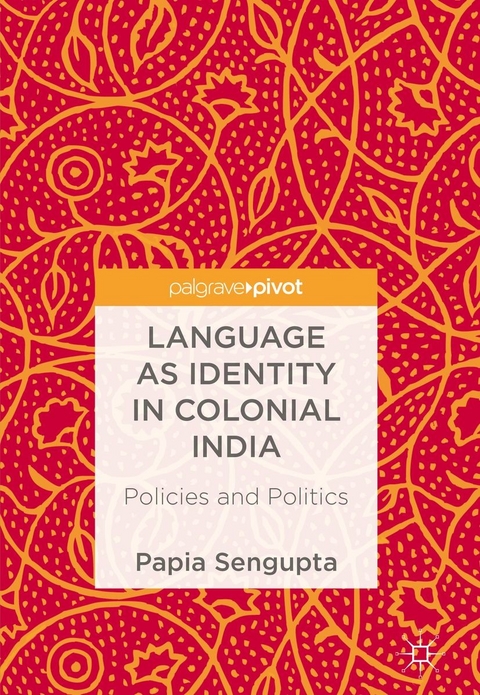
Language as Identity in Colonial India (eBook)
120 Seiten
Springer Singapore (Verlag)
978-981-10-6844-7 (ISBN)
This book is a systematic narrative, tracking the colonial language policies and acts responsible for the creation of a sense of 'self-identity' and culminating in the evolution of nationalistic fervor in colonial India. British policy on language for administrative use and as a weapon to rule led to the parallel development of Indian vernaculars: poets, novelists, writers and journalists produced great and fascinating work that conditioned and directed India's path to independence. The book presents a theoretical proposition arguing that language as identity is a colonial construct in India, and demonstrates this by tracing the events, policies and changes that led to the development and churning up of Indian national sentiments and attitudes. It is a testimony of India's linguistic journey from a British colony to a modern state. Demonstrating that language as basis of identity was a colonial construct in modern India, the book asserts that any in-depth understanding of identity and politics in contemporary India remains incomplete without looking at colonial policies on language and education, from which the multiple discourses on 'self' and belonging in modern India emanated.
Dr. Papia Sengupta, Assistant Professor, Centre for Political Studies, School of Social Sciences II, Jawaharlal Nehru University, New Delhi, India.
This book is a systematic narrative, tracking the colonial language policies and acts responsible for the creation of a sense of "e;self-identity"e; and culminating in the evolution of nationalistic fervor in colonial India. British policy on language for administrative use and as a weapon to rule led to the parallel development of Indian vernaculars: poets, novelists, writers and journalists produced great and fascinating work that conditioned and directed India's path to independence. The book presents a theoretical proposition arguing that language as identity is a colonial construct in India, and demonstrates this by tracing the events, policies and changes that led to the development and churning up of Indian national sentiments and attitudes. It is a testimony of India's linguistic journey from a British colony to a modern state. Demonstrating that language as basis of identity was a colonial construct in modern India, the book asserts that any in-depth understanding of identity and politics in contemporary India remains incomplete without looking at colonial policies on language and education, from which the multiple discourses on "e;self"e; and belonging in modern India emanated.
Dr. Papia Sengupta, Assistant Professor, Centre for Political Studies, School of Social Sciences II, Jawaharlal Nehru University, New Delhi, India.
Chapter 1 Theoretical developments-linking language to identity.- Chapter 2 Language situation in colonial India: Story of Bengal.- Chapter 3 Making identity out of language: Beyond Bengal.- Chapter 4 Building identity: Information, intellect and inspiration.- Chapter 5 Language and construction of plural selves.- Chapter 6 Language conundrum.
| Erscheint lt. Verlag | 15.11.2017 |
|---|---|
| Zusatzinfo | XXI, 120 p. |
| Verlagsort | Singapore |
| Sprache | englisch |
| Themenwelt | Schulbuch / Wörterbuch ► Wörterbuch / Fremdsprachen |
| Geschichte ► Teilgebiete der Geschichte ► Wirtschaftsgeschichte | |
| Geisteswissenschaften ► Sprach- / Literaturwissenschaft ► Sprachwissenschaft | |
| Sozialwissenschaften ► Politik / Verwaltung ► Politische Systeme | |
| Sozialwissenschaften ► Politik / Verwaltung ► Vergleichende Politikwissenschaften | |
| Schlagworte | Anglicists versus Orientalist • Development of Education • Imperial India • Language and Construction of Self • Language as Politics • Linguistic Identity |
| ISBN-10 | 981-10-6844-5 / 9811068445 |
| ISBN-13 | 978-981-10-6844-7 / 9789811068447 |
| Informationen gemäß Produktsicherheitsverordnung (GPSR) | |
| Haben Sie eine Frage zum Produkt? |
 PDF (Wasserzeichen)
DRM: Digitales Wasserzeichen
Dieses eBook enthält ein digitales Wasserzeichen und ist damit für Sie personalisiert. Bei einer missbräuchlichen Weitergabe des eBooks an Dritte ist eine Rückverfolgung an die Quelle möglich.
Dateiformat: PDF (Portable Document Format)
Mit einem festen Seitenlayout eignet sich die PDF besonders für Fachbücher mit Spalten, Tabellen und Abbildungen. Eine PDF kann auf fast allen Geräten angezeigt werden, ist aber für kleine Displays (Smartphone, eReader) nur eingeschränkt geeignet.
Systemvoraussetzungen:
PC/Mac: Mit einem PC oder Mac können Sie dieses eBook lesen. Sie benötigen dafür einen PDF-Viewer - z.B. den Adobe Reader oder Adobe Digital Editions.
eReader: Dieses eBook kann mit (fast) allen eBook-Readern gelesen werden. Mit dem amazon-Kindle ist es aber nicht kompatibel.
Smartphone/Tablet: Egal ob Apple oder Android, dieses eBook können Sie lesen. Sie benötigen dafür einen PDF-Viewer - z.B. die kostenlose Adobe Digital Editions-App.
Buying eBooks from abroad
For tax law reasons we can sell eBooks just within Germany and Switzerland. Regrettably we cannot fulfill eBook-orders from other countries.
aus dem Bereich