Rhetorical Touch (eBook)
272 Seiten
University of South Carolina Press (Verlag)
978-1-61117-384-0 (ISBN)
Fresh insights into redefining rhetoric discourse in the context of disability studies through touch
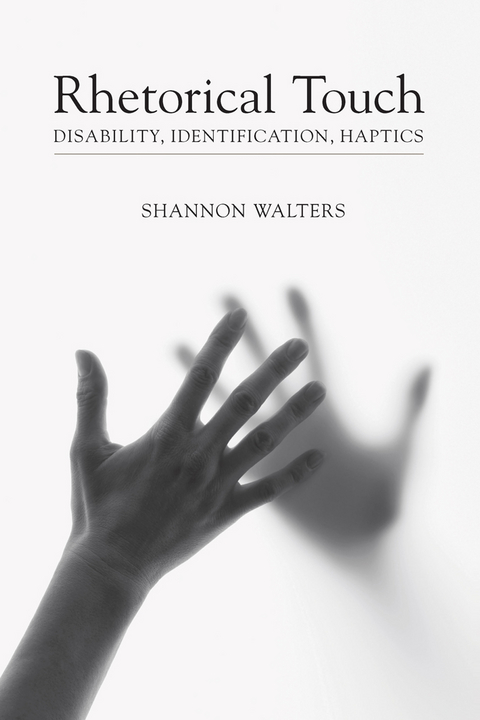
Rhetorical Touch argues for an understanding of touch as a rhetorical art by approaching the sense of touch through the kinds of bodies and minds that rhetorical history and theory have tended to exclude. In resistance to a rhetorical tradition focused on shaping able bodies and neurotypical minds, Shannon Walters explores how people with various disabilities—psychological, cognitive, and physical—employ touch to establish themselves as communicators and to connect with disabled and nondisabled audiences. In doing so, she argues for a theory of rhetoric that understands and values touch as rhetorical.
Essential to her argument is a redefinition of key concepts and terms—the rhetorical situation, rhetorical identification, and the appeals of ethos (character), pathos (emotion), and logos (logic or message). By connecting Empedoclean and sophistic theories to Aristotelian rhetoric and Burkean approaches, Walters's methods mobilize a wide range of key figures in rhetorical history and theory in response to the context of disability. Using Empedocles' tactile approach to logos, Walters shows how the iterative writing processes of people with psychological disabilities shape crucial spaces for identification based on touch in online and real life spaces. Mobilizing the touch-based properties of the rhetorical practice of mētis, Walters demonstrates how rhetors with autism approach the crafting of ethos in generative and embodied ways. Rereading the rhetorical practice of kairos in relation to the proximity between bodies, Walters demonstrates how writers with physical disabilities move beyond approaches of pathos based on pity and inspiration. The volume also includes a classroom-based exploration of the discourses and assumptions regarding bodies in relation to haptic, or touch-based, technologies.
Because the sense of touch is the most persistent of the senses, Walters argues that in contexts of disability and in situations in which people with and without disabilities interact, touch can be a particularly vital instrument for creating meaning, connection, and partial identification. She contends that a rhetoric thus reshaped stretches contemporary rhetoric and composition studies to respond to the contributions of disabled rhetors and transforms the traditional rhetorical appeals and canons. Ultimately, Walters argues, a rhetoric of touch allows for a richer understanding of the communication processes of a wide range of rhetors who use embodied strategies.
Shannon Walters is an assistant professor of English at Temple University, where she teaches courses in rhetoric and composition, disability studies, and women's studies. Her work has appeared in JAC: A Journal of Rhetoric, Culture & Politics; Technical Communication Quarterly; Feminist Media Studies; Disability Studies Quarterly, Journal of Literary and Cultural Disability Studies, and PMLA.
| Erscheint lt. Verlag | 20.10.2014 |
|---|---|
| Reihe/Serie | Studies in Rhetoric & Communication |
| Studies in Rhetoric & Communication | |
| Studies in Rhetoric / Communication | Studies in Rhetoric/Communication |
| Verlagsort | Columbia |
| Sprache | englisch |
| Maße | 150 x 150 mm |
| Themenwelt | Geisteswissenschaften ► Sprach- / Literaturwissenschaft ► Sprachwissenschaft |
| Sozialwissenschaften ► Kommunikation / Medien ► Kommunikationswissenschaft | |
| Sozialwissenschaften ► Soziologie | |
| Schlagworte | Assistive Technology • Augmentative and alternative communication • Collaboration • critique • Decorum • Douglas Biklen • Figure of Speech • Inquiry • Lateral Thinking • meaning-making • Mediation • Modes of persuasion • New rhetorics • reason • rhetoric • rhetorical device • Rhetorical stance • Suggestion • Thought • transference |
| ISBN-10 | 1-61117-384-1 / 1611173841 |
| ISBN-13 | 978-1-61117-384-0 / 9781611173840 |
| Informationen gemäß Produktsicherheitsverordnung (GPSR) | |
| Haben Sie eine Frage zum Produkt? |
 EPUB (Adobe DRM)
Kopierschutz: Adobe-DRM
Adobe-DRM ist ein Kopierschutz, der das eBook vor Mißbrauch schützen soll. Dabei wird das eBook bereits beim Download auf Ihre persönliche Adobe-ID autorisiert. Lesen können Sie das eBook dann nur auf den Geräten, welche ebenfalls auf Ihre Adobe-ID registriert sind.
Details zum Adobe-DRM
Dateiformat: EPUB (Electronic Publication)
EPUB ist ein offener Standard für eBooks und eignet sich besonders zur Darstellung von Belletristik und Sachbüchern. Der Fließtext wird dynamisch an die Display- und Schriftgröße angepasst. Auch für mobile Lesegeräte ist EPUB daher gut geeignet.
Systemvoraussetzungen:
PC/Mac: Mit einem PC oder Mac können Sie dieses eBook lesen. Sie benötigen eine
eReader: Dieses eBook kann mit (fast) allen eBook-Readern gelesen werden. Mit dem amazon-Kindle ist es aber nicht kompatibel.
Smartphone/Tablet: Egal ob Apple oder Android, dieses eBook können Sie lesen. Sie benötigen eine
Geräteliste und zusätzliche Hinweise
Buying eBooks from abroad
For tax law reasons we can sell eBooks just within Germany and Switzerland. Regrettably we cannot fulfill eBook-orders from other countries.
aus dem Bereich