


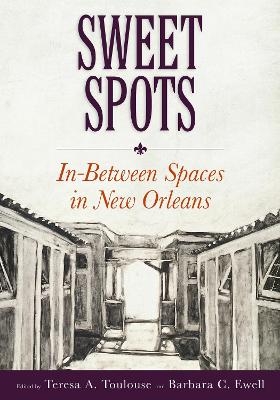
Sweet Spots
In-Between Spaces in New Orleans
Seiten
2018
University Press of Mississippi (Verlag)
978-1-4968-1702-0 (ISBN)
University Press of Mississippi (Verlag)
978-1-4968-1702-0 (ISBN)
Much has been written about New Orleans's distinctive architecture and urban fabric, as well as the city's art, literature, and music. There is, however, little discussion connecting these features. Sweet Spots provides multiple connections between the city's spaces, its complex culture, and its future.
Contributions by Carrie Bernhard, Scott Bernhard, Marilyn R. Brown, Richard Campanella, John P. Clark, Joel Dinerstein, Pableaux Johnson, John P. Klingman, Angel Adams Parham, Bruce Boyd Raeburn, Ruth Salvaggio, Christopher Schaberg, Teresa A. Toulouse, and Beth Willinger
Much has been written about New Orleans's distinctive architecture and urban fabric, as well as the city's art, literature, and music. There is, however, little discussion connecting these features. Sweet Spots--a title drawn from jazz musicians' name for the space ""in-between"" performers and dancers where music best resonates--provides multiple connections between the city's spaces, its complex culture, and its future.
Drawing on the late Tulane architect Malcolm Heard's ideas about ""interstitial"" spaces, this collection examines how a variety of literal and represented ""in-between"" spaces in New Orleans have addressed race, class, gender, community, and environment. As scholars of architecture, art, African American studies, English, history, jazz, philosophy, and sociology, the authors incorporate materials from architectural history and practice, literary texts, paintings, drawings, music, dance, and even statistical analyses. Interstitial space refers not only to functional elements inside and outside of many New Orleans houses--high ceilings, hidden staircases, galleries, and courtyards--but also to compelling spatial relations between the city's houses, streets, and neighborhoods.
Rich with visual materials, Sweet Spots reveals the ways that diverse New Orleans spaces take on meanings and accrete stories that promote certain consequences both for those who live in them and for those who read such stories. The volume evokes, preserves, criticizes, and amends understanding of a powerful and often-missed feature of New Orleans's elusive reality.
Contributions by Carrie Bernhard, Scott Bernhard, Marilyn R. Brown, Richard Campanella, John P. Clark, Joel Dinerstein, Pableaux Johnson, John P. Klingman, Angel Adams Parham, Bruce Boyd Raeburn, Ruth Salvaggio, Christopher Schaberg, Teresa A. Toulouse, and Beth Willinger
Much has been written about New Orleans's distinctive architecture and urban fabric, as well as the city's art, literature, and music. There is, however, little discussion connecting these features. Sweet Spots--a title drawn from jazz musicians' name for the space ""in-between"" performers and dancers where music best resonates--provides multiple connections between the city's spaces, its complex culture, and its future.
Drawing on the late Tulane architect Malcolm Heard's ideas about ""interstitial"" spaces, this collection examines how a variety of literal and represented ""in-between"" spaces in New Orleans have addressed race, class, gender, community, and environment. As scholars of architecture, art, African American studies, English, history, jazz, philosophy, and sociology, the authors incorporate materials from architectural history and practice, literary texts, paintings, drawings, music, dance, and even statistical analyses. Interstitial space refers not only to functional elements inside and outside of many New Orleans houses--high ceilings, hidden staircases, galleries, and courtyards--but also to compelling spatial relations between the city's houses, streets, and neighborhoods.
Rich with visual materials, Sweet Spots reveals the ways that diverse New Orleans spaces take on meanings and accrete stories that promote certain consequences both for those who live in them and for those who read such stories. The volume evokes, preserves, criticizes, and amends understanding of a powerful and often-missed feature of New Orleans's elusive reality.
Teresa A. Toulouse, Boulder, Colorado, is professor of English at University of Colorado, Boulder, previously serving as long-time professor of English and director of the American Studies Department at Tulane University in New Orleans. Barbara C. Ewell, New Orleans, Louisiana, is former Dorothy Brown Distinguished Professor of English at Loyola University, New Orleans, where she taught for three decades.
| Erscheinungsdatum | 17.07.2018 |
|---|---|
| Verlagsort | Jackson |
| Sprache | englisch |
| Maße | 182 x 259 mm |
| Gewicht | 978 g |
| Themenwelt | Geisteswissenschaften ► Geschichte ► Regional- / Ländergeschichte |
| Sozialwissenschaften ► Soziologie ► Empirische Sozialforschung | |
| Technik ► Architektur | |
| ISBN-10 | 1-4968-1702-8 / 1496817028 |
| ISBN-13 | 978-1-4968-1702-0 / 9781496817020 |
| Zustand | Neuware |
| Informationen gemäß Produktsicherheitsverordnung (GPSR) | |
| Haben Sie eine Frage zum Produkt? |
Mehr entdecken
aus dem Bereich


aus dem Bereich
die Geschichte meiner Urgroßmutter
Buch | Hardcover (2025)
C.H.Beck (Verlag)
CHF 32,15
Träume und Macht : eine Biografie
Buch | Hardcover (2025)
C.H.Beck (Verlag)
CHF 61,60


