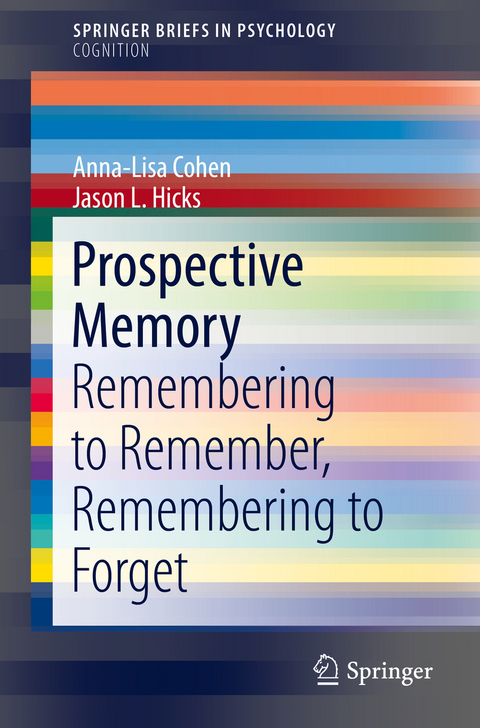
Prospective Memory (eBook)
XI, 106 Seiten
Springer International Publishing (Verlag)
9783319689906 (ISBN)
This Brief offers a comprehensive and up-to-date overview of the current developments in the field of prospective memory, or memory for delayed intentions. It explores several key areas in prospective memory research, including computational modeling, neuroscience and prospective memory, output monitoring, and implementation intentions. It seeks to increase understanding of prospective memory as well as offer the latest and most compelling findings in the field.
Prospective memory, or the act of remembering to carry out a previously formed intention, requires the processes of encoding, storage, and delayed retrieval of intended actions. Chapters in this Brief discuss the implementation and execution of intended actions, as well as the conditions in which they can fail. In addition, chapters also include reviews of the current state of the neuroscience of prospective memory as well as developments in statistical modeling. Laboratory research in the field of prospective memory began in the late 1980s and since then, the number of studies has increased exponentially. This Brief provides timely and relevant information in a field that is ever expanding and growing.
This Brief is an informative resource for researchers and undergraduate and graduate students in the field of psychology, cognitive psychology, and neuroscience.
Anna-Lisa Cohen is an Associate Professor of Psychology at Yeshiva University in New York, New York. Her research is guided by an interest in the influence that future goals and intentions have on behavior. She earned her Ph.D. in Psychology from the University of Victoria, Canada. Her research informs the development of theoretical orientations for understanding the cognitive processes that support prospective memory. For example, her research on the intention interference effect shows that cues related to a delayed intention are difficult to ignore when encountered in an unexpected context and this is true for both young and older adults. An enduring theme in much of her research is the flexibility with which participants are able to engage and disengage monitoring processes depending on the nature of task demands.Jason L. Hicks is a Professor of Psychology at Louisiana State University in Baton Rouge, Louisiana. In 1998 he earned his Ph.D. in Cognitive/Experimental Psychology from the University of Georgia. His research interests include source memory, recognition memory, false memory, and prospective memory (PM). He has published over 30 articles or book chapters on PM. His work focuses on encoding, retrieval, and contextual factors that predict successful intention retrieval. Perhaps the most programmatic contribution in this area is a specification of the cognitive resources demanded by prospective memory retrieval. His early work highlighted the degrees to which prospective memory retrieval requires executive resources, but more recent work demonstrates that people can flexibly allocate attention depending on their appreciation of the demands governing anticipated retrieval contexts.
Chapter 1. Introduction.- Chapter 2. The Cognitive Neuroscience of Prospective Memory.- Chapter 3. Computational Investigations of Prospective Memory.- Chapter 4. Output Monitoring of Intention Execution.- Chapter 5. Implementation Intentions.- Chapter 6. Conclusion and Future Directions.
| Erscheint lt. Verlag | 17.11.2017 |
|---|---|
| Reihe/Serie | SpringerBriefs in Cognition |
| SpringerBriefs in Cognition | |
| SpringerBriefs in Cognition | |
| SpringerBriefs in Psychology | SpringerBriefs in Psychology |
| Zusatzinfo | XI, 106 p. 16 illus., 6 illus. in color. |
| Verlagsort | Cham |
| Sprache | englisch |
| Themenwelt | Geisteswissenschaften ► Psychologie |
| Schlagworte | Commission Errors • Computational Modelling • Delayed Actions • Delayed Intentions • False Memory • Future Oriented Intentions • Implementation Intentions • Neuroscience • Output Monitoring • Prospective Memory |
| ISBN-13 | 9783319689906 / 9783319689906 |
| Informationen gemäß Produktsicherheitsverordnung (GPSR) | |
| Haben Sie eine Frage zum Produkt? |
 PDF (Wasserzeichen)
DRM: Digitales Wasserzeichen
Dieses eBook enthält ein digitales Wasserzeichen und ist damit für Sie personalisiert. Bei einer missbräuchlichen Weitergabe des eBooks an Dritte ist eine Rückverfolgung an die Quelle möglich.
Dateiformat: PDF (Portable Document Format)
Mit einem festen Seitenlayout eignet sich die PDF besonders für Fachbücher mit Spalten, Tabellen und Abbildungen. Eine PDF kann auf fast allen Geräten angezeigt werden, ist aber für kleine Displays (Smartphone, eReader) nur eingeschränkt geeignet.
Systemvoraussetzungen:
PC/Mac: Mit einem PC oder Mac können Sie dieses eBook lesen. Sie benötigen dafür einen PDF-Viewer - z.B. den Adobe Reader oder Adobe Digital Editions.
eReader: Dieses eBook kann mit (fast) allen eBook-Readern gelesen werden. Mit dem amazon-Kindle ist es aber nicht kompatibel.
Smartphone/Tablet: Egal ob Apple oder Android, dieses eBook können Sie lesen. Sie benötigen dafür einen PDF-Viewer - z.B. die kostenlose Adobe Digital Editions-App.
Buying eBooks from abroad
For tax law reasons we can sell eBooks just within Germany and Switzerland. Regrettably we cannot fulfill eBook-orders from other countries.
aus dem Bereich