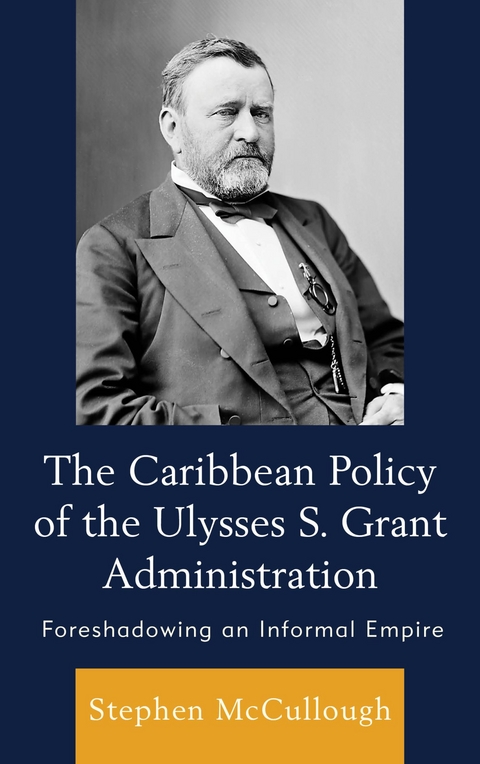
Caribbean Policy of the Ulysses S. Grant Administration (eBook)
230 Seiten
Lexington Books (Verlag)
978-1-4985-0013-5 (ISBN)
From 1869 to 1877, the United States found itself deeply involved in the Caribbean as Washington sought to replace European influence and colonialism with an informal American empire. The Ulysses S. Grant administration primarily dealt with an uprising in Spanish Cuba known as the Ten Years' War that threatened to draw in the United States. The Cuban rebels used the United States as a base of support, causing conflict between Washington and Madrid. Many Americans, including Grant, wanted to replace Spanish rule in Cuba with a U.S. protectorate, but Secretary of State Hamilton Fish opposed American colonial entanglements. President Grant looked to expand U.S. interests in the Caribbean. He looked to acquire colonies to provide naval bases to protect the trade routes to a potential American built and controlled canal in Central America.Fish preferred to expand U.S. commercial interests in the region rather than acquiring colonies. At no time was he prepared to obligate the United States to any long-term commitments. He wanted to end the war in Cuba because it hurt U.S. economic interests. He had no desire to acquire territory, but expected the Caribbean to fall into the U.S. economic sphere. Despite his personal opposition to territorial acquisition in Fish went along with Grant's Dominican annexation project because he foresaw it as a chance to end European imperialism and to gain the president's confidence. The Senate's failure to approve the Dominican annexation only hardened his opposition to the creation of an American empire. He rejected Haitian offers of a naval base within that country, and he continually sought an end to the Cuban rebellion, lest it drag in the United States. Though the administration's many peace initiatives failed, it forestalled Congressional intervention and kept the United States neutral in the conflict.
Stephen McCullough is associate professor of history at Bryant University Zhuhai.
Chapter 1: A Failing Peace Effort: The US Mediation Offer of 1869Chapter 2: The South and the Cuban WarChapter 3: Thorny IssuesChapter 4: “A Most Painful Affair”: The Santo Domingo FiascoChapter 5: “A Ripe Orange”: American Relations with HaitiChapter 6: Neutrality ProclamationChapter 7: Turbulent Years: 1870–1873Chapter 8: The Virginius
| Zusatzinfo | 3 Illustrations including: - 2 Halftones, Black & White including Black & White Photographs; - 1 Maps. |
|---|---|
| Sprache | englisch |
| Themenwelt | Literatur ► Klassiker / Moderne Klassiker |
| Geschichte ► Allgemeine Geschichte ► Neuzeit (bis 1918) | |
| Geisteswissenschaften ► Geschichte ► Regional- / Ländergeschichte | |
| Schlagworte | American imperialism • Grant administration • Grant presidency • Hamilton Fish • reconstruction • Spain and Cuba • Ten Years' War • Ulysses S. Grant • US-Cuba relations • US diplomatic history • US imperialism • Virginius |
| ISBN-10 | 1-4985-0013-7 / 1498500137 |
| ISBN-13 | 978-1-4985-0013-5 / 9781498500135 |
| Informationen gemäß Produktsicherheitsverordnung (GPSR) | |
| Haben Sie eine Frage zum Produkt? |
 EPUB (Adobe DRM)
Kopierschutz: Adobe-DRM
Adobe-DRM ist ein Kopierschutz, der das eBook vor Mißbrauch schützen soll. Dabei wird das eBook bereits beim Download auf Ihre persönliche Adobe-ID autorisiert. Lesen können Sie das eBook dann nur auf den Geräten, welche ebenfalls auf Ihre Adobe-ID registriert sind.
Details zum Adobe-DRM
Dateiformat: EPUB (Electronic Publication)
EPUB ist ein offener Standard für eBooks und eignet sich besonders zur Darstellung von Belletristik und Sachbüchern. Der Fließtext wird dynamisch an die Display- und Schriftgröße angepasst. Auch für mobile Lesegeräte ist EPUB daher gut geeignet.
Systemvoraussetzungen:
PC/Mac: Mit einem PC oder Mac können Sie dieses eBook lesen. Sie benötigen eine
eReader: Dieses eBook kann mit (fast) allen eBook-Readern gelesen werden. Mit dem amazon-Kindle ist es aber nicht kompatibel.
Smartphone/Tablet: Egal ob Apple oder Android, dieses eBook können Sie lesen. Sie benötigen eine
Geräteliste und zusätzliche Hinweise
Buying eBooks from abroad
For tax law reasons we can sell eBooks just within Germany and Switzerland. Regrettably we cannot fulfill eBook-orders from other countries.
aus dem Bereich