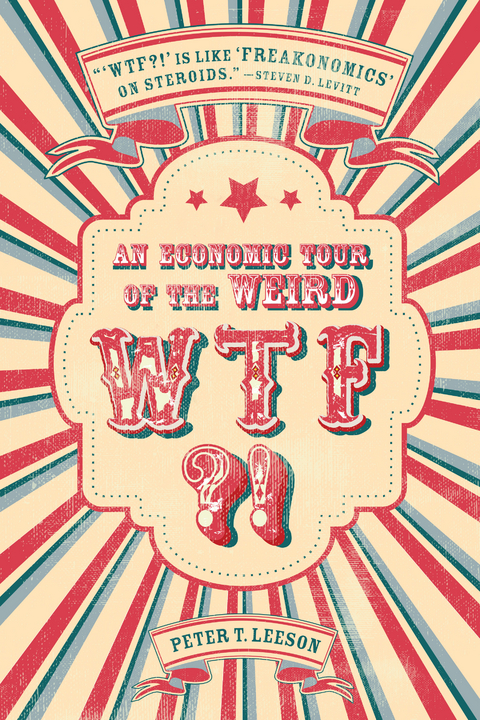
WTF?! (eBook)
264 Seiten
Stanford University Press (Verlag)
978-1-5036-0449-0 (ISBN)

"e;The most interesting book I have read in years. . . . WTF?! is like Freakonomics on steroids."e; -Steven D. Levitt, New York Times-bestselling coauthor of Freakonomics Did you know that "e;pre-owned"e; wives were sold at auction in nineteenth-century England? That today, in Liberia, accused criminals sometimes drink poison to determine their fate? How about the fact that, for 250 years, Italy criminally prosecuted cockroaches and crickets? Do you wonder why? Then this book is for you! Introducing us to a cast of colorful characters, economist Peter T. Leeson explains how to use economic thinking to reveal the hidden sense behind seemingly senseless human behavior including your own. Leeson shows that far from "e;irrational"e; or "e;accidents of history,"e; humanity's most outlandish rituals are ingenious solutions to pressing problems developed by clever people, driven by incentives, and tailor-made for their time and place. "e;A fascinating tour of some of the world's strangest customs and behaviors, led by a brilliant, funny, and eccentric tour guide dedicated to the proposition that no matter how strange it looks, there's always a reason for it and a lesson to be learned by discovering that reason."e; Steven E. Landsburg, author of The Armchair Economist
Peter T. Leeson is the Duncan Black Professor of Economics and Law at George Mason University. He is the author of the award-winning The Invisible Hook: The Hidden Economics of Pirates (2009) and Anarchy Unbound: Why Self-Governance Works Better Than You Think (2014). He can be reached via his website peterleeson.com.
Contents and Abstracts1Your Favorite Acronym chapter abstractThis chapter introduces the concepts of rational choice theory: incentives, rules, and constraints. It defines them and explains the connections between them, drawing on examples from everyday life. These concepts are identified as the key to finding the sense in seemingly senseless social practices.2Burn, Baby, Burn chapter abstractThis chapter uses the economic way of thinking to understand judicial ordeals—trials by fire and water—in medieval Europe. It explains how judges leveraged citizens' superstition through ordeals to find fact in criminal cases. This enabled judges to accurately determine defendants' guilt or innocence where "ordinary" evidence was absent.3FSBO: Like-New, Preowned Wife chapter abstractThis chapter uses the economic way of thinking to understand the sale of wives at public auctions in Industrial Revolution England. It explains how unhappy wives used wife sales to exit marriage where the law effectively gave husbands the right to their wives' marital status and denied wives property rights. This enabled spouses to forge Coasean divorce bargains indirectly when they couldn't do so directly.4Public Uses for Private Parts chapter abstractThis chapter uses the economic way of thinking to understand Vlax Gypsy superstitions: belief in ritual pollution, belief that pollution is contagious, and belief that non-Gypsies are dangerously polluted. It explains how Gypsies use these superstitions to support social ostracism as a means of governing their societies. This enables Gypsies to secure public order in their communities despite their inability to rely on government or ostracism alone for this purpose.5God Damn chapter abstractThis chapter uses the economic way of thinking to understand monastic maledictions—divine curses—in tenth- through twelfth-century Francia. It explains how clerics used maledictions to protect their communities' property rights against plunder. This enabled clerics to secure their property rights despite government's absence and their inability to rely on physical self-help for this purpose.6Chicken, Please; Hold the Poison chapter abstractThis chapter uses the economic way of thinking to understand oracles among the Azande people of Africa. It explains how the Azande leveraged their superstition through a poisoned-chicken oracle—benge—to peacefully resolve petty conflicts with their neighbors. This enabled the Azande to address cooperation-threatening animus that couldn't be addressed through formal legal institutions.7Jiminy Cricket's Journey to Hell chapter abstractThis chapter uses the economic way of thinking to understand the criminal prosecution of insects and rodents by ecclesiastic courts in Renaissance France, Italy, and Switzerland. It explains how ecclesiastics used vermin trials to bolster citizens' waning belief in the validity of ecclesiastics' supernatural sanctions. This enabled ecclesiastics to improve tithe compliance where heretics threatened their tithe revenue.8Fighting Solves Everything chapter abstractThis chapter uses the economic way of thinking to understand trial by battle in land disputes in Norman England. It explains how judges used judicial combats as "violent auctions" to allocate contested property rights to the litigants who valued them more when judges were unable to identify those rights' true owners. This enabled judges to efficiently allocate contested property rights where a high cost of trading land prevented the Coase theorem from doing so.
| Erscheint lt. Verlag | 17.10.2017 |
|---|---|
| Zusatzinfo | 1 figure, 9 halftones, 1 table, 1 map |
| Sprache | englisch |
| Themenwelt | Geschichte ► Teilgebiete der Geschichte ► Wirtschaftsgeschichte |
| Sozialwissenschaften ► Ethnologie ► Volkskunde | |
| Sozialwissenschaften ► Soziologie | |
| Wirtschaft ► Volkswirtschaftslehre ► Mikroökonomie | |
| Schlagworte | Economics • Gypsies • maledictions • Oracles • ordeals • Rituals • Superstition • trial by battle • vermin trials • wife sales |
| ISBN-10 | 1-5036-0449-7 / 1503604497 |
| ISBN-13 | 978-1-5036-0449-0 / 9781503604490 |
| Informationen gemäß Produktsicherheitsverordnung (GPSR) | |
| Haben Sie eine Frage zum Produkt? |
 EPUB (Adobe DRM)
Kopierschutz: Adobe-DRM
Adobe-DRM ist ein Kopierschutz, der das eBook vor Mißbrauch schützen soll. Dabei wird das eBook bereits beim Download auf Ihre persönliche Adobe-ID autorisiert. Lesen können Sie das eBook dann nur auf den Geräten, welche ebenfalls auf Ihre Adobe-ID registriert sind.
Details zum Adobe-DRM
Dateiformat: EPUB (Electronic Publication)
EPUB ist ein offener Standard für eBooks und eignet sich besonders zur Darstellung von Belletristik und Sachbüchern. Der Fließtext wird dynamisch an die Display- und Schriftgröße angepasst. Auch für mobile Lesegeräte ist EPUB daher gut geeignet.
Systemvoraussetzungen:
PC/Mac: Mit einem PC oder Mac können Sie dieses eBook lesen. Sie benötigen eine
eReader: Dieses eBook kann mit (fast) allen eBook-Readern gelesen werden. Mit dem amazon-Kindle ist es aber nicht kompatibel.
Smartphone/Tablet: Egal ob Apple oder Android, dieses eBook können Sie lesen. Sie benötigen eine
Geräteliste und zusätzliche Hinweise
Buying eBooks from abroad
For tax law reasons we can sell eBooks just within Germany and Switzerland. Regrettably we cannot fulfill eBook-orders from other countries.
aus dem Bereich