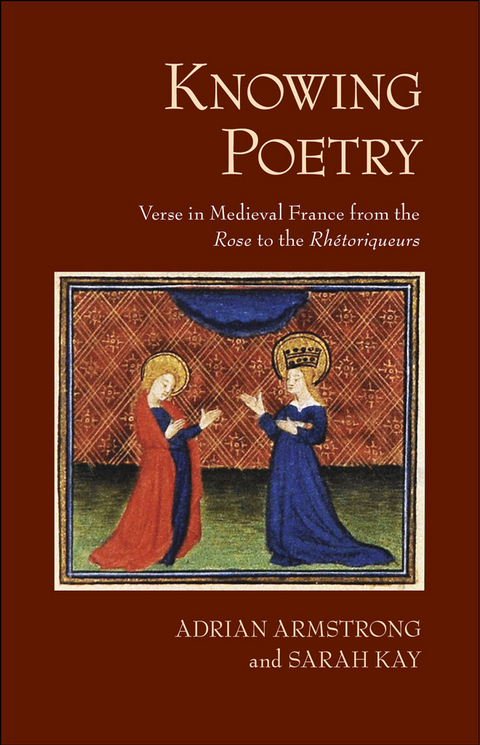
Knowing Poetry (eBook)
264 Seiten
Cornell University Press (Verlag)
978-0-8014-6106-4 (ISBN)
Exploring how verse was used to transmit and shape philosophical, historical, and other forms of knowledge in France in the later Middle Ages.
In the later Middle Ages, many writers claimed that prose is superior to verse as a vehicle of knowledge because it presents the truth in an unvarnished form, without the distortions of meter and rhyme. Beginning in the thirteenth century, works of verse narrative from the early Middle Ages were recast in prose, as if prose had become the literary norm. Instead of dying out, however, verse took on new vitality. In France verse texts were produced, in both French and Occitan, with the explicit intention of transmitting encyclopedic, political, philosophical, moral, historical, and other forms of knowledge.
In Knowing Poetry, Adrian Armstrong and Sarah Kay explore why and how verse continued to be used to transmit and shape knowledge in France. They cover the period between Jean de Meun's Roman de la rose (c. 1270) and the major work of Jean Bouchet, the last of the grands rhétoriqueurs (c. 1530). The authors find that the advent of prose led to a new relationship between poetry and knowledge in which poetry serves as a medium for serious reflection and self-reflection on subjectivity, embodiment, and time. They propose that three major works—the Roman de la rose, the Ovide moralisé, and Boethius' Consolation of Philosophy—form a single influential matrix linking poetry and intellectual inquiry, metaphysical insights, and eroticized knowledge. The trio of thought-world-contingency, poetically represented by Philosophy, Nature, and Fortune, grounds poetic exploration of reality, poetry, and community.
In the later Middle Ages, many writers claimed that prose is superior to verse as a vehicle of knowledge because it presents the truth in an unvarnished form, without the distortions of meter and rhyme. Beginning in the thirteenth century, works of verse narrative from the early Middle Ages were recast in prose, as if prose had become the literary norm. Instead of dying out, however, verse took on new vitality. In France verse texts were produced, in both French and Occitan, with the explicit intention of transmitting encyclopedic, political, philosophical, moral, historical, and other forms of knowledge.
In Knowing Poetry, Adrian Armstrong and Sarah Kay explore why and how verse continued to be used to transmit and shape knowledge in France. They cover the period between Jean de Meun's Roman de la rose (c. 1270) and the major work of Jean Bouchet, the last of the grands rhétoriqueurs (c. 1530). The authors find that the advent of prose led to a new relationship between poetry and knowledge in which poetry serves as a medium for serious reflection and self-reflection on subjectivity, embodiment, and time. They propose that three major works—the Roman de la rose, the Ovide moralisé, and Boethius' Consolation of Philosophy—form a single influential matrix linking poetry and intellectual inquiry, metaphysical insights, and eroticized knowledge. The trio of thought-world-contingency, poetically represented by Philosophy, Nature, and Fortune, grounds poetic exploration of reality, poetry, and community.
Adrian Armstrong is Professor of Early French Culture at The University of Manchester, the author of Technique and Technology: Script, Print, and Poetics in France 1470–1550, and the editor of several late medieval texts including Vol. 1 of the Œuvres complètes of Jean Bouchet. Sarah Kay is Professor of French at Princeton University, the author of several monographs on medieval French literature, including Courtly Contradictions and The Place of Thought, coauthor of A Short History of French Literature and Thinking Through Chrétien de Troyes, and coeditor of various volumes, most recently The Cambridge Companion to Medieval French Literature.
IntroductionPart I. Situating Knowledge
1. Persistent Presence: Verse after Prose
2. Poetry and History
3. Poetry and ThoughtPart II. Transmitting and Shaping Knowledge
4. Knowing the World in Verse Encyclopedias and Encyclopedic Verse
5. Knowledge and the Practice of Poetry
6. Textual Communities: Poetry and the Social Construction of KnowledgeConclusionBibliography
Index
| Erscheint lt. Verlag | 15.5.2011 |
|---|---|
| Verlagsort | Ithaca |
| Sprache | englisch |
| Maße | 160 x 160 mm |
| Themenwelt | Literatur ► Essays / Feuilleton |
| Sachbuch/Ratgeber ► Geschichte / Politik ► Mittelalter | |
| Geschichte ► Allgemeine Geschichte ► Mittelalter | |
| Geisteswissenschaften ► Sprach- / Literaturwissenschaft ► Anglistik / Amerikanistik | |
| Geisteswissenschaften ► Sprach- / Literaturwissenschaft ► Literaturwissenschaft | |
| Schlagworte | prose, prose vs verse, poetry and knowledge, poetry as a medium for self-reflection, Roman de la rose, poetry and intellectual inquiry, philosophy |
| ISBN-10 | 0-8014-6106-5 / 0801461065 |
| ISBN-13 | 978-0-8014-6106-4 / 9780801461064 |
| Informationen gemäß Produktsicherheitsverordnung (GPSR) | |
| Haben Sie eine Frage zum Produkt? |
 EPUB (Adobe DRM)
Kopierschutz: Adobe-DRM
Adobe-DRM ist ein Kopierschutz, der das eBook vor Mißbrauch schützen soll. Dabei wird das eBook bereits beim Download auf Ihre persönliche Adobe-ID autorisiert. Lesen können Sie das eBook dann nur auf den Geräten, welche ebenfalls auf Ihre Adobe-ID registriert sind.
Details zum Adobe-DRM
Dateiformat: EPUB (Electronic Publication)
EPUB ist ein offener Standard für eBooks und eignet sich besonders zur Darstellung von Belletristik und Sachbüchern. Der Fließtext wird dynamisch an die Display- und Schriftgröße angepasst. Auch für mobile Lesegeräte ist EPUB daher gut geeignet.
Systemvoraussetzungen:
PC/Mac: Mit einem PC oder Mac können Sie dieses eBook lesen. Sie benötigen eine
eReader: Dieses eBook kann mit (fast) allen eBook-Readern gelesen werden. Mit dem amazon-Kindle ist es aber nicht kompatibel.
Smartphone/Tablet: Egal ob Apple oder Android, dieses eBook können Sie lesen. Sie benötigen eine
Geräteliste und zusätzliche Hinweise
Buying eBooks from abroad
For tax law reasons we can sell eBooks just within Germany and Switzerland. Regrettably we cannot fulfill eBook-orders from other countries.
aus dem Bereich