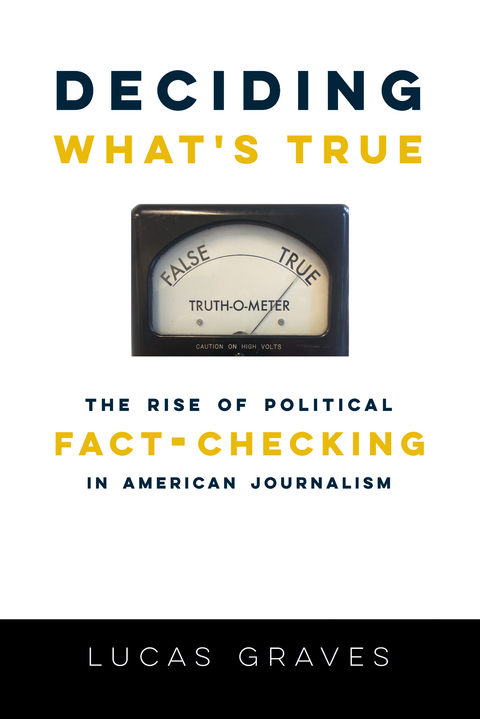
Deciding What’s True (eBook)
Columbia University Press (Verlag)
978-0-231-54222-7 (ISBN)
Over the past decade, American outlets such as PolitiFact, FactCheck.org, and the Washington Post's Fact Checker have shaken up the political world by holding public figures accountable for what they say. Cited across social and national news media, these verdicts can rattle a political campaign and send the White House press corps scrambling. Yet fact-checking is a fraught kind of journalism, one that challenges reporters' traditional roles as objective observers and places them at the center of white-hot, real-time debates. As these journalists are the first to admit, in a hyperpartisan world, facts can easily slip into fiction, and decisions about which claims to investigate and how to judge them are frequently denounced as unfair play. Deciding What's True draws on Lucas Graves's unique access to the members of the newsrooms leading this movement. Graves vividly recounts the routines of journalists at three of these hyperconnected, technologically innovative organizations and what informs their approach to a story. Graves also plots a compelling, personality-driven history of the fact-checking movement and its recent evolution from the blogosphere, reflecting on its revolutionary remaking of journalistic ethics and practice. His book demonstrates the ways these rising organizations depend on professional networks and media partnerships yet have also made inroads with the academic and philanthropic worlds. These networks have become a vital source of influence as fact-checking spreads around the world.
Lucas Graves is an assistant professor at the School of Journalism and Mass Communication at the University of Wisconsin. He is the coauthor of The Story So Far: What We Know About the Business of Digital Journalism (Columbia, 2011), and his writing has appeared in the Columbia Journalism Review, Wired, the New York Times, and other publications.
AcknowledgmentsPart I. The Landscape of Fact-CheckingIntroduction1. Ink-Stained Fact-Checkers2. Objectivity, Truth Seeking, and Institutional FactsPart II. The Work of Fact-Checking3. Choosing Facts to Check4. Deciding What's True5. Operating the Truth-O-MeterPart III. The Effects of Fact-Checking6. Fact-Checkers and Their Publics7. The Limits of Fact-CheckingEpilogueNotesSelected BibliographyIndex
| Erscheint lt. Verlag | 6.9.2016 |
|---|---|
| Verlagsort | New York |
| Sprache | englisch |
| Themenwelt | Geisteswissenschaften ► Sprach- / Literaturwissenschaft ► Literaturwissenschaft |
| Sozialwissenschaften ► Kommunikation / Medien ► Journalistik | |
| Sozialwissenschaften ► Politik / Verwaltung ► Staat / Verwaltung | |
| ISBN-10 | 0-231-54222-4 / 0231542224 |
| ISBN-13 | 978-0-231-54222-7 / 9780231542227 |
| Informationen gemäß Produktsicherheitsverordnung (GPSR) | |
| Haben Sie eine Frage zum Produkt? |
 EPUB (Adobe DRM)
Kopierschutz: Adobe-DRM
Adobe-DRM ist ein Kopierschutz, der das eBook vor Mißbrauch schützen soll. Dabei wird das eBook bereits beim Download auf Ihre persönliche Adobe-ID autorisiert. Lesen können Sie das eBook dann nur auf den Geräten, welche ebenfalls auf Ihre Adobe-ID registriert sind.
Details zum Adobe-DRM
Dateiformat: EPUB (Electronic Publication)
EPUB ist ein offener Standard für eBooks und eignet sich besonders zur Darstellung von Belletristik und Sachbüchern. Der Fließtext wird dynamisch an die Display- und Schriftgröße angepasst. Auch für mobile Lesegeräte ist EPUB daher gut geeignet.
Systemvoraussetzungen:
PC/Mac: Mit einem PC oder Mac können Sie dieses eBook lesen. Sie benötigen eine
eReader: Dieses eBook kann mit (fast) allen eBook-Readern gelesen werden. Mit dem amazon-Kindle ist es aber nicht kompatibel.
Smartphone/Tablet: Egal ob Apple oder Android, dieses eBook können Sie lesen. Sie benötigen eine
Geräteliste und zusätzliche Hinweise
Buying eBooks from abroad
For tax law reasons we can sell eBooks just within Germany and Switzerland. Regrettably we cannot fulfill eBook-orders from other countries.
aus dem Bereich