


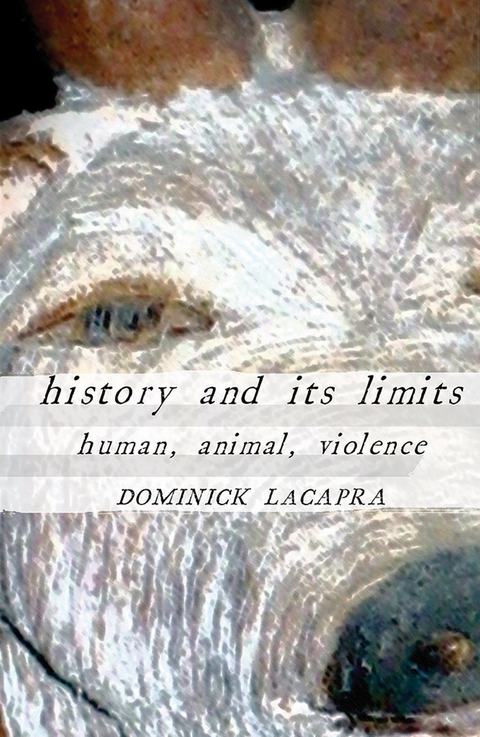
History and Its Limits (eBook)
248 Seiten
Cornell University Press (Verlag)
978-0-8014-5768-5 (ISBN)
Dominick LaCapra's History and Its Limits articulates the relations among intellectual history, cultural history, and critical theory, examining the recent rise of "Practice Theory" and probing the limitations of prevalent forms of humanism.
Dominick LaCapra's History and Its Limits articulates the relations among intellectual history, cultural history, and critical theory, examining the recent rise of "Practice Theory" and probing the limitations of prevalent forms of humanism. LaCapra focuses on the problem of understanding extreme cases, specifically events and experiences involving violence and victimization. He asks how historians treat and are simultaneously implicated in the traumatic processes they attempt to represent. In addressing these questions, he also investigates violence's impact on various types of writing and establishes a distinctive role for critical theory in the face of an insufficiently discriminating aesthetic of the sublime (often unreflectively amalgamated with the uncanny).In History and Its Limits, LaCapra inquires into the related phenomenon of a turn to the "postsecular," even the messianic or the miraculous, in recent theoretical discussions of extreme events by such prominent figures as Giorgio Agamben, Eric L. Santner, and Slavoj Zizek. In a related vein, he discusses Martin Heidegger's evocative, if not enchanting, understanding of "The Origin of the Work of Art." LaCapra subjects to critical scrutiny the sometimes internally divided way in which violence has been valorized in sacrificial, regenerative, or redemptive terms by a series of important modern intellectuals on both the far right and the far left, including Georges Sorel, the early Walter Benjamin, Georges Bataille, Frantz Fanon, and Ernst Jünger.Violence and victimization are prominent in the relation between the human and the animal. LaCapra questions prevalent anthropocentrism (evident even in theorists of the "posthuman") and the long-standing quest for a decisive criterion separating or dividing the human from the animal. LaCapra regards this attempt to fix the difference as misguided and potentially dangerous because it renders insufficiently problematic the manner in which humans treat other animals and interact with the environment.In raising the issue of desirable transformations in modernity, History and Its Limits examines the legitimacy of normative limits necessary for life in common and explores the disconcerting role of transgressive initiatives beyond limits (including limits blocking the recognition that humans are themselves animals).
Dominick LaCapra's History and Its Limits articulates the relations among intellectual history, cultural history, and critical theory, examining the recent rise of "Practice Theory" and probing the limitations of prevalent forms of humanism. LaCapra focuses on the problem of understanding extreme cases, specifically events and experiences involving violence and victimization. He asks how historians treat and are simultaneously implicated in the traumatic processes they attempt to represent. In addressing these questions, he also investigates violence's impact on various types of writing and establishes a distinctive role for critical theory in the face of an insufficiently discriminating aesthetic of the sublime (often unreflectively amalgamated with the uncanny).
In History and Its Limits, LaCapra inquires into the related phenomenon of a turn to the "postsecular," even the messianic or the miraculous, in recent theoretical discussions of extreme events by such prominent figures as Giorgio Agamben, Eric L. Santner, and Slavoj Zizek. In a related vein, he discusses Martin Heidegger's evocative, if not enchanting, understanding of "The Origin of the Work of Art." LaCapra subjects to critical scrutiny the sometimes internally divided way in which violence has been valorized in sacrificial, regenerative, or redemptive terms by a series of important modern intellectuals on both the far right and the far left, including Georges Sorel, the early Walter Benjamin, Georges Bataille, Frantz Fanon, and Ernst Jünger.
Violence and victimization are prominent in the relation between the human and the animal. LaCapra questions prevalent anthropocentrism (evident even in theorists of the "posthuman") and the long-standing quest for a decisive criterion separating or dividing the human from the animal. LaCapra regards this attempt to fix the difference as misguided and potentially dangerous because it renders insufficiently problematic the manner in which humans treat other animals and interact with the environment. In raising the issue of desirable transformations in modernity, History and Its Limits examines the legitimacy of normative limits necessary for life in common and explores the disconcerting role of transgressive initiatives beyond limits (including limits blocking the recognition that humans are themselves animals).
Dominick LaCapra is Bryce and Edith Bowmar Professor of Humanistic Studies and Professor of History and Comparative Literature at Cornell University. He is the author or editor of twelve other books published by Cornell, including History in Transit and History and Memory after Auschwitz.
Introduction1. Articulating Intellectual History, Cultural History, and Critical Theory2. Vicissitudes of Practice and Theory3. " Traumatropisms": From Trauma via Witnessing to the Sublime?/4. Toward a Critique of Violence5. Heidegger, Violence, and the Origin of the Work of Art6. Reopening the Question of the Human and the Animal7. Tropisms of Intellectual HistoryIndex
| Verlagsort | Ithaca |
|---|---|
| Sprache | englisch |
| Maße | 160 x 160 mm |
| Gewicht | 28 g |
| Themenwelt | Geisteswissenschaften ► Geschichte ► Geschichtstheorie / Historik |
| Geisteswissenschaften ► Philosophie ► Philosophie der Neuzeit | |
| Geisteswissenschaften ► Sprach- / Literaturwissenschaft ► Anglistik / Amerikanistik | |
| Geisteswissenschaften ► Sprach- / Literaturwissenschaft ► Literaturwissenschaft | |
| Schlagworte | violence and victimization, anthropocentrism, Practice Theory, violence effect on history, how humans treat animals, humanism • violence and victimization, anthropocentrism, Practice Theory, violences effect on history |
| ISBN-10 | 0-8014-5768-8 / 0801457688 |
| ISBN-13 | 978-0-8014-5768-5 / 9780801457685 |
| Informationen gemäß Produktsicherheitsverordnung (GPSR) | |
| Haben Sie eine Frage zum Produkt? |
 EPUB (Adobe DRM)
Kopierschutz: Adobe-DRM
Adobe-DRM ist ein Kopierschutz, der das eBook vor Mißbrauch schützen soll. Dabei wird das eBook bereits beim Download auf Ihre persönliche Adobe-ID autorisiert. Lesen können Sie das eBook dann nur auf den Geräten, welche ebenfalls auf Ihre Adobe-ID registriert sind.
Details zum Adobe-DRM
Dateiformat: EPUB (Electronic Publication)
EPUB ist ein offener Standard für eBooks und eignet sich besonders zur Darstellung von Belletristik und Sachbüchern. Der Fließtext wird dynamisch an die Display- und Schriftgröße angepasst. Auch für mobile Lesegeräte ist EPUB daher gut geeignet.
Systemvoraussetzungen:
PC/Mac: Mit einem PC oder Mac können Sie dieses eBook lesen. Sie benötigen eine
eReader: Dieses eBook kann mit (fast) allen eBook-Readern gelesen werden. Mit dem amazon-Kindle ist es aber nicht kompatibel.
Smartphone/Tablet: Egal ob Apple oder Android, dieses eBook können Sie lesen. Sie benötigen eine
Geräteliste und zusätzliche Hinweise
Buying eBooks from abroad
For tax law reasons we can sell eBooks just within Germany and Switzerland. Regrettably we cannot fulfill eBook-orders from other countries.


