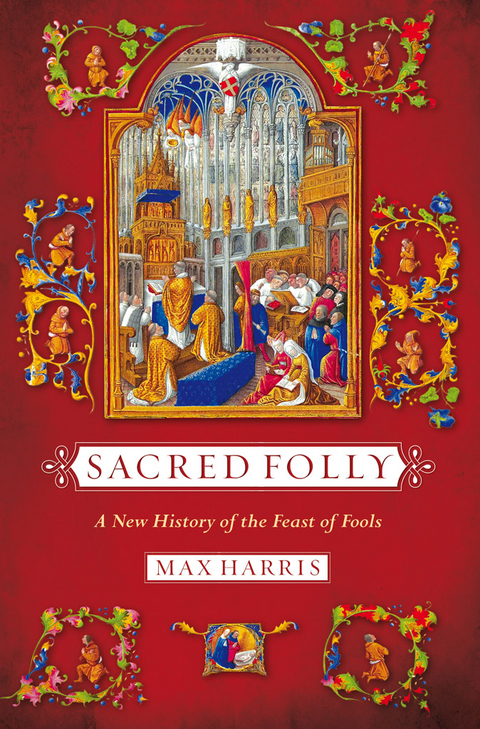
Sacred Folly (eBook)
336 Seiten
Cornell University Press (Verlag)
978-0-8014-6193-4 (ISBN)
The real history and meaning of the Feast of Fools—usually misunderstood as a sacrilegious festival.
For centuries, the Feast of Fools has been condemned and occasionally celebrated as a disorderly, even transgressive Christian festival, in which reveling clergy elected a burlesque Lord of Misrule, presided over the divine office wearing animal masks or women's clothes, sang obscene songs, swung censers that gave off foul-smelling smoke, played dice at the altar, and otherwise parodied the liturgy of the church. Afterward, they would take to the streets, howling, issuing mock indulgences, hurling manure at bystanders, and staging scurrilous plays. The problem with this popular account-intriguing as it may be-is that it is wrong. In Sacred Folly, Max Harris rewrites the history of the Feast of Fools, showing that it developed in the late twelfth and early thirteenth centuries as an elaborate and orderly liturgy for the day of the Circumcision (1 January)-serving as a dignified alternative to rowdy secular New Year festivities. The intent of the feast was not mockery but thanksgiving for the incarnation of Christ. Prescribed role reversals, in which the lower clergy presided over divine office, recalled Mary's joyous affirmation that God has put down the mighty from their seat and exalted the humble. The fools represented those chosen by God for their lowly status. The feast, never widespread, was largely confined to cathedrals and collegiate churches in northern France. In the fifteenth century, high-ranking clergy who relied on rumor rather than firsthand knowledge attacked and eventually suppressed the feast. Eighteenth- and nineteenth-century historians repeatedly misread records of the feast; their erroneous accounts formed a shaky foundation for subsequent understanding of the medieval ritual. By returning to the primary documents, Harris reconstructs a Feast of Fools that is all the more remarkable for being sanctified rather than sacrilegious.
Max Harris is Executive Director Emeritus of the Wisconsin Humanities Council, University of Wisconsin–Madison. He has also taught at Yale University and the University of Virginia. He is the author of four previous books, including Carnival and Other Christian Festivals: Folk Theology and Folk Performance and Aztecs, Moors, and Christians: Festivals of Reconquest in Mexico and Spain.
Prologue: A Letter from ParisPart I. Before the Feast of Fools
1. The Kalends of January
2. The Holy City of Byzantium
3. Roman Games
4. Herod in Germany
5. Tossing a Ball in a French CathedralPart II. Shaping the Feast of Fools
6. The Feast of the Subdeacons
7. The Feast of the Ass
8. The Complaints of Innocent III
9. The Office of the Circumcision
10. The Plays of Daniel and JosephPart III. Supporting the Feast of Fools
11. Chapter Support
12. Rumors of Disorder
13. A Spirited Defense
14. Youth Groups, Coal Dust, and Cow Dung
15. Outside FrancePart IV. Suppressing the Feast of Fools
16. Jean Gerson and the Auxerre Affair
17. Trouble in St.-Omer and Noyon
18. Troyes, Sens, and the Council of Basel
19. Rereading the Letter from Paris
20. A Durable FeastPart V. Beyond the Feast of Fools
21. Festive Societies
22. Innocents and Fools
23. King of the Breeches
24. Our Lady of the Trellis
25. Mother FoolEpilogue: Orange Peel in AntibesBibliography
Index
| Erscheint lt. Verlag | 2.5.2011 |
|---|---|
| Zusatzinfo | 1 map |
| Verlagsort | Ithaca |
| Sprache | englisch |
| Maße | 160 x 160 mm |
| Gewicht | 28 g |
| Themenwelt | Sachbuch/Ratgeber ► Geschichte / Politik ► Mittelalter |
| Geisteswissenschaften ► Archäologie | |
| Geschichte ► Allgemeine Geschichte ► Mittelalter | |
| Geisteswissenschaften ► Geschichte ► Regional- / Ländergeschichte | |
| Religion / Theologie ► Christentum ► Gebete / Lieder / Meditationen | |
| Religion / Theologie ► Christentum ► Kirchengeschichte | |
| Religion / Theologie ► Christentum ► Moraltheologie / Sozialethik | |
| Religion / Theologie ► Christentum ► Religionspädagogik / Katechetik | |
| Schlagworte | christian criticism, historical criticism, christian festival, history rewritten, historical inaccuracies, day of the circumcision, history of new years, new years, christianity |
| ISBN-10 | 0-8014-6193-6 / 0801461936 |
| ISBN-13 | 978-0-8014-6193-4 / 9780801461934 |
| Informationen gemäß Produktsicherheitsverordnung (GPSR) | |
| Haben Sie eine Frage zum Produkt? |
 EPUB (Adobe DRM)
Kopierschutz: Adobe-DRM
Adobe-DRM ist ein Kopierschutz, der das eBook vor Mißbrauch schützen soll. Dabei wird das eBook bereits beim Download auf Ihre persönliche Adobe-ID autorisiert. Lesen können Sie das eBook dann nur auf den Geräten, welche ebenfalls auf Ihre Adobe-ID registriert sind.
Details zum Adobe-DRM
Dateiformat: EPUB (Electronic Publication)
EPUB ist ein offener Standard für eBooks und eignet sich besonders zur Darstellung von Belletristik und Sachbüchern. Der Fließtext wird dynamisch an die Display- und Schriftgröße angepasst. Auch für mobile Lesegeräte ist EPUB daher gut geeignet.
Systemvoraussetzungen:
PC/Mac: Mit einem PC oder Mac können Sie dieses eBook lesen. Sie benötigen eine
eReader: Dieses eBook kann mit (fast) allen eBook-Readern gelesen werden. Mit dem amazon-Kindle ist es aber nicht kompatibel.
Smartphone/Tablet: Egal ob Apple oder Android, dieses eBook können Sie lesen. Sie benötigen eine
Geräteliste und zusätzliche Hinweise
Buying eBooks from abroad
For tax law reasons we can sell eBooks just within Germany and Switzerland. Regrettably we cannot fulfill eBook-orders from other countries.
aus dem Bereich