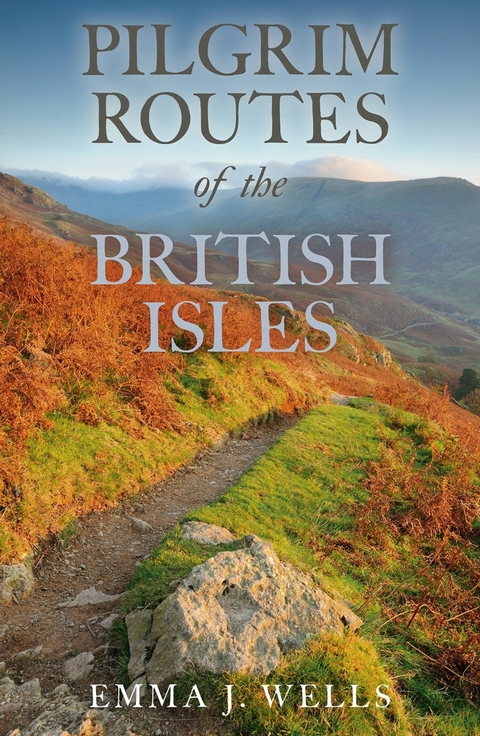
Pilgrim Routes of the British Isles (eBook)
341 Seiten
Crowood (Verlag)
978-0-7198-2049-6 (ISBN)
Emma Wells is an historian, archaeologist, author, broadcaster and award-winning academic. She has a PhD in Buildings Archaeology from the University of Durham and has been interviewed by the BBC as an expert on pilgrimage.
This book leads the modern traveller along some of the key medieval walking routes of England, Scotland and Wales, taking in world-famous sites such as Canterbury and Lindisfarne, and out-of-the-way places along paths not so widely travelled. Each route has easy-to-follow directions that guide walkers step by step on a journey of discovery. Illustrated throughout in colour, this practical book provides clear maps and informative commentary on the history of each route, as well as its current landscape, shrines, art and architecture, making this an ideal starting point for those looking for new places to visit. This book offers an understanding of the history, significance and practices surrounding the pilgrim routes and sites of Britain, helping us to follow in the footsteps of our forebears and gain invaluable insights into their medieval world.
Emma Wells is an historian, archaeologist, author, broadcaster and award-winning academic. She has a PhD in Buildings Archaeology from the University of Durham and has been interviewed by the BBC as an expert on pilgrimage.
Introduction: A History of Pilgrimage
Open a book and you’re a pilgrim at the gates of a new city.
Hebrew proverb
Throughout contemporary and medieval literature, the concept of ‘pilgrimage’ is thought to have acquired different meanings for different cultures, eras, levels of society and even religions. Accordingly, a precise definition of the term has often eluded scholars but, in essence, historical pilgrimage involved any journey undertaken for a specifically religious purpose and which involved an overnight stay at a pilgrimage centre, particularly the latter. Canon law defined it as a mandatory journey imposed as penance for wrongdoing, or a voluntary act which involved a preliminary vow – and both had to be undertaken in the appropriate manner, that is, carrying the pilgrim insignia of scrip and staff. Derived from the Latin peregrinatio, or wandering/travelling around, pilgrimage journeys thus usually have a specific underlying religious intention. On the other hand, the Middle English Dictionary attributes a wide range of meanings to the term ‘pilgrim’, from the Latin word peregrinus (per, through, and ager, field, country, land), including: a traveller to a holy place; a wayfarer; an alien/foreigner/stranger/sojourner/exile for the Christian faith; or man or soul as an alien, especially one whose home/destination is heaven.
Map showing location of all seven routes in Britain. JIM BRIGHTMAN
The zenith of pilgrimage to these blessed sites in Britain was from the mid to late Middle Ages. The acquisition of relics was vital to the income of a church, and it was believed that the possession of saintly relics increased a church’s spiritual authenticity. Parish churches, monasteries and cathedrals all vied for pilgrims’ custom with sacred relics or, failing that, a locally associated saint was very much an in-demand entity. People would travel far and wide just to get a glimpse of the shining beacons of their faith: the shrines of saints, due to their promises of hope and the ridding of sins. And in addition to an historical form of tourism – a sort of ‘been there, done that’ – it is this penitential hope, the quest for penance of one’s sins, that motivated most and forced some to direct others to go on their behalf both in life and, making suitable provision in their wills, also after death.
Many faiths still believe in pilgrimage as an act of penance or spiritual cleansing. Yet, although there is penitential motivation in subjecting the body to the rigours of the journey to rid oneself of past sin, Christianity required pilgrims to endeavour upon such journeys as a form of insurance in order to gain indulgences that would release them from time spent in Purgatory. It was, it could be argued, the desire to obtain indulgences that populated the idea of pilgrimages. Controlled by the medieval Western Church, indulgences were used to encourage visits to shrine sites, and ultimately led to the idea of ‘buying salvation’. Both popes and bishops granted indulgences, perhaps equally for the intentions of the pilgrim’s soul and for the prosperity of the shrine or associated site.
The rituals of venerating saints and following paths ‘in their footsteps’ is by no means a new phenomenon and rather has been practised for thousands upon thousands of years. And while pilgrimage was ubiquitous in the Anglo-Saxon and medieval periods in Britain, pilgrimage is still, to this day, a powerful and resonant act of worship. Many of the most visited and revered of these medieval shrines have faced a modern revival, with pilgrims creating their own paths to them loosely based on the ancient routes of the past. While some are attempting to evoke the experience of the Middle Ages, others are keen to uncover these routes and sites, some from a purely anthropological perspective, and some simply out of mere curiosity for our history and landscape.
The concept of physical travel to a sacred place for varying kinds of religious belief is not exclusive to Christianity. Journeying in search of enlightenment, salvation or hope was, and still is, a common practice of virtually every culture and faith. The majority have adopted an idea of pilgrimage, and for many it is, or has been, an important aspect of religious life. In Britain, pilgrimage began even before there were Christians! Prehistoric trackways are a ‘lore unto themselves’ and have shown the way to our ancestors for millennia. The chalky trails of the English Downs, for example, can still be traced and are still walked upon, continuing their existence as subtle landmarks, chains across our landscapes, ingrained with the mysticism of the past as they have been for so long. Muslims have also travelled to Mecca and Jews to Jerusalem: where even, as a boy, Jesus travelled with his family for the High Holy Days. In the 2,000 years since his crucifixion, Christians have been eager to follow in his footsteps.
The archetypal pilgrimage for Christians is to the Holy Land or simply Jerusalem, and it is this journeying to the places where Christ lived and died that began such tourism for faith. Since the second and third centuries CE, evidence survives of pilgrims’ desires to discover and learn about the biblical lands, and of their visiting both the holy sites associated with them and the Christians who lived there. However, it was the early fourth century that marked a major shift in Christian attitudes. When Emperor Constantine was converted to Christianity in 313CE, he brought with his new faith the concepts of sacred places and buildings derived from Roman and Greek pagan religion. This led to the construction of churches on the site of the ‘rediscovered’ tomb of Christ, on the Mount of Olives and in Bethlehem, which therefore became focuses for the Christian ‘Holy Land’. With them, a new sacred geography was born, enabling spiritual tourism through journeying.
At a similar time, particularly from the fourth century onwards, places were beginning to be viewed as inherently holy if they featured an association with the Trinity, or with a person whose closeness to God had given them a comparable holiness (either through martyrdom or the leading of an exemplary Christian life). The development of these saintly cults was crucial to the growth of place-orientated pilgrimage. The actual presence of the saint, through their existing relics or body, or their association with a particular place in life or death, drew pilgrims and helped to establish a new sacred geography across the whole of Christendom, as relics were transferred from one place to another and new local saints emerged. In essence, anywhere or anything that had been in contact with a saint or his shrine was instilled with a sacred quantity.
Unfortunately, it was this absence of any rational criteria for assessing the authenticity of relics that ultimately led to Reformation consternation towards them, as several churches laid claim to the same relic (a common occurrence) while others were accused of fraudulently substituting saintly bones for those of animals – think the Pardoner in Geoffrey Chaucer’s Prologue to the Canterbury Tales (c.1385–1400), who we are told is carrying among his relics a jar full of pig bones, and that with them, he is able to cheat a poor parson out of two months’ salary! The rapid expansion of pilgrimage seen in the fifteenth century largely encouraged these frauds and sat at the heart of the criticisms put forth throughout the sixteenth-century English Reformation and Break with Rome.
During the centuries when the Holy Lands were inaccessible or too dangerous to visit, many Christians sought out reproduction pilgrimage practices such as walking labyrinths in the grounds of cathedrals, journeying to European sites, or simply visiting shrines closer to home. The primary pilgrimage site in Europe was St Peter’s in Rome, the home of the earthly remains of the Apostle Peter. The second most visited contained the remains of the Apostle James at Santiago de Compostela in Spain, and it was his emblem of the scallop shell that became the universal attribute of the pilgrim. During the journey, this symbol played an important role in signifying that the wearer was a pilgrim, and granted them special protection. After their pilgrimage had been completed, the badges (which were often collected at each station or shrine site) became emblems of their faith and devotion, a relic of their transformation as well as proof of their journey – many would often be thrown in wells or hidden within the home in the hope of continuing their thaumaturgical powers.
England’s most famous site began as St Cuthbert’s shrine at Durham Cathedral (Cuthbert died on Lindisfarne in 687AD) but, following the martyrdom of Archbishop Thomas Becket in 1170 on the order of Henry II within the confines of Canterbury Cathedral, Durham was then eclipsed as thousands flocked to the city that housed the tomb and later the embellished shrine of the murdered holy man. The popularity of the site, which drew tens of thousands every year, was immortalized by Chaucer’s Canterbury Tales, the story of twenty-nine erstwhile pilgrims ostensibly seeking healing and transformation.
Evidence suggests that many journeys were actually very short (a few days, like Chaucer’s pilgrims took), and so long-haul pilgrimages were seen as the exception rather than the rule. However, many think of pilgrimage as involving tortuous and arduous journeys lasting months...
| Erscheint lt. Verlag | 31.12.2016 |
|---|---|
| Verlagsort | London |
| Sprache | englisch |
| Themenwelt | Geisteswissenschaften ► Geschichte ► Regional- / Ländergeschichte |
| Religion / Theologie ► Christentum ► Kirchengeschichte | |
| Religion / Theologie ► Christentum ► Liturgik / Homiletik | |
| Religion / Theologie ► Christentum ► Moraltheologie / Sozialethik | |
| Schlagworte | Canterbury • Our Lady of Caversham Pilgrimage Walk • St Andrew's Way • St Cuthbert's Way • The Canterbury tales • The North Wales Pilgrim's Way • The Pilgrim's Trail • The Pilgrim's Way • The Saint's Way |
| ISBN-10 | 0-7198-2049-9 / 0719820499 |
| ISBN-13 | 978-0-7198-2049-6 / 9780719820496 |
| Informationen gemäß Produktsicherheitsverordnung (GPSR) | |
| Haben Sie eine Frage zum Produkt? |
 EPUB (Adobe DRM)
Kopierschutz: Adobe-DRM
Adobe-DRM ist ein Kopierschutz, der das eBook vor Mißbrauch schützen soll. Dabei wird das eBook bereits beim Download auf Ihre persönliche Adobe-ID autorisiert. Lesen können Sie das eBook dann nur auf den Geräten, welche ebenfalls auf Ihre Adobe-ID registriert sind.
Details zum Adobe-DRM
Dateiformat: EPUB (Electronic Publication)
EPUB ist ein offener Standard für eBooks und eignet sich besonders zur Darstellung von Belletristik und Sachbüchern. Der Fließtext wird dynamisch an die Display- und Schriftgröße angepasst. Auch für mobile Lesegeräte ist EPUB daher gut geeignet.
Systemvoraussetzungen:
PC/Mac: Mit einem PC oder Mac können Sie dieses eBook lesen. Sie benötigen eine
eReader: Dieses eBook kann mit (fast) allen eBook-Readern gelesen werden. Mit dem amazon-Kindle ist es aber nicht kompatibel.
Smartphone/Tablet: Egal ob Apple oder Android, dieses eBook können Sie lesen. Sie benötigen eine
Geräteliste und zusätzliche Hinweise
Buying eBooks from abroad
For tax law reasons we can sell eBooks just within Germany and Switzerland. Regrettably we cannot fulfill eBook-orders from other countries.
aus dem Bereich