


Fixing Babel (eBook)
656 Seiten
Bucknell University Press (Verlag)
9781611488104 (ISBN)
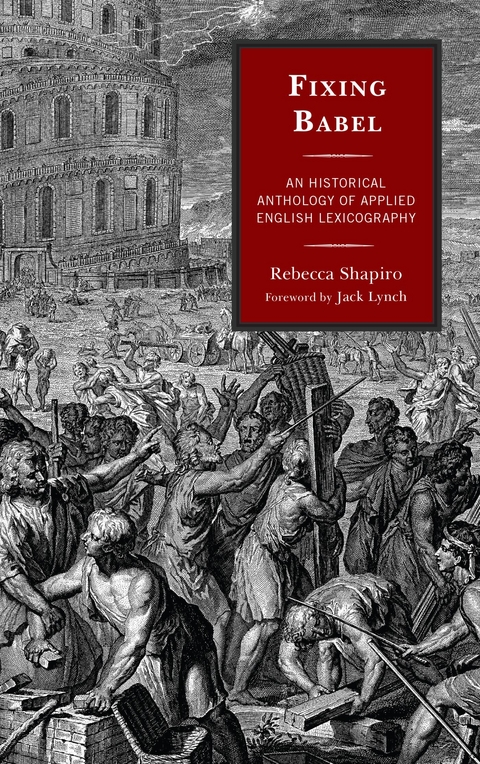
We all think we know what a dictionary is for and how to use one, so most of us skip the first pages-the front matter-and go right to the words we wish to look up. Yet dictionary users have not always known how English "e;works"e; and my book reproduces and examines for the first time important texts in which seventeenth- and eighteenth-century dictionary authors explain choices and promote ideas to readers, their "e;end users."e; Unlike French, Spanish, and Italian dictionaries compiled during this time and published by national academies, the goal of English dictionaries was usually not to "e;purify"e; the language, though some writers did attempt to regularize it. Instead, English lexicographers aimed to teach practical ways for their users to learn English, improve their language skills, even transcend their social class. The anthology strives to be comprehensive in its coverage of the first phase of this tradition from the early seventeenth century-from Robert Cawdrey's (1604) A Table Alphabeticall, to Samuel Johnson's Dictionary of the English Language (1755), and finally, to Noah Webster's An American Dictionary of the English Language (1828). The book puts English dictionaries in historical, national, linguistic, literary, cultural contexts, presenting lexicographical trends and the change in the English language over two centuries, and examines how writers attempted to control it by appealing to various pedagogical and legal authorities. Moreover, the development of dictionary and attempts to codify English language and grammar coincided with the arc of the British Empire; the promulgation of "e;proper"e; English has been a subject of debate and inquiry for centuries and, in part, dictionaries and the teaching of English historically have been used to present and support ideas about what is correct, regardless of how and where English is actually used. The authors who wrote these texts apply ideas about capitalism, nationalism, sex and social status to favor one language theory over another. I show how dictionaries are not neutral documents: they challenge or promote biases. The book presents and analyzes the history of lexicography, demonstrating how and why dictionaries evolved into the reference books we now often take for granted and we can see that there is no easy answer to the question of "e;who owns English."e;
Rebecca Shapiro is associate professor of English at the City University of New York.
PrefaceAcknowledgementsIntroductionEditorial MethodList of Abbreviations William ClarkA Dictionarie in English and Latine for Children, and Yong Beginners (1602)Robert CawdreyA Table Alphabeticall, 2nd ed. (1609)[I. B.] John BullokarAn English Expositor: Teaching the Interpretation of the Hardest Words Vsed in Our Language (1616)Henry CockeramThe English Dictionarie: Or, an Interpreter of Hard English Words (1623)Edmund CooteThe English Schoole-Master (1627)Thomas BlountGlossographia: Or a Dictionary (1656)Edward PhillipsThe New World of English Words: Or, a General Dictionary (1658)John RayA Collection of English Words, Not Generally Used (1674)Elisha ColesAn English Dictionary (1676)AnonymousGazophylacium Anglicanum (1689)Abel BoyerThe Royal Dictionary (1699)[J. K.] John KerseyA New English Dictionary (1702)John KerseyA New World of Words: Or, Universal English Dictionary, 6th ed., rev. by John Kersey (1706)AnonymousGlossographia Anglicana Nova: Or, a Dictionary (1707)John Kersey [Philobibl.]Dictionarium Anglo-Britannicum (1708)Nathan BaileyAn Universal Etymological Dictionary (1721)Thomas DycheThe Spelling Dictionary (1725)B. N. [Benjamin Norton] DefoeA Compleat Dictionary (1735)Nathan BaileyDictionarium Britannicum, 2nd ed. (1736)Thomas Dyche and William PardonA New General English Dictionary, 2nd ed. (1737)Samuel JohnsonThe Plan of a Dictionary of the English Language (1747)Benjamin MartinLingua Britannica Reformata: Or, A New English Dictionary (1749)Samuel JohnsonA Dictionary of the English Language (1755)Joseph Nicol ScottA New Universal Etymological English Dictionary (1755)Samuel JohnsonA Dictionary of the English Language . . . Abstracted (1756)James BuchananLinguæ Britannicæ Vera Pronunciato: Or, A New English Dictionary (1757)William JohnstonA Pronouncing and Spelling Dictionary (1764)John TruslerThe Difference between Words, Esteemed Synonymous, in the English Language (1766)William KenrickA New Dictionary of the English Language: Containing, Not Only the Explanation of Words . . . but Likewise, Their Orthoepia or Pronunciation (1773)James BarclayA Complete and Universal English Dictionary on a New Plan (1774)John AshThe New and Complete Dictionary of the English Language (1775)William PerryThe Royal Standard English Dictionary (1775)John WalkerA Dictionary of the English Language (1775)Thomas SheridanA General Dictionary of the English Language (1780)Francis GroseA Classical Dictionary of the Vulgar Tongue (1785)John WalkerA Critical Pronouncing Dictionary and Expositor of the English Language (1791)Hester Lynch PiozziBritish Synonymy (1794)Noah WebsterA Compendious Dictionary of the English Language (1806)Noah WebsterAn American Dictionary of the English Language (1828)Dictionaries with Their Complete TitlesBibliographyIndex
| Erscheint lt. Verlag | 2.12.2016 |
|---|---|
| Vorwort | Jack Lynch |
| Zusatzinfo | 7 Illustrations including: - 7 Halftones, Black & White including Black & White Photographs. |
| Sprache | englisch |
| Themenwelt | Geisteswissenschaften ► Sprach- / Literaturwissenschaft ► Sprachwissenschaft |
| Schlagworte | Anthropology • History • Literary Studies • Sociology |
| ISBN-13 | 9781611488104 / 9781611488104 |
| Informationen gemäß Produktsicherheitsverordnung (GPSR) | |
| Haben Sie eine Frage zum Produkt? |
 EPUB (Adobe DRM)
Kopierschutz: Adobe-DRM
Adobe-DRM ist ein Kopierschutz, der das eBook vor Mißbrauch schützen soll. Dabei wird das eBook bereits beim Download auf Ihre persönliche Adobe-ID autorisiert. Lesen können Sie das eBook dann nur auf den Geräten, welche ebenfalls auf Ihre Adobe-ID registriert sind.
Details zum Adobe-DRM
Dateiformat: EPUB (Electronic Publication)
EPUB ist ein offener Standard für eBooks und eignet sich besonders zur Darstellung von Belletristik und Sachbüchern. Der Fließtext wird dynamisch an die Display- und Schriftgröße angepasst. Auch für mobile Lesegeräte ist EPUB daher gut geeignet.
Systemvoraussetzungen:
PC/Mac: Mit einem PC oder Mac können Sie dieses eBook lesen. Sie benötigen eine
eReader: Dieses eBook kann mit (fast) allen eBook-Readern gelesen werden. Mit dem amazon-Kindle ist es aber nicht kompatibel.
Smartphone/Tablet: Egal ob Apple oder Android, dieses eBook können Sie lesen. Sie benötigen eine
Geräteliste und zusätzliche Hinweise
Buying eBooks from abroad
For tax law reasons we can sell eBooks just within Germany and Switzerland. Regrettably we cannot fulfill eBook-orders from other countries.
aus dem Bereich


