
Practical Evaluation Guide (eBook)
140 Seiten
Rowman & Littlefield Publishers (Verlag)
978-1-4422-6355-0 (ISBN)
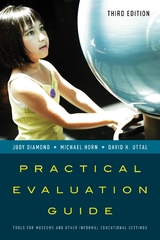
Administrators of museums and other informal-learning centers often need to demonstrate, in some tangible way, the effectiveness of their institutions as teaching tools. Practical Evaluation Guide discusses specific methods for analyzing audience learning and behavior in museums, zoos, botanic gardens, nature centers, camps, and youth programs. Evaluation is essential because it allows you to answer critical questions like:How can one measure the impacts of educational experiences in a museum, zoo, or aquarium?Are digital technologies more effective than traditional exhibits for enhancing visitor interest and understanding? How does one measure learning in these informal environments where visitors themselves decide what they will experience? Since we know many visitors come to informal institutions for social interaction and play, how does one access these social impacts? The Practical Evaluation Guide is an all-in-one resource to guide professionals working in museums and other informal educational institutions. This new edition includes updates throughout and features a brand-new chapter on evaluating digital interactive exhibits. The section on observational tools includes a new section on using video recordings and the section on interviews includes recent studies from countries outside the U.S. Practical Evaluation Guide serves as a basic, easy-to-follow guide for museum professionals and students who want to understand the effects of such public institutions on the people who visit them.
Judy Diamond is professor and curator of informal science education at the University of Nebraska State Museum. A biologist and science educator, she is the author of over 40 publications on informal learning. She has a long career working in science museums, first as curriculum developer at the Lawrence Hall of Science, as evaluator and project coordinator at the Exploratorium, and as deputy director for public programs at the San Diego Natural History Museum. Michael Stephen Horn is assistant professor of learning sciences and computer science at Northwestern University where he directs the Tangible Interaction Design and Learning Lab. Horn earned a PhD in Human Computer Interaction from Tufts University in 2009 and has been developing innovative technology-based learning experiences for museum and other informal learning environments for over ten year. His research interests involve understanding the role of cultural forms in shaping participating and learning around physical and technological artifacts. He is the author of over 30 scholarly articles and his work can be seen at the Museum of Science, Boston, the California Academy of Sciences, the Field Museum, and the Computer History Museum. David H. Uttal is professor of psychology and education at Northwestern University. He holds a doctorate in developmental psychology from the University of Michigan, and he is the author of over 50 articles and book chapters. His research interests are in the development of children’s thinking, with a focus on symbolic and spatial reasoning, and his work has been supported by the National Institutes of Health, the National Science Foundation, and the Institute of Education Sciences. At Northwestern he directs the multidisciplinary program in education sciences, which trains graduate students from different disciplines to conduct rigorous research in educational contexts.
| Erscheint lt. Verlag | 1.3.2016 |
|---|---|
| Reihe/Serie | American Association for State and Local History |
| Sprache | englisch |
| Themenwelt | Kunst / Musik / Theater |
| Geisteswissenschaften ► Geschichte ► Hilfswissenschaften | |
| Sozialwissenschaften ► Kommunikation / Medien ► Buchhandel / Bibliothekswesen | |
| Wirtschaft ► Betriebswirtschaft / Management ► Unternehmensführung / Management | |
| ISBN-10 | 1-4422-6355-5 / 1442263555 |
| ISBN-13 | 978-1-4422-6355-0 / 9781442263550 |
| Informationen gemäß Produktsicherheitsverordnung (GPSR) | |
| Haben Sie eine Frage zum Produkt? |
 EPUB (Adobe DRM)
Kopierschutz: Adobe-DRM
Adobe-DRM ist ein Kopierschutz, der das eBook vor Mißbrauch schützen soll. Dabei wird das eBook bereits beim Download auf Ihre persönliche Adobe-ID autorisiert. Lesen können Sie das eBook dann nur auf den Geräten, welche ebenfalls auf Ihre Adobe-ID registriert sind.
Details zum Adobe-DRM
Dateiformat: EPUB (Electronic Publication)
EPUB ist ein offener Standard für eBooks und eignet sich besonders zur Darstellung von Belletristik und Sachbüchern. Der Fließtext wird dynamisch an die Display- und Schriftgröße angepasst. Auch für mobile Lesegeräte ist EPUB daher gut geeignet.
Systemvoraussetzungen:
PC/Mac: Mit einem PC oder Mac können Sie dieses eBook lesen. Sie benötigen eine
eReader: Dieses eBook kann mit (fast) allen eBook-Readern gelesen werden. Mit dem amazon-Kindle ist es aber nicht kompatibel.
Smartphone/Tablet: Egal ob Apple oder Android, dieses eBook können Sie lesen. Sie benötigen eine
Geräteliste und zusätzliche Hinweise
Buying eBooks from abroad
For tax law reasons we can sell eBooks just within Germany and Switzerland. Regrettably we cannot fulfill eBook-orders from other countries.
aus dem Bereich