


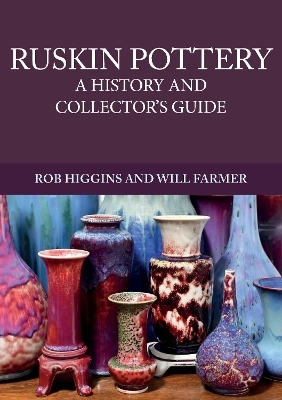
Ruskin Pottery
A History and Collector's Guide
Seiten
2018
Amberley Publishing (Verlag)
978-1-4456-7570-1 (ISBN)
Amberley Publishing (Verlag)
978-1-4456-7570-1 (ISBN)
This is the first book devoted to Ruskin Pottery, one of the most important potteries of the Arts and Crafts movement.
The Ruskin Pottery operated from around 1898 to 1935. Founded by William Howson Taylor and his father Edward (Superintendent of the Birmingham School of Art) the pottery used simple forms and new glaze technologies in contrast to highly decorated majolica and earthenware that had been popular in the second half of the nineteenth century.
The Ruskin Pottery was one of the most important potteries of the Arts and Crafts Movement, and William Howson Taylor was pre-eminent among a group of ‘chemist potters’ at the start of the twentieth century.
The most important glaze effect was the reduction of copper and iron oxides during firing, to produce rich red, blue, lavender and green hues. This technique was also called ‘high-fired’ ware and the red glaze, ‘sang de boeuf’. The Chinese had used reduction firing in previous centuries, but it fell out of use and was re-introduced by several European ceramicists during the late nineteenth century. William Howson Taylor became the greatest exponent of the technique, and won major awards at successive International Exhibitions, the first being at St Louis in 1904. This initiated an important export business to the USA, with stores that retailed his wares including Tiffany’s.
The pottery closed in 1933 with some pots being fired until final closure in 1935. William Howson Taylor, then ill, burnt all the glaze recipes and died soon after.
The Ruskin Pottery operated from around 1898 to 1935. Founded by William Howson Taylor and his father Edward (Superintendent of the Birmingham School of Art) the pottery used simple forms and new glaze technologies in contrast to highly decorated majolica and earthenware that had been popular in the second half of the nineteenth century.
The Ruskin Pottery was one of the most important potteries of the Arts and Crafts Movement, and William Howson Taylor was pre-eminent among a group of ‘chemist potters’ at the start of the twentieth century.
The most important glaze effect was the reduction of copper and iron oxides during firing, to produce rich red, blue, lavender and green hues. This technique was also called ‘high-fired’ ware and the red glaze, ‘sang de boeuf’. The Chinese had used reduction firing in previous centuries, but it fell out of use and was re-introduced by several European ceramicists during the late nineteenth century. William Howson Taylor became the greatest exponent of the technique, and won major awards at successive International Exhibitions, the first being at St Louis in 1904. This initiated an important export business to the USA, with stores that retailed his wares including Tiffany’s.
The pottery closed in 1933 with some pots being fired until final closure in 1935. William Howson Taylor, then ill, burnt all the glaze recipes and died soon after.
Professor Rob Higgins works at the University of Warwick and University Hospital Coventry. He is a doctor who was born and trained in East London, and has worked in many hospitals around London. He has an interest in local and medical history, and has an extensive collection of images of London hospitals. He has previously published extensively on kidney transplantation and on ceramics of the nineteenth and twentieth centuries. Will Farmer is a fine art and antiques auctioneer specializing in ceramics, glass and 20th century decorative arts. He appears as an expert on the BBC ‘Antiques Roadshow’ since 2006. His books include Clarice Cliff and Poole Pottery.
| Erscheinungsdatum | 25.08.2018 |
|---|---|
| Zusatzinfo | 180 Illustrations |
| Verlagsort | Chalford |
| Sprache | englisch |
| Maße | 165 x 234 mm |
| Gewicht | 281 g |
| Themenwelt | Sachbuch/Ratgeber ► Freizeit / Hobby ► Kreatives Gestalten |
| Geschichte ► Teilgebiete der Geschichte ► Kulturgeschichte | |
| ISBN-10 | 1-4456-7570-6 / 1445675706 |
| ISBN-13 | 978-1-4456-7570-1 / 9781445675701 |
| Zustand | Neuware |
| Informationen gemäß Produktsicherheitsverordnung (GPSR) | |
| Haben Sie eine Frage zum Produkt? |
Mehr entdecken
aus dem Bereich



aus dem Bereich
Die Revolution des Gemeinen Mannes
Buch | Softcover (2024)
C.H.Beck (Verlag)
CHF 16,80
Eine Geschichte des Geschmacks
Buch | Hardcover (2025)
C.H.Beck (Verlag)
CHF 49,95


