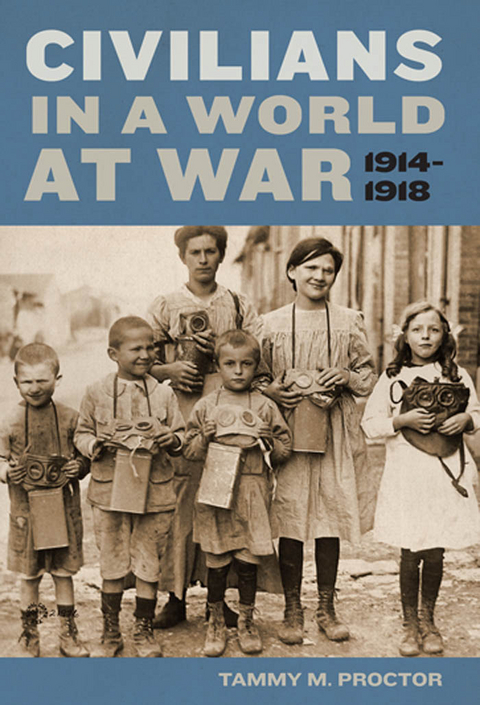
World War I heralded a new global era of warfare, consolidating and expanding changes that had been building throughout the previous century, while also instituting new notions of war. The 1914-18 conflict witnessed the first aerial bombing of civilian populations, the first widespread concentration camps for the internment of enemy alien civilians, and an unprecedented use of civilian labor and resources for the war effort. Humanitarian relief programs for civilians became a common feature of modern society, while food became as significant as weaponry in the fight to win.Tammy M. Proctor argues that it was World War I the first modern, global war that witnessed the invention of both the modern civilian and the home front, where a totalizing war strategy pitted industrial nations and their citizenries against each other. Civilians in a World at War, 1914-1918, explores the different ways civilians work and function in a war situation, and broadens our understanding of the civilian to encompass munitions workers, nurses, laundresses, refugees, aid workers, and children who lived and worked in occupied zones, on home and battle fronts, and in the spaces in between. Comprehensive and global in scope, spanning the Eastern, Western, Italian, East African, and Mediterranean fronts, Proctor examines in lucid and evocative detail the role of experts in the war, the use of forced labor, and the experiences of children in the combatant countries.As in many wars, civilians on both sides of WWI were affected, and vast displacements of the populations shaped the contemporary world in countless ways, redrawing boundaries and creating or reviving lines of ethnic conflict. Exploring primary source materials and secondary studies of combatant and neutral nations, while synthesizing French, German, Dutch, and English language sources, Proctor transcends the artificial boundaries of national histories and the exclusive focus on soldiers. Instead she tells the fascinating and long-buried story of the civilian in the Great War, allowing voices from the period to speak for themselves.
Illustrations Acknowledgments Introduction 1 Citizens in Uniform 2 Civilians and the Labor of War 3 Constructing Home Fronts 4 Caught between the Lines 5 Caring for the Wounded 6 Creating War Experts 7 Civilians behind the Wire 8 Civil War and Revolution Conclusion: Consequences of World War I Notes Bibliography Index About the Author
 EPUB (Adobe DRM)
Kopierschutz: Adobe-DRM
Adobe-DRM ist ein Kopierschutz, der das eBook vor Mißbrauch schützen soll. Dabei wird das eBook bereits beim Download auf Ihre persönliche Adobe-ID autorisiert. Lesen können Sie das eBook dann nur auf den Geräten, welche ebenfalls auf Ihre Adobe-ID registriert sind.
Details zum Adobe-DRM
Dateiformat: EPUB (Electronic Publication)
EPUB ist ein offener Standard für eBooks und eignet sich besonders zur Darstellung von Belletristik und Sachbüchern. Der Fließtext wird dynamisch an die Display- und Schriftgröße angepasst. Auch für mobile Lesegeräte ist EPUB daher gut geeignet.
Systemvoraussetzungen:
PC/Mac: Mit einem PC oder Mac können Sie dieses eBook lesen. Sie benötigen eine Adobe-ID und die Software Adobe Digital Editions (kostenlos). Von der Benutzung der OverDrive Media Console raten wir Ihnen ab. Erfahrungsgemäß treten hier gehäuft Probleme mit dem Adobe DRM auf.
eReader: Dieses eBook kann mit (fast) allen eBook-Readern gelesen werden. Mit dem amazon-Kindle ist es aber nicht kompatibel.
Smartphone/Tablet: Egal ob Apple oder Android, dieses eBook können Sie lesen. Sie benötigen eine Adobe-ID sowie eine kostenlose App.
Geräteliste und zusätzliche Hinweise
Buying eBooks from abroad
For tax law reasons we can sell eBooks just within Germany and Switzerland. Regrettably we cannot fulfill eBook-orders from other countries.