


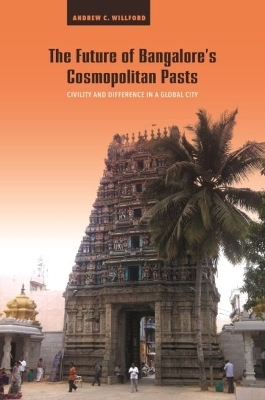
The Future of Bangalore's Cosmopolitan Pasts
Civility and Difference in a Global City
Seiten
2018
University of Hawai'i Press (Verlag)
978-0-8248-7290-8 (ISBN)
University of Hawai'i Press (Verlag)
978-0-8248-7290-8 (ISBN)
- Titel z.Zt. nicht lieferbar
- Versandkostenfrei
- Auch auf Rechnung
- Artikel merken
Bangalore is often heralded as India’s future—a city where global technologies converge with multinational capital to produce a cosmopolitan workforce and vibrant economic growth. In this narrative the city’s main challenge revolves around its success: whether its physical infrastructure can support its burgeoning population. Most observers assume that Bangalore’s emergence as a “global city” represents its more complete integration into the world economy and, by extension, a more inclusive and cosmopolitan outlook among its growing middle class.
Andrew C. Willford’s new book sheds light on a growing paradox: even as Bangalore has come to signify “progress” and economic possibility both within India and to the outside world, movements to make the city more monocultural and monolinguistic have gained prominence. Bangalore is the capital of the state of Karnataka, its borders linguistically redrawn by the postcolonial Indian state in 1956. In the decades that followed, organizations and leaders emerged to promote linguistic nationalism aimed at protecting the fragile unity of Kannadiga culture and literature against the twin threats of globalization and internal migration. Ironically, they support parochial cultural policies that impose a cultural and linguistic unity upon an area that historically stood at the crossroads of empires, trade routes, language practices, devotional literatures, and pilgrimage routes. Willford’s analysis, which focuses on the minority experience of Bangalore’s sizeable Tamil-speaking community, shows how the same forces of globalization that create growth and prosperity also foster uncertainty and tension around religion and language that completely contradict the region’s long history of cosmopolitanism.
Exploring this paradox in Bangalore’s entangled and complex linguistic and cultural pasts serves as a useful case study for understanding the forces behind cultural and ethnic revivalism in the contemporary postcolonial world. Buttressed by field research conducted over a twenty-two-year period (1992–2015), Willford shows how the past is a living resource for the negotiation of identity in the present. Against the gloom of increasingly communal conflicts, he finds that Bangalore still retains a fabric of civility against the modern markings of cultural difference.
Andrew C. Willford’s new book sheds light on a growing paradox: even as Bangalore has come to signify “progress” and economic possibility both within India and to the outside world, movements to make the city more monocultural and monolinguistic have gained prominence. Bangalore is the capital of the state of Karnataka, its borders linguistically redrawn by the postcolonial Indian state in 1956. In the decades that followed, organizations and leaders emerged to promote linguistic nationalism aimed at protecting the fragile unity of Kannadiga culture and literature against the twin threats of globalization and internal migration. Ironically, they support parochial cultural policies that impose a cultural and linguistic unity upon an area that historically stood at the crossroads of empires, trade routes, language practices, devotional literatures, and pilgrimage routes. Willford’s analysis, which focuses on the minority experience of Bangalore’s sizeable Tamil-speaking community, shows how the same forces of globalization that create growth and prosperity also foster uncertainty and tension around religion and language that completely contradict the region’s long history of cosmopolitanism.
Exploring this paradox in Bangalore’s entangled and complex linguistic and cultural pasts serves as a useful case study for understanding the forces behind cultural and ethnic revivalism in the contemporary postcolonial world. Buttressed by field research conducted over a twenty-two-year period (1992–2015), Willford shows how the past is a living resource for the negotiation of identity in the present. Against the gloom of increasingly communal conflicts, he finds that Bangalore still retains a fabric of civility against the modern markings of cultural difference.
Andrew C. Willford is professor of anthropology at Cornell University.
| Erscheinungsdatum | 07.08.2018 |
|---|---|
| Zusatzinfo | 8 black & white illustrations |
| Verlagsort | Honolulu, HI |
| Sprache | englisch |
| Maße | 152 x 231 mm |
| Gewicht | 523 g |
| Themenwelt | Sachbuch/Ratgeber ► Geschichte / Politik ► Allgemeines / Lexika |
| Geisteswissenschaften ► Geschichte ► Regional- / Ländergeschichte | |
| Sozialwissenschaften ► Ethnologie | |
| Sozialwissenschaften ► Soziologie | |
| ISBN-10 | 0-8248-7290-8 / 0824872908 |
| ISBN-13 | 978-0-8248-7290-8 / 9780824872908 |
| Zustand | Neuware |
| Informationen gemäß Produktsicherheitsverordnung (GPSR) | |
| Haben Sie eine Frage zum Produkt? |
Mehr entdecken
aus dem Bereich



aus dem Bereich
Handbuch zum Lesen des Himmels
Buch | Hardcover (2025)
Harpercollins (Verlag)
CHF 30,80


