


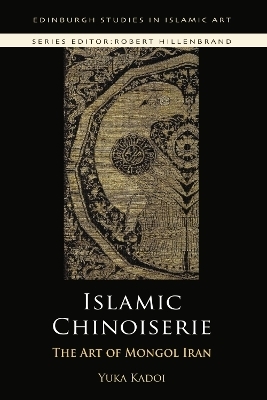
Islamic Chinoiserie
The Art of Mongol Iran
Seiten
2018
Edinburgh University Press (Verlag)
978-1-4744-3720-2 (ISBN)
Edinburgh University Press (Verlag)
978-1-4744-3720-2 (ISBN)
This illustrated book aims to provide a fresh insight into medieval Islamic art through the prism of Chinese elements in Iranian art under the Mongols.
The Mongol invasion in the thirteenth century marked a new phase in the development of Islamic art. Trans-Eurasian exchanges of goods, people and ideas were encouraged on a large scale under the auspices of the Pax Mongolica. With the fascination of portable objects brought from China and Central Asia, a distinctive, hitherto unknown style - Islamic chinoiserie - was born in the art of Iran.Highly illustrated, Islamic Chinoiserie offers a fascinating glimpse into the artistic interaction between Iran and China under the Mongols. By using rich visual materials from various media of decorative and pictorial arts - textiles, ceramics, metalwork and manuscript painting - the book illustrates the process of adoption and adaptation of Chinese themes in the art of Mongol-ruled Iran in a visually compelling way. The observation of this unique artistic phenomenon serves to promote the understanding of the artistic diversity of Islamic art in the Middle Ages.Key Features*Covers various media of decorative and pictorial arts from Iran, Central Asia and China*Deals with a diverse range of issues related to the East-West artistic relationship in the Middle Ages*Features in-depth studies of style, technique and iconography in Iranian art under the Mongols*Includes 125 illustrations, 24 in colour
The Mongol invasion in the thirteenth century marked a new phase in the development of Islamic art. Trans-Eurasian exchanges of goods, people and ideas were encouraged on a large scale under the auspices of the Pax Mongolica. With the fascination of portable objects brought from China and Central Asia, a distinctive, hitherto unknown style - Islamic chinoiserie - was born in the art of Iran.Highly illustrated, Islamic Chinoiserie offers a fascinating glimpse into the artistic interaction between Iran and China under the Mongols. By using rich visual materials from various media of decorative and pictorial arts - textiles, ceramics, metalwork and manuscript painting - the book illustrates the process of adoption and adaptation of Chinese themes in the art of Mongol-ruled Iran in a visually compelling way. The observation of this unique artistic phenomenon serves to promote the understanding of the artistic diversity of Islamic art in the Middle Ages.Key Features*Covers various media of decorative and pictorial arts from Iran, Central Asia and China*Deals with a diverse range of issues related to the East-West artistic relationship in the Middle Ages*Features in-depth studies of style, technique and iconography in Iranian art under the Mongols*Includes 125 illustrations, 24 in colour
Yuka Kadoi, PhD, is a historian of Islamic and Asian art. She is the author and editor of numerous publications, including Persian Art: Image-making in Eurasia (EUP, 2017).
Introduction: West Asia meets East Asia1. Textiles: Beyond the Silk Road2. Ceramics: The Notion of chini-i-faghfuri3. Metalwork: from East Asian Perspectives4. Miscellaneous Objects5. Miniatures: the Birth of Landscape PaintingConclusionBibliographyIndex
| Erscheinungsdatum | 17.07.2018 |
|---|---|
| Reihe/Serie | Edinburgh Studies in Islamic Art |
| Zusatzinfo | 49 black and white illustrations, 79 colour illustrations |
| Verlagsort | Edinburgh |
| Sprache | englisch |
| Maße | 172 x 244 mm |
| Gewicht | 755 g |
| Themenwelt | Kunst / Musik / Theater ► Kunstgeschichte / Kunststile |
| Geisteswissenschaften ► Religion / Theologie ► Islam | |
| Sozialwissenschaften ► Soziologie ► Spezielle Soziologien | |
| ISBN-10 | 1-4744-3720-6 / 1474437206 |
| ISBN-13 | 978-1-4744-3720-2 / 9781474437202 |
| Zustand | Neuware |
| Informationen gemäß Produktsicherheitsverordnung (GPSR) | |
| Haben Sie eine Frage zum Produkt? |
Mehr entdecken
aus dem Bereich


aus dem Bereich


