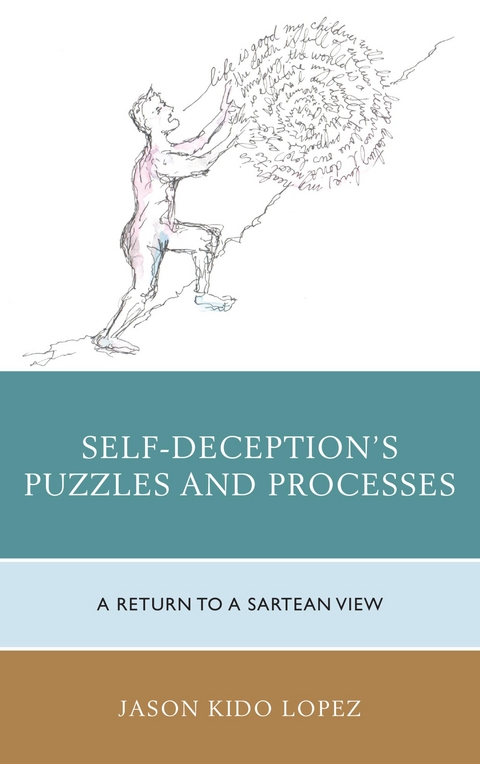
Self-Deception's Puzzles and Processes (eBook)
174 Seiten
Lexington Books (Verlag)
978-0-7391-7991-8 (ISBN)
The contemporary literature on self-deception was born out of Jean-Paul Sartre's work on bad faith-lying to oneself. As time has progressed, the conception of self-deception has moved further and further away from Sartre's conception of bad faith. In Self-Deception's Puzzles and Processes: A Return to a Sartrean View, Jason Kido Lopez argues that this departure is a mistake and that we should return to thinking about self-deception in a Sartrean fashion, in which we are self-deceived when we intentionally use the strategies and methods of interpersonal deception on ourselves. Since literally tricking ourselves cannot work-we will always see through our own self-deception, after all-self-deception merely consists of the attempt to trick ourselves in this way. Other scholars have rejected this notion of self-deception historically, dismissing it as paradoxical. Lopez argues first that it isn't paradoxical, and he further suggests that moving away from this notion of self-deception has caused the contemporary literature on the topic to be littered with disparate and conflicting theories. Indeed, there are a great many ways to avoid the allegedly paradoxical Sartrean notion of self-deception, and the resulting plethora of accounts lead to a fragmented picture of self-deception. If, however, the Sartrean view isn't paradoxical, then there was no need for the host of contradictory theories and most researchers on self-deception have missed what was originally so intriguing about self-deception: that it, like bad faith, is the process of literally trying to trick oneself into believing what is false or unwarranted.Self-Deception's Puzzles and Processes will be of great interest to students and scholars of epistemology, philosophy of mind, psychology, and continental philosophy, and to anyone else interested in the problems of self-deception.
Jason Kido Lopez is lecturer at the University of Wisconsin, Madison.
Preface AcknowledgmentsIntroduction: Puzzles, Paradoxes, and ProcessesChapter 1: The Origin of Thought on Self-DeceptionChapter 2: Definition, Diversity, and DisagreementChapter 3: The Strict Reading and the Process View of Self-DeceptionChapter 4: Exploring and Situating Self-DeceptionBibliography
| Erscheint lt. Verlag | 16.8.2016 |
|---|---|
| Verlagsort | Lanham |
| Sprache | englisch |
| Themenwelt | Geisteswissenschaften ► Philosophie ► Allgemeines / Lexika |
| Geisteswissenschaften ► Philosophie ► Metaphysik / Ontologie | |
| Schlagworte | bad faith • Bias • Continental Philosophy • Epistemology • Existentialism • Lying • motivated belief • Paradox • Philosophy of mind • Psychology • Sartre |
| ISBN-10 | 0-7391-7991-8 / 0739179918 |
| ISBN-13 | 978-0-7391-7991-8 / 9780739179918 |
| Informationen gemäß Produktsicherheitsverordnung (GPSR) | |
| Haben Sie eine Frage zum Produkt? |
 EPUB (Adobe DRM)
Kopierschutz: Adobe-DRM
Adobe-DRM ist ein Kopierschutz, der das eBook vor Mißbrauch schützen soll. Dabei wird das eBook bereits beim Download auf Ihre persönliche Adobe-ID autorisiert. Lesen können Sie das eBook dann nur auf den Geräten, welche ebenfalls auf Ihre Adobe-ID registriert sind.
Details zum Adobe-DRM
Dateiformat: EPUB (Electronic Publication)
EPUB ist ein offener Standard für eBooks und eignet sich besonders zur Darstellung von Belletristik und Sachbüchern. Der Fließtext wird dynamisch an die Display- und Schriftgröße angepasst. Auch für mobile Lesegeräte ist EPUB daher gut geeignet.
Systemvoraussetzungen:
PC/Mac: Mit einem PC oder Mac können Sie dieses eBook lesen. Sie benötigen eine
eReader: Dieses eBook kann mit (fast) allen eBook-Readern gelesen werden. Mit dem amazon-Kindle ist es aber nicht kompatibel.
Smartphone/Tablet: Egal ob Apple oder Android, dieses eBook können Sie lesen. Sie benötigen eine
Geräteliste und zusätzliche Hinweise
Buying eBooks from abroad
For tax law reasons we can sell eBooks just within Germany and Switzerland. Regrettably we cannot fulfill eBook-orders from other countries.
aus dem Bereich