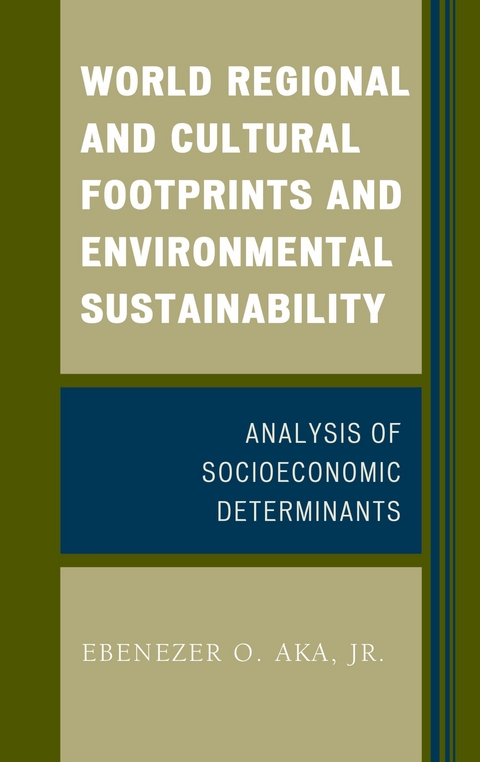
World Regional and Cultural Footprints and Environmental Sustainability (eBook)
368 Seiten
Hamilton Books (Verlag)
978-0-7618-6865-1 (ISBN)
The book examines the issues of sustainability in general. It addresses various socioeconomic determinants of ecological footprints in different world's nations, regions, and cultures. Major socioeconomic determinants of ecological footprints are fleshed out using Comparative Model Analysis and rigorous Multiple Regression Analysis. The study exposes the inequitable distribution of the world's ecological footprints and also heightens the concern about ecological imbalances and overshoots. It explains how sustainable development can be promoted and achieved in regional, national, and local jurisdictions. The study provides information that will likely help various governments and policy-makers determine if a given nation, region, or culture is on a sustainable path. It helps government leaders, planners, policy-makers, and even students of sustainability make a difference in mitigating the effects of various environmental stressors. If this book makes people and policy-makers in different countries, regions, and cultures think globally but act locally, then the objectives are well-served.
DR. EBENEZER OSITA AKA is Professor of Urban Studies and Planning at Morehouse College in Atlanta, Georgia, USA. He is the Director of Urban Studies Program; and was once the Interim Chair of Department of Political Science that includes, International Studies Program and Urban Studies Program at the College. His Bachelor of City and Regional Planning (BCRP, Cum Laude) and MA in Geography and Urban Planning (Magna Cum Laude) are from The University of Louisiana, Lafayette, Louisiana; Master of City and Regional Planning (MCRP) from Rutgers--- The State University of New Jersey, New Brunswick, New Jersey; and Ph.D. in Urban and Regional Planning from Texas A&M University, College Station, Texas.Dr. Aka is a member of Environmental Studies Group; Sustainability and Sustainable Energy Group; and Morehouse Research Institute (MRI) at the College. He is the author of a book, Regional Disparities in Nigeria’s Development: Lessons and Challenges for the 21st Century (University Press of America); as well as monographs, book chapters, and several articles and proceedings in various refereed and reputable journals, such as Cities: The International Journal of Urban Policy and Planning; Review of Urban and Regional Development Studies (RURDS); The Journal of Public Sector Management; Journal of Social Development in Africa; African Urban Quarterly--- Journal of Comparative Urbanization and Planning in Africa; The International Journal of Environmental, Cultural, Economic & Social Sustainability; The International Journal of Interdisciplinary Social Sciences; The National Social Science Journal (NSSJ); and American International Journal of Humanities and Social Sciences.Dr. Aka’s Research Interests include: Comparative Urbanization and Planning; Urban and Regional Development & Revitalization; Regional Disparities; Geographic Information Systems (GIS) Applications in Planning; and Environmental Sustainability and Sustainable Development.
Table of ContentsPROLOGUEACKNOWLEDGEMENTSCHAPTER 1: INTRODUCTIONPurposeFocus of StudySignificance of the StudyLimitations of the StudyMethodology of the StudyHypothesis for the StudyVariable DefinitionsComparative Model AnalysisRegression AnalysisReferencesDefinition, Description, and Explanation of Terms on Sustainability and Environmental Footprints ConceptsCHAPTER 2: ECOLOGICAL FOOTPRINT, ENVIRONMENTAL SUSTAINABILITY, AND BIODIVERSITY CONSERVATION: A CROSS-CULTURAL ANALYSISIntroductionPurpose of StudyTheoretical Framework for the StudyMethodology for the StudyResults and DiscussionsPopulation and Affluence on Total Ecological Footprints of CountriesWorld-System Positions, Ecostructural Factors, and Per Capita Ecological Footprints of CountriesEnvironmental Sustainability and Biodiversity ConservationPolicy RecommendationsConclusionsReferencesCHAPTER 3: BIODIVERSITY, CONSERVATION, AND SUSTAINABLE SOCIO-ECONOMIC GROWTH AND DEVELOPMENT: PROBLEMS AND PROSPECTSIntroductionPurpose of StudyTheoretical Argument for the StudyMethodology for the StudyBiodiversity Conservation Problems: Empirical EvidenceThe U.S. CaseBiodiversity Conservation ProspectsPolicy Recommendations and ProspectsConclusionsReferencesCHAPTER 4: GENDER EQUITY AND SUSTAINABLE SOCIO-ECONOMIC GROWTH AND DEVELOPMENT: A CROSS-CULTURAL ANALYSISIntroductionPurpose of StudyTheories and Counter-Movement Theories of DevelopmentMethodology for the StudyRegional Socio-Demographic Trend, 1975-2015Regional Economic Performance, 2002Human Capital and Sustainable DevelopmentGender and Sustainable DevelopmentPolicy Suggestions and RecommendationsConclusionsReferencesCHAPTER 5: SOCIO-ECONOMIC DETERMIANTS OF NATIONAL ECOLOGICAL FOOTPRINTS IN AFRICA: A MULTIPLE REGRESSION ANALYSIS OF THE FACTORIAL IMPACTSIntroductionFocus of the StudyTheoretical Framework for the StudyMethodology for the StudyHypothesis for the StudyComparative Model Analysis (Results and Discussions)Total Footprint Per Capita, Biological Capacity, and Ecological Balance by World RegionsHuman Development and Affluence on Biological Capacity, Ecological Footprint and balance in African CountriesPopulation, Ecostructural Factors, and Total Footprint Per Capita in African CountriesRegression Analysis and Regression EquationRegression Analysis (Results and Discussions)Policy RecommendationsConclusionsReferencesTablesMap of African CountriesCHAPTER 6: SOCIO-ECONOMIC DETERMINANTS OF NATIONAL ECOLOGICAL FOOTPRINTS IN ORGANIZATION FOR ECONOMIC COOPERATION AND DEVELOPMENT (OECD) COUNTRIES: A MULTIPLE REGRESSION ANALYSIS OF THE FACTORIAL IMPACTS IntroductionFocus of the StudyPurpose of StudyTheoretical Framework for the StudyMethodology of the StudyHypothesis for the StudyComparative Model Analysis (Results and Discussions)Carbon Dioxide (CO2) Emissions from Fuel Combustion (in Million Tons) in Organization for Economic Cooperation and Development (OECD) Countries: 2000-2005Total Public (Government) Social Expenditure Per Head (at Current Prices and PPPs in US Dollars) in Organization for Economic Cooperation and Development (OECD) Countries: 2000-2005 Human Development and Affluence on Biological Capacity, Ecological Footprint and Balance in Organization for Economic Cooperation and Development (OECD) CountriesPopulation, Ecostructural Factors, and Total Footprint Per Capita in Organization for Economic Cooperation and Development CountriesRegression Analysis and Regression EquationRegression Analysis (Results and Discussions)Policy RecommendationsAppendix A: Variable DefinitionsAppendix B: Regression Analysis TermsReferencesTablesCHAPTER 7: SOCIO-ECONOMIC DETERMINANTS OF NATIONAL ECOLOGICAL FOOTPRINTS IN LATIN AMERICA AND CARIBBEAN: A MULTIPLE REGRESSION ANALYSIS OF THE FACTORIAL IMPACTSIntroductionFocus of the StudyPurpose of StudyTheoretical Framework for the StudyMethodology for the StudyHypothesis for the StudyComparative Model Analysis (Results and Discussions)Per Capita Ecological Footprint, Biological Capacity, and Ecological Balance by World RegionsHuman Development and Affluence on Biological Capacity, Ecological Footprint and Balance in Latin America and Caribbean CountriesPopulation, Ecostructural Factors, and Total Footprint Per Capita in Latin America and Caribbean CountriesRegression Analysis and Regression EquationRegression Analysis (Results and Discussions)Policy Recommendations ConclusionsAppendix A: Variable DefinitionsAppendix B: Regression Analysis TermsReferencesTablesMap of Latin America and the CaribbeanCHAPTER 8: SOCIO-ECONOMIC DETERMINANTS OF NATIONAL ECOLOGICAL FOOTPRINTS IN MIDDLE EAST AND CENTRAL ASIA COUNTRIES: A MULTIPLE REGRESSION ANALYSIS OF THE FACTORIAL IMPACTSIntroductionFocus of the StudyPurpose of StudyTheoretical Framework for the StudyMethodology for the StudyHypothesis for the StudyComparative Model Analysis (Results and Discussions)Human Development and Affluence on Biological Capacity, Ecological Footprint and Balance in Middle East and Central Asia CountriesPopulation, Ecostructural Factors, and Total Footprint Per Capita in Middle East and Central Asia CountriesRegression Analysis (Results and Discussions)Policy RecommendationsConclusionsReferencesTablesMap of Middle East and Central AsiaCHAPTER 9: SOCIO-ECONOMIC DETERMINANTS OF NATIONAL ECOLOGICAL FOOTPRINTS IN ASIA-PACIFIC COUNTRIES: A MULTIPLE REGRESSION ANALYSIS OF THE FACTORIAL IMPACTSIntroductionFocus of StudyPurpose of StudyThe EconomyWomen Issues and DevelopmentEducationHealthEnvironmentTheoretical Framework for the StudyMethodology for the StudyHypothesis for the StudyComparative Model Analysis (Results and Discussions)Per Capita Ecological Footprint, Biological Capacity, and Ecological Balance by World Regions in 2005Human Development and Affluence on Biological Capacity, Ecological Footprint and Balance in Asia-Pacific CountriesPopulation, Ecostructural Factors, and Total Footprint Per Capita in Asia-Pacific CountriesRegression Analysis and Regression EquationPolicy RecommendationsConclusionsAppendix A: Variable DefinitionsAppendix B: Regression Analysis TermsReferencesTablesMap of Asia-Pacific CountriesCHAPTER 10: WORLD REGIONAL AND CULTURAL FOOTPRINTS AND ENVIRONMENTAL SUSTAINABILITY: A SUMMARY OF SOCIO-ECONOMIC DETERMINANTSIntroductionFocus of StudyTheoretical Framework for the StudyMethodology for the StudyHypothesis for the StudyVariable DefinitionsComparative Model AnalysisRegression AnalysisRegression Analysis Results and Model Equations for Different Regions and CulturesAfrican Region Footprint Socioeconomic Determinants ModelOrganization for Economic Cooperation and Development (OECD) Region Footprint Socioeconomic Determinants ModelLatin America and Caribbean Region Footprint Socioeconomic Determinants ModelMiddle East and Central Asia Region Footprint Socioeconomic Determinants ModelAsia-Pacific Region Footprint Socioeconomic Determinants ModelPolicy RecommendationsConclusionsReferencesTablesEPILOGUEThe Future of SustainabilityReferencesLIST OF FIGURES
| Erscheint lt. Verlag | 26.4.2017 |
|---|---|
| Zusatzinfo | 117 Illustrations including: - 117 Tables. |
| Sprache | englisch |
| Themenwelt | Geisteswissenschaften ► Sprach- / Literaturwissenschaft ► Literaturwissenschaft |
| Naturwissenschaften ► Biologie ► Ökologie / Naturschutz | |
| Sozialwissenschaften ► Politik / Verwaltung ► Staat / Verwaltung | |
| Sozialwissenschaften ► Soziologie ► Allgemeines / Lexika | |
| Wirtschaft ► Betriebswirtschaft / Management | |
| Wirtschaft ► Volkswirtschaftslehre | |
| Schlagworte | biodiversity • Carbon Footprints • Ecological Footprints • Environmental economics • global warming • Social Sustainability • sustainability |
| ISBN-10 | 0-7618-6865-8 / 0761868658 |
| ISBN-13 | 978-0-7618-6865-1 / 9780761868651 |
| Informationen gemäß Produktsicherheitsverordnung (GPSR) | |
| Haben Sie eine Frage zum Produkt? |
 EPUB (Adobe DRM)
Kopierschutz: Adobe-DRM
Adobe-DRM ist ein Kopierschutz, der das eBook vor Mißbrauch schützen soll. Dabei wird das eBook bereits beim Download auf Ihre persönliche Adobe-ID autorisiert. Lesen können Sie das eBook dann nur auf den Geräten, welche ebenfalls auf Ihre Adobe-ID registriert sind.
Details zum Adobe-DRM
Dateiformat: EPUB (Electronic Publication)
EPUB ist ein offener Standard für eBooks und eignet sich besonders zur Darstellung von Belletristik und Sachbüchern. Der Fließtext wird dynamisch an die Display- und Schriftgröße angepasst. Auch für mobile Lesegeräte ist EPUB daher gut geeignet.
Systemvoraussetzungen:
PC/Mac: Mit einem PC oder Mac können Sie dieses eBook lesen. Sie benötigen eine
eReader: Dieses eBook kann mit (fast) allen eBook-Readern gelesen werden. Mit dem amazon-Kindle ist es aber nicht kompatibel.
Smartphone/Tablet: Egal ob Apple oder Android, dieses eBook können Sie lesen. Sie benötigen eine
Geräteliste und zusätzliche Hinweise
Buying eBooks from abroad
For tax law reasons we can sell eBooks just within Germany and Switzerland. Regrettably we cannot fulfill eBook-orders from other countries.
aus dem Bereich