


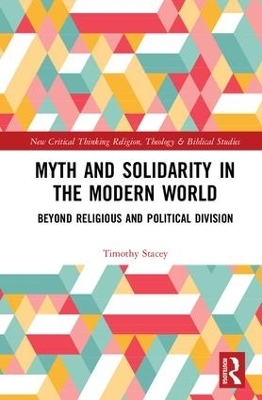
Myth and Solidarity in the Modern World
Beyond Religious and Political Division
Seiten
2018
Routledge (Verlag)
978-0-8153-4816-0 (ISBN)
Routledge (Verlag)
978-0-8153-4816-0 (ISBN)
Drawing on an increasingly influential Christian theological movement, postliberalism, this book claims that the dominance of liberal, secular rationality has blinded people to the fundamental role of transcendence and myth in developing solidarity.
In the context of the rise of reactionary politics across the globe, this book seeks new ways of developing solidarity across religious, political and economic differences. Drawing on an increasingly influential Christian theological movement, postliberalism, it claims that the dominance of liberal, secular rationality has blinded people to the fundamental role of transcendence and myth in developing solidarity. The result is either atrophy, or a retrenching in divisive myths of faith, race, nation or economic status.
Liberalism is now a dominant force across the globe. But its resonance in the Anglo-Saxon West, from which it originates and has been most fully realized, is relatively underexplored. The book thus follows two simultaneous lines of enquiry. Firstly, a genealogical study of social scientific and policy iterations of the relationship between belief and solidarity in the Anglo-Saxon West, placing postliberal theory into dialogue with the sociology and anthropology of religion, politics and economics. Secondly, it draws from original ethnographic research with groups in London, UK, that seek to develop solidarity in the face of deep-seated difference.
By bringing a new way of framing these contentious debates about contemporary society, this research offers tools for more productive conversations around religious and political topics, in particular concluding with a clear policy proposal. It is, therefore, a useful resource for both academics of theology and religious studies, political philosophy, sociology and anthropology; and for politicians, policy makers and practitioners hoping to develop solidarity in the modern world.
In the context of the rise of reactionary politics across the globe, this book seeks new ways of developing solidarity across religious, political and economic differences. Drawing on an increasingly influential Christian theological movement, postliberalism, it claims that the dominance of liberal, secular rationality has blinded people to the fundamental role of transcendence and myth in developing solidarity. The result is either atrophy, or a retrenching in divisive myths of faith, race, nation or economic status.
Liberalism is now a dominant force across the globe. But its resonance in the Anglo-Saxon West, from which it originates and has been most fully realized, is relatively underexplored. The book thus follows two simultaneous lines of enquiry. Firstly, a genealogical study of social scientific and policy iterations of the relationship between belief and solidarity in the Anglo-Saxon West, placing postliberal theory into dialogue with the sociology and anthropology of religion, politics and economics. Secondly, it draws from original ethnographic research with groups in London, UK, that seek to develop solidarity in the face of deep-seated difference.
By bringing a new way of framing these contentious debates about contemporary society, this research offers tools for more productive conversations around religious and political topics, in particular concluding with a clear policy proposal. It is, therefore, a useful resource for both academics of theology and religious studies, political philosophy, sociology and anthropology; and for politicians, policy makers and practitioners hoping to develop solidarity in the modern world.
Timothy Stacey is a Postdoctoral Fellow at both the Religion and Diversity Project, University of Ottawa, Canada and the Faiths and Civil Society Unit, Goldsmiths, University of London, UK. He is interested in the role of religion and belief, or 'myth' as he prefers, in developing solidarity, with special attention to the implications for politics, public policy and practice. He has developed successful funding bids both internally and with a range of funders, including the AHRC.
Introduction 1 Postliberalism: Revalorising a lost world 2 Myth and solidarity in pluralist settings 3 Myth, solidarity and the state 4 Myth, solidarity and capitalism 5 Imagining solidarity: conjuring a world to come Conclusion: An awareness of what is missing
| Erscheinungsdatum | 18.02.2018 |
|---|---|
| Reihe/Serie | Routledge New Critical Thinking in Religion, Theology and Biblical Studies |
| Verlagsort | New York |
| Sprache | englisch |
| Maße | 156 x 234 mm |
| Gewicht | 500 g |
| Themenwelt | Geisteswissenschaften ► Philosophie |
| Religion / Theologie ► Christentum ► Kirchengeschichte | |
| ISBN-10 | 0-8153-4816-9 / 0815348169 |
| ISBN-13 | 978-0-8153-4816-0 / 9780815348160 |
| Zustand | Neuware |
| Informationen gemäß Produktsicherheitsverordnung (GPSR) | |
| Haben Sie eine Frage zum Produkt? |
Mehr entdecken
aus dem Bereich

aus dem Bereich
eine andere Geschichte der Papststadt
Buch | Softcover (2024)
C.H.Beck (Verlag)
CHF 25,20
die Macht des Dunklen in unserer Zeit und wie wir ihr entgegentreten
Buch | Hardcover (2025)
Verlag Herder
CHF 27,90


