


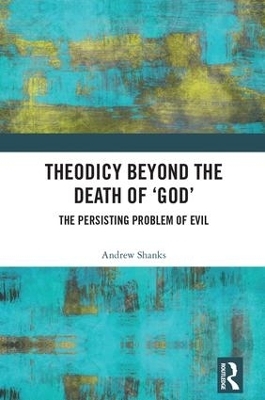
Theodicy Beyond the Death of 'God'
The Persisting Problem of Evil
Seiten
2018
Routledge (Verlag)
978-1-138-09239-6 (ISBN)
Routledge (Verlag)
978-1-138-09239-6 (ISBN)
True theodicy is partly a theoretical corrective to evangelistic impatience: discounting the distortions arising from over-eager salesmanship. And partly it is a work of poetic intensification, dedicated to faith’s necessary struggle against resentment. A boldly polemical study, this book is a bid to re-ignite debate on the whole topic of theodicy.
True theodicy is partly a theoretical corrective to evangelistic impatience: discounting the distortions arising from over-eager salesmanship. And partly it is a work of poetic intensification, dedicated to faith’s necessary struggle against resentment.
This book contains a systematic survey of the classic theoretical-corrective theodicy tradition initiated, in the early Seventeenth Century, by Jakob Böhme. Two centuries later, Böhme’s lyrical thought is translated into rigorous philosophical terms by Schelling; and is, then, further, set in context by Hegel’s doctrine of providence at work in world history. The old ‘God’ of mere evangelistic impatience is, as Hegel sees things, ‘dead’. And so theodicy is liberated, to play its proper role: illustrated here with particular reference to the book of Job, the post-Holocaust poetry of Nelly Sachs, and the thought of Simone Weil.
A boldly polemical study, this book is a bid to re-ignite debate on the whole topic of theodicy. As such, it will be of great interest to scholars in religious studies, theology and philosophy.
True theodicy is partly a theoretical corrective to evangelistic impatience: discounting the distortions arising from over-eager salesmanship. And partly it is a work of poetic intensification, dedicated to faith’s necessary struggle against resentment.
This book contains a systematic survey of the classic theoretical-corrective theodicy tradition initiated, in the early Seventeenth Century, by Jakob Böhme. Two centuries later, Böhme’s lyrical thought is translated into rigorous philosophical terms by Schelling; and is, then, further, set in context by Hegel’s doctrine of providence at work in world history. The old ‘God’ of mere evangelistic impatience is, as Hegel sees things, ‘dead’. And so theodicy is liberated, to play its proper role: illustrated here with particular reference to the book of Job, the post-Holocaust poetry of Nelly Sachs, and the thought of Simone Weil.
A boldly polemical study, this book is a bid to re-ignite debate on the whole topic of theodicy. As such, it will be of great interest to scholars in religious studies, theology and philosophy.
Andrew Shanks is Canon Emeritus of Manchester Cathedral, UK. He is widely published in the field of religion, theology and philosophy, having written more than 10 monographs including Hegel and Religious Faith (2011) and Hegel versus ‘Inter-faith Dialogue’ (2015).
Introduction 1 Hegel’s Riddle: truth-as-openness, a temperate theodicean ideal 2 Hegel versus Nietzsche: truth-as-openness, a (small ‘c’) catholic theodicean ideal, without manipulation 3 God / Godhead / ‘God’: truth-as-openness, a modestly patient theodicean ideal 4 Job redux: truth-as-openness, a poetically exposed theodicean ideal Conclusion
| Erscheinungsdatum | 16.03.2018 |
|---|---|
| Verlagsort | London |
| Sprache | englisch |
| Maße | 156 x 234 mm |
| Gewicht | 400 g |
| Themenwelt | Religion / Theologie ► Christentum ► Kirchengeschichte |
| ISBN-10 | 1-138-09239-8 / 1138092398 |
| ISBN-13 | 978-1-138-09239-6 / 9781138092396 |
| Zustand | Neuware |
| Informationen gemäß Produktsicherheitsverordnung (GPSR) | |
| Haben Sie eine Frage zum Produkt? |
Mehr entdecken
aus dem Bereich

aus dem Bereich
eine andere Geschichte der Papststadt
Buch | Softcover (2024)
C.H.Beck (Verlag)
CHF 25,20
die Macht des Dunklen in unserer Zeit und wie wir ihr entgegentreten
Buch | Hardcover (2025)
Verlag Herder
CHF 27,90


