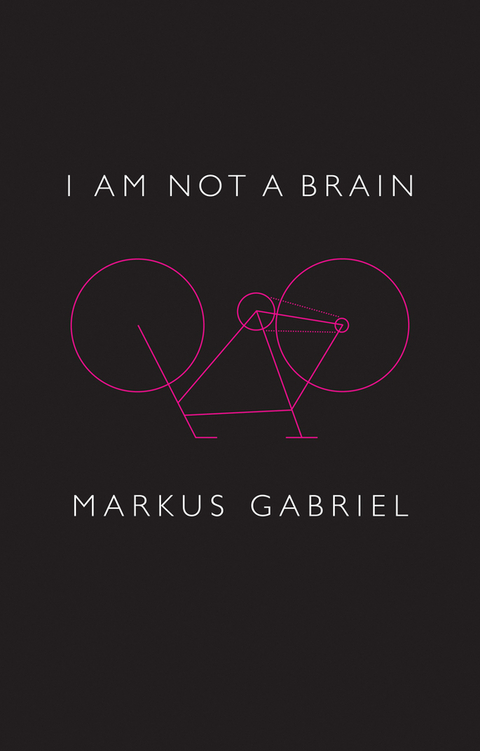
I am Not a Brain (eBook)
378 Seiten
John Wiley & Sons (Verlag)
978-1-5095-1478-6 (ISBN)
Many consider the nature of human consciousness to be one of the last great unsolved mysteries. Why should the light turn on, so to speak, in human beings at all? And how is the electrical storm of neurons under our skull connected with our consciousness? Is the self only our brain's user interface, a kind of stage on which a show is performed that we cannot freely direct?
In this book, philosopher Markus Gabriel challenges an increasing trend in the sciences towards neurocentrism, a notion which rests on the assumption that the self is identical to the brain. Gabriel raises serious doubts as to whether we can know ourselves in this way. In a sharp critique of this approach, he presents a new defense of the free will and provides a timely introduction to philosophical thought about the self - all with verve, humor, and surprising insights.
Gabriel criticizes the scientific image of the world and takes us on an eclectic journey of self-reflection by way of such concepts as self, consciousness, and freedom, with the aid of Kant, Schopenhauer, and Nagel but also Dr. Who, The Walking Dead, and Fargo.
Markus Gabriel was born in 1980 and studied in Heidelberg, Lisbon and New York. Since 2009 he has held the chair for Epistemology at the University of Bonn; and with this appointment he became Germany's youngest philosophy professor. He is also the director of the International Center for Philosophy in Bonn.
Many consider the nature of human consciousness to be one of the last great unsolved mysteries. Why should the light turn on, so to speak, in human beings at all? And how is the electrical storm of neurons under our skull connected with our consciousness? Is the self only our brain s user interface, a kind of stage on which a show is performed that we cannot freely direct? In this book, philosopher Markus Gabriel challenges an increasing trend in the sciences towards neurocentrism, a notion which rests on the assumption that the self is identical to the brain. Gabriel raises serious doubts as to whether we can know ourselves in this way. In a sharp critique of this approach, he presents a new defense of the free will and provides a timely introduction to philosophical thought about the self all with verve, humor, and surprising insights. Gabriel criticizes the scientific image of the world and takes us on an eclectic journey of self-reflection by way of such concepts as self, consciousness, and freedom, with the aid of Kant, Schopenhauer, and Nagel but also Dr. Who, The Walking Dead, and Fargo.
Markus Gabriel was born in 1980 and studied in Heidelberg, Lisbon and New York. Since 2009 he has held the chair for Epistemology at the University of Bonn; and with this appointment he became Germany's youngest philosophy professor. He is also the director of the International Center for Philosophy in Bonn.
Introduction
Mind and Geist
Elementary Particles and Conscious Organisms
The Decade of the Brain
Can the Mind Be Free in a Brain Scan?
The Self as a USB-Stick
Neuromania and Darwinitis - The Example of Fargo
Mind - Brain - Ideology
The Cartography of Self-Interpretation
I. What is at Stake in the Philosophy of Mind?
Mind in the Universe?
In the Spirit of Hegel
The Historical Animal on the Social Stage
Why not Everything, but at least Something is Teleological
II. Consciousness
I See Something That You Do Not See!
Neuronal Thunderstorms and the Arena of Consciousness
Buddha, the Snake and the Bat - Again
Surfing On the Wave of Neuro-Kantianism
Nothing Is Beyond Our Experience - Or Is There?
Faith, Love, Hope - Are They All Just Illusions?
An Altruist is Lodged in Every Ego
Davidson's Dog and Derrida's Cat
Tasty Consciousness
The Intelligence of the Robot Vacuum Cleaner
Strange Days - The Noise of Consciousness
What Mary Still Doesn't Know
The Discovery of the Universe in a Monastery
Sensations are Not Subtitles to a Chinese Movie
God's-Eye View
III. Self-Consciousness
How History Can Expand Our Consciousness
Monads in the Mill
Bio is Not Always Better than Techno
How the Clown Attempted To Get Rid of Omnipotence
Self-Consciousness in a Circle
IV. Who or What Is This Thing We Call: The Self?
The Reality of Illusions
Puberty-Reductionism and the Toilet Theory
Self is God
Fichte: The Almost Forgotten Grandmaster of the Self
The Three Pillars of the Science of Knowledge
In the Human Being Nature Opens her Eyes and Sees that She Exists
'Let Daddy Take Care of this': Freud and Stromberg
Drives Meet Hard Facts
Oedipus and the Milk Carton
V. Freedom
Can I Will Not to Will What I Will?
The Self is Not a One-Armed Bandit
Why Cause and Reason are Not the Same Thing and What That Has to Do with Tomato Sauce
Friendly Smites Meanie and Defeats Metaphysical Pessimism
Human Dignity is Inviolable
On the Same Level as God or Nature?
PS: There Are No Savages
Man is Not a Face Drawn in Sand
Notes
Bibliography
Index of Concepts
Index of Names
"Challenging the lofty claims of many neuroscientists.... Markus Gabriel has written a wonderfully polemical work. Its clearly developed arguments and lively examples are highly convincing."
--Die Welt
"It is a rare gift to be able to philosophize from first principles in a way that is neither patronizingly derivative nor technically arcane and in a manner that is accessible to the general reader. But Gabriel possesses that gift in bucketloads."
--Simon Critchley, New School for Social Research
"Markus Gabriel is a speculative wunderkind."
--Neue Zürcher Zeitüng
"Gabriel's engaging, accessible and incisive introduction to the philosophy of mind tackles the deep problems raised by both classical thinkers and modern neuroscience. Bringing the zombies and homunculi of the philosophical debates together with the Daleks and Fargo, it is as illuminating as it is enjoyable."
--Dr. Sacha Golob, King's College London
"Nowadays, 'The Brain' has taken over all the attributes with which the Modernity endowed 'the Subject.' Against this travesty, Markus Gabriel makes subjectivity as such prominent again and, by so doing, maybe, helps us make better sense of the brain as well."
--Jocelyn Benoist, Université Paris 1 Panthéon-Sorbonne
"Gabriel shows up the flaws and contradictions in reductive theories of mind, based on natural science. His many-facetted argument, where the technical terms are explained in an engaging and available language, with frequent references to contemporary science fiction films and stories, culminates in a powerful vision of 21st-century humanism."
--Charles Taylor, Emeritus Professor of Philosophy, McGill University
"Only 37, Gabriel is demonstrating that German philosophers can find a wide audience -- without being merely slick or superficial."
--Foreign Policy
1
What is at Stake in the Philosophy of Mind?
At first glance, nothing seems more obvious than that mind is at stake in the philosophy of mind. But I have already argued that the mind is not a thing, a natural kind out there in the universe, whose nature we need to study in some natural scientific way. In the last century, in particular, a new approach emerged to the fact that we are creatures who are aware of their surroundings by perceiving them, who have feelings, thoughts and dreams, etc. This new approach is called “philosophy of mind”1 and was presented in paradigmatic form in Bertrand Russell’s influential book The Analysis of Mind.2 What is called Philosophie des Geistes in German, even today by many authors in the German-speaking world, stems from the discipline of the “philosophy of mind” in the English-speaking world. However, in German, Bewusstseinsphilosophie [philosophy of consciousness] would be a more accurate translation of “philosophy of mind,” which I would like to use in order to be able to distinguish this new orientation from previous currents of thought. Philosophers from Hegel to Habermas suggested a distinction between philosophy of consciousness and philosophy which deals with mind in the sense of Geist. This distinction is obscured by the decision to come up with a unified category, the mind, and think of it along the lines of consciousness. Consciousness is, roughly speaking, a subjective process that, for all we know, is somehow connected with the fact that we have a suitable brain. In order to be able to sketch the outlines for my contribution to the revival of self-conceptions in terms of Geist, I will distinguish philosophy of consciousness and philosophy of mind. Philosophy of consciousness, then, corresponds to the mainstream discipline called “philosophy of mind” in the English-speaking world, and philosophy of mind, as in the title of this book, refers to an investigation into human mindedness, into the invariant capacity to produce self-conceptions and its differentiation into conceptual modules, such as consciousness, self-consciousness, thought, representation, will, etc.
What is problematically new in philosophy of consciousness is not so much to be found in its content but, rather, consists in the fact that the philosophy of consciousness typically assigns the philosophy of mind in general the task of seeking the answer to a specific question: What marks something out as a mental state or a mental event? For, if we ever want to make progress on the mind–brain problem, it seems a good move to carve out the concept of a mark of the mental so that we know what to relate to what. Notice that the concept of a brain is also more complicated than is presented by standard discussions. Usually, we speak of a “normal” healthy adult brain, for which we have a map on which we find the neural correlates of specific mental functions, such as the visual cortex with its subregions. However, this brain is really a model of a brain and not the kind of thing everybody has within their skulls. Brain science can only ever work out a model of the brain on the basis of very limited samples, and it tells us that brains have plasticity – that is, they can be highly individual and even change the function of some areas in order to replace other areas, etc. Yet, for the rest of this book I will simply play along and assume that we know how to individuate a brain. Hence, I will not try to attack neuroscience on that front and simply grant the concept of the brain.
This leaves us with the task of finding a “mark of the mental,” as the saying goes, something which helps us to distinguish mind and brain first on a conceptual level in order to find out how they hang together in the natural world (if they do!). The mark accepted by many turns out to be consciousness, which is why the philosophy of mind has been concentrated one-sidedly on a single capacity of the human mind: consciousness.
The question referred to, concerning the mark of the mental, arises against the backdrop of the modern presumption that much of what we once may have considered in terms of mind turned out to be purely natural. Here once more the modern struggle against superstition comes to the fore. While it may once have been believed that the heavenly bodies move in regular paths and constellations in order to transmit the messages of the gods, in modernity we have finally realized that the universe contains no such messages for us. It is meaningless in that it does not contain messages and is not driven by any mind. The regular movements of the heavenly bodies can be explained mechanistically, and neither intention nor mind of any other kind is behind such an explanation. I have no intention to deny this.
Yet, according to this view, the mind was progressively banished from the universe or nature until it was resurrected in the shape of philosophy of consciousness. Mind has turned into consciousness, which, in turn, is supposed to rest on essentially subpersonal, non-conscious processes encapsulated in our brain. Some associate this progressive banishment with secularization, and thus with the disappearance of religion in favor of that which is not religious, above all scientific explanations, something supposedly characteristic of modernity. However, the question here is whether we even have criteria for something that can be considered as mental, and under what conditions a religious and a scientific explanation are really incompatible.
Mind in the universe?
The first contrast that is prominent in the modern line of reasoning is that of nature and mind. In this vein, Russell ventures the claim that we should not make use of precisely this contrast, since otherwise the dualism feared and despised by nearly everyone will force itself upon us. This dualism is the thesis that the universe consists of two different kinds of objects or events: mental and natural. Most philosophers of consciousness today consider it untenable, because one must then assume that mental events would somehow have to impinge on the mechanism of the conservation and transformation of energy that belongs to purely natural processes. According to many contemporary scientists (but not according to Isaac Newton himself!), the laws of nature that teach us how the conservation and transformation of energy function tell us nothing about there being a mind that impinges causally on what happens. On the contrary, everything which takes place in nature or the universe apparently can be explained without recourse to a mind, since the laws of nature teach us that nothing can impinge causally on something without a transformation of energy/matter. Sure, this assumes that mind itself is not something material. If it were, by this logic it could easily impinge on what happens causally. Mind-matter has not yet been discovered, or so it seems. Thus one prefers to seek mind in the brain, because without the latter we would in fact have no conscious inner life, and therefore no consciousness, which the philosophy of consciousness ultimately considers to be the mark of the mental.
It is easy to imagine a perspective from which the mind-matter problem appears quite striking. Imagine Yonca would like to drink coffee. Accordingly, she goes to the kitchen and turns on the coffee machine. From the perspective of physics, we have no reason to assume that somewhere in Yonca’s body a vital force, a soul or a mind is diffused and guides her body into the kitchen. Were something like this the case, its interaction with the body would have been proven long ago, since such a mind can impinge on the material-energetic reality studied by physics only if it leaves material-energetic traces according to the laws of nature. This means that energy would have been put to use, which can be measured. From this perspective, it seems most natural that we have to look for Yonca’s apparent wish to drink coffee somewhere in the energetic meshwork of nature. Since, however, no soul is to be found there, but at most a brain, the question of how brain and mind are related to one another starts to look to make sense. We know from the description of the scenario that Yonca wants to drink coffee, and we know from the point of view of physics that this cannot mean that an immaterial soul interacts with her body without leaving any material-energetic trace. In this context, one usually invokes the principle of the causal closure of nature, which involves the claim that purely natural processes can never be interfered with by purely mental processes. Nothing which does not leave any material-energetic footprints can interfere causally with processes which require a material-energetic grounding in order to take place. This causes a problem if one wishes to distinguish mind from nature by the fact that the former is understood to be a non-material substance, a purely mental bearer of thoughts, and the latter is understood as the closed realm of the causal world, the universe or nature.
Within this framework, the American philosopher of consciousness Jaegwon Kim (b. 1934) asked somewhat derisively whether an almost immaterial mind, so to speak, could not still be somehow causally connected to our body. But then the question arises as to how the mind manages to accompany the body at great velocity. For example, how does the mind accelerate when an astronaut is sent into outer space? Can one measure it physically, or how does one conceive it? Could our body outrun our mind if only it were quick enough? Or is...
| Erscheint lt. Verlag | 18.9.2017 |
|---|---|
| Übersetzer | Christopher Turner |
| Sprache | englisch |
| Themenwelt | Geisteswissenschaften ► Philosophie ► Allgemeines / Lexika |
| Geisteswissenschaften ► Philosophie ► Geschichte der Philosophie | |
| Geisteswissenschaften ► Philosophie ► Philosophie der Neuzeit | |
| Schlagworte | Geistesphilosophie • neuroscience, brain, consciousness • Philosophie • Philosophie des Geistes • Philosophie in den Naturwissenschaften • Philosophy • Philosophy of mind • philosophy of science • Philosophy Special Topics • Spezialthemen Philosophie |
| ISBN-10 | 1-5095-1478-3 / 1509514783 |
| ISBN-13 | 978-1-5095-1478-6 / 9781509514786 |
| Informationen gemäß Produktsicherheitsverordnung (GPSR) | |
| Haben Sie eine Frage zum Produkt? |
 EPUB (Adobe DRM)
Kopierschutz: Adobe-DRM
Adobe-DRM ist ein Kopierschutz, der das eBook vor Mißbrauch schützen soll. Dabei wird das eBook bereits beim Download auf Ihre persönliche Adobe-ID autorisiert. Lesen können Sie das eBook dann nur auf den Geräten, welche ebenfalls auf Ihre Adobe-ID registriert sind.
Details zum Adobe-DRM
Dateiformat: EPUB (Electronic Publication)
EPUB ist ein offener Standard für eBooks und eignet sich besonders zur Darstellung von Belletristik und Sachbüchern. Der Fließtext wird dynamisch an die Display- und Schriftgröße angepasst. Auch für mobile Lesegeräte ist EPUB daher gut geeignet.
Systemvoraussetzungen:
PC/Mac: Mit einem PC oder Mac können Sie dieses eBook lesen. Sie benötigen eine
eReader: Dieses eBook kann mit (fast) allen eBook-Readern gelesen werden. Mit dem amazon-Kindle ist es aber nicht kompatibel.
Smartphone/Tablet: Egal ob Apple oder Android, dieses eBook können Sie lesen. Sie benötigen eine
Geräteliste und zusätzliche Hinweise
Buying eBooks from abroad
For tax law reasons we can sell eBooks just within Germany and Switzerland. Regrettably we cannot fulfill eBook-orders from other countries.
aus dem Bereich