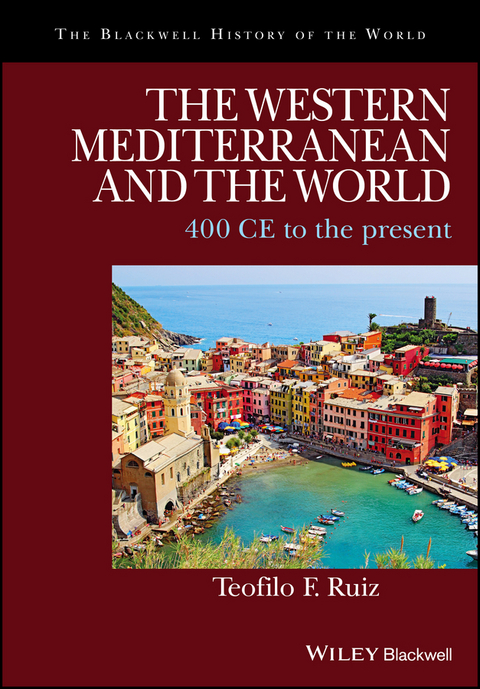
From the Straits of Gibraltar to Sicily, the European northern Mediterranean nations to the shores of North Africa, the western Mediterranean is a unique cultural and sociopolitical entity which has had a singular role in shaping today's global society. The Western Mediterranean and the World is the fascinating story of the rise of that peculiar world and of its evolution from the end of the Western Roman Empire to the present. Uniquely, rather than present the history of the region as a strict chronological progression, the author takes a thematic approach, telling his story through a series of vignettes, case studies, and original accounts so as to provide a more immediate sense of what life in and around the Mediterranean was like from the end of the Roman Empire in the West to the present immigration crisis now unfolding in Mediterranean waters. Emphasizing the development of religion and language and the enduring synergies and struggles between Christian, Jews, and Muslims on both shores of the western sea, Dr. Ruiz connects the region to the larger world and locates the development of Mediterranean societies within a global context.
- Describes the move from religious and linguistic unity under Roman rule to the fragmented cultural landscape of today
- Explores the relationship of language, culture, and geography, focusing on the role of language formation and linguistic identity in the emergence of national communities
- Traces the movements of peoples across regions and their encounters with new geographical, cultural, and political realities
- Addresses the emergence of various political identities and how they developed into set patterns of political organization
- Emphasizes the theme of encounters as seen from Christian, Muslim, and Jewish perspectives
While it is sure to become a definitive text for university courses on Mediterranean history, The Western Mediterranean and the World will also have great appeal among scholars of the Mediterranean as well as general readers of history.
TEOFILO F. RUIZ, PhD is Distinguished Professor of History and of Spanish and Portuguese Literature, at UCLA, Los Angeles, CA, USA. A scholar of the social and popular culture of late medieval and early modern Spain, Dr. Ruiz received the UCLA Distinguished Teaching Award in 2008, and was selected the Faculty Research lecturer for 2011-12. He received a National Humanities Medal in 2011 for his 'inspired teaching and writing,' a doctor honoris causa from the Universidad de Cantabria, Spain in 2017.
TEOFILO F. RUIZ, PhD is Distinguished Professor of History and of Spanish and Portuguese Literature, at UCLA, Los Angeles, CA, USA. A scholar of the social and popular culture of late medieval and early modern Spain, Dr. Ruiz received the UCLA Distinguished Teaching Award in 2008, and was selected the Faculty Research lecturer for 2011-12. He received a National Humanities Medal in 2011 for his "inspired teaching and writing," a doctor honoris causa from the Universidad de Cantabria, Spain in 2017.
Series Editor's Preface ix
Acknowledgments xiii
1 The Western Mediterranean: Sites of Encounter and Cultural Production 1
Part I Geography, History, and Cultural Contexts 17
2 The Imperatives of Geography and Climate: Sea and Land in the Western Mediterranean 19
3 History in the Mediterranean: From Unity to Fragmentation, circa 450 CE until the Early Modern World 47
4 History in the Mediterranean: The Making of the Modern World 75
5 Religions of the Western Mediterranean: Unity and Fragmentation in the Religious History of the Sea 105
6 Religions of the Western Mediterranean: Conversos and Renegades 125
7 Language, Culture, and Community in the Western Mediterranean 145
Part II Mediterranean Encounters 169
8 Encounters I: Traveling in the Western Mediterranean 171
9 Encounters II: The Mediterranean as a Site of Conflict, Movement, and Encounter 197
10 Between Two Worlds: Iberia, Sicily, Tunis, Algiers, and Marseille 227
11 On the Waters of the Western Mediterranean: Islands and Towns 265
12 Epilogue: The Western Mediterranean and the World 297
Bibliography 323
Index 335
[1]
The Western Mediterranean: Sites of Encounter and Cultural Production
Mediterráneo
Lyrics of a song by Joan Manuel Serrat
Quizá porque mi niñez sigue jugando en tu playa y escondido tras las cañas duerme mi primer amor llevo tu luz y tu olor por donde quiera que vaya y amontonado en tu arena guardo amor, juegos y penas.
Yo que en la piel tengo el sabor amargo del llanto eterno que han vertido en ti cien pueblos de Algeciras a Estambul para que pintes de azul sus largas noches de invierno a fuerza de desventuras tu alma es profunda y oscura.
A tus atardeceres rojos se acostumbraron mis ojos como el recodo al camino soy cantor, soy embustero, me gusta el juego y el vino, tengo alma de marinero. !Qué le voy hacer! si yo nací en el Mediterráneo.
Y te acercas y te vas después de besar mi aldea jugando con la marea te vas pensando en volver eres como una mujer perfumadita de brea que se añora y que se quiere, que se conoce y se teme.
!Ay!, si un día para mi mal viene a buscarme la parca empujad al mar mi barca con un levante otoñal y dejad que el temporal desguace sus alas blancas y a mi enterradme sin duelo entre la playa y el cielo.
En la ladera de un monte más alto que el horizonte quiero tener buena vista mi cuerpo será camino, le daré verde a los pinos y amarillo a la…. Cerca del mar porque yo nací en el Mediterráneo.
Source: http://fotos.euroresidentes.com/fotos/postales_Alicante/Mar_Mediterraneo_Azul/imagepages/image22.html. The song, as written and performed by Joan Manuel Serrat, may be found on youtube.com or on Google under “Yo nací en el Mediterráneo.”
In Joan Manuel Serrat's extraordinarily lyrical song “Mediterráneo” (1970), the gifted Catalan singer presents us with a moving vision of the Mediterranean Sea. His song captures the sea's essence far more compellingly than historiographical debates or scholarly works may do. In its moving lyrics, Serrat packs an emotional and psychological punch that goes to the very heart of the issues this book seeks to address. The portrait of the Mediterranean that emerges from his well-crafted song is a complex one, aiming to grasp and explain what it means to be born and to grow by the shores of a sea or an ocean, and, in Serrat's case, to be born by the shores of the Mediterranean. Perhaps because I too was born and grew up by the shores of a sea (the Caribbean) – a different sea indeed but as beguiling nonetheless – the song speaks to me in ways that it may not do to someone bound to the land and not to the ocean.
In Serrat's song, the protagonist carries the “light and smell of the Mediterranean on his skin,” but also the “bitter taste of the tears shed by a hundred different people [nations] from Algeciras to Istanbul.” We gaze therefore on the whole span of the Middle Sea: from one of its most westernmost towns, Algeciras, a town redolent with its Muslim past and Arabic name, to the magical city of Istanbul with its Roman, Greek, and Ottoman overlapping histories. “Mediterranean” evokes the love dreams of childhood and adolescence, but also the accumulated bitter memories of many generations. The sea, compared in a song to a woman – and in several Romance languages the sea is either feminine, as in la mer in French, or has changing gender registers, either masculine: el mar es azul (the sea is blue), or feminine: echar un barco a la mar (to sail a boat in the sea) in Spanish – is longed for, loved, known and unknown, feared. The Mediterranean is a space of storms, long winter nights – something that we seldom associate with the Mediterranean, but which is another of its realities. But the Mediterranean is also is a sea of crystalline blue.
Nothing, however, is more telling about the relations of people to the sea than the song's reoccurring phrase: “yo nací en el Mediterráneo.” I was born, Serrat insists, not in Spain, not in Catalonia. I was born, he reminds us throughout the song, on the shores of a sea that has shaped my identity, my memories, my hopes, and my sadness. And seas truly shape one's identity – whether Serrat's, mine, or those of others born by the shores of a sea – in ways not very different but far more intense than the identities shaped by nations. The fluid and constructed way in which Serrat identifies himself is not very different from the manner in which I have often, through my very long life, identified myself as “having been born in the Caribbean.” That is, not born in Cuba itself, but born by the shores of a sea that gives me a shared culture, language, music, and identity with all those who came from the collection of islands that dot the Caribbean Sea. Thus, my Caribbean identity remains the constant in the long list of all other sorts of identities gained and lost over the decades of my life. And, yet, my connection with the sea remains stronger than identities constructed by political jurisdictions, ideological loyalties, and the like. Written in 1970, Serrat's wonderful song reached out to a world outside Franco's repressive Spain (especially towards the Catalans) and pledged allegiance to something older, broader, and far more enduring than the demands of the nation-state.
This overlapping set of identities, this sense of belonging to an ancestral sea that is our home, can also be found in the Mediterranean Sea's quintessential novel, Alexander Dumas's enchanting The Count of Monte Cristo. Although the late chapters of the novel have Paris as a setting, far away from the warm shores of the Mediterranean, the site for its early dramatic developments that power the entire novel are firmly bound with the history of the sea. From the ship, the Pharaon, that brought Edmund Dantès from Smyrna, Trieste, Naples, Civitavecchia, and the island of Elba to Marseille and his cruel destiny, from the fears about the fate of the Pharaon in a later voyage and thus the threat to the financial fate of the Morrell family, to the Catalan community on the fringes of Marseille, the Mediterranean Sea is ever present, as are its uncertainty, passionless cruelties, and rewards. In The Count of Monte Cristo we also meet those sailors – a mysterious and heterogeneous crew in the service of the Count. Their places of origin were to be found in many different towns and islands dotting the Mediterranean. They spoke a lingua franca, understood only by those who lived in the sea; they had no home or loyalty to any nation, except to their calling, to their master, to their sea. We also meet bandits on the outskirts of Rome, a reminder of Braudel's description of violence and banditry as resistance to the state in his study of the Mediterranean in the age of Philip II (see below). In Dumas's fictional work, bandits remained a fixture of the nineteenth-century Mediterranean landscape.
In a lesser key, Pérez Reverte's entertaining novel, La reina del sur (The Queen of the South), a novel inspired loosely by The Count of Monte Cristo, presents us, once again, with a group of men carrying drugs between North Africa and Spain. Their allegiances, diverse places of origin, and identities are erased by their illicit activities and by the brotherhood of the sea. That the protagonist of the novel is a Mexican woman, fleeing to Spain away from the violence and vengeance of drug lords, serves only as a reminder, though a fictional one, of the manner in which the Mediterranean, ancient or present, has always been connected to a broader world beyond its shores.
There were of course earlier fictional histories spanning the Mediterranean and bringing into focus the transnational character of the Sea. Storytelling describing the links that bound the Middle Sea is also an important part of this book. These stories often glossed the inextricable relations between Muslims and Christians along the shores of the Mediterranean, or the movement from one shore to another. In Johanot Martorell's Tirant lo Blanch (late fifteenth century), for example, the hero, born in Brittany, travels (and fights) in France, England, and the eastern Mediterranean. Serving the Byzantine emperor in his campaigns against the Ottoman Turks, Tirant, one of Cervantes's most beloved characters and mentioned most lovingly in Don Quixote, is a very different knight from the usual preposterous and hard-to-believe warriors of late medieval romances. Through Tirant's deeds, we see a portrait of the diversity and “connectivity” of the entire sea.
Flores y Blancaflor, a medieval text I will revisit in greater detail in Chapter 9, was also a Mediterranean romance (most likely of southern French origin), with versions in several languages. The entire fictional story was integrated as historical fact into one of Alfonso X of Castile's (1252–1284) works. As was often the case, it told the story of a romance between a Muslim and a Christian, alerting us to the porous sexual frontiers, notwithstanding the strict rules governing interfaith sexual liaisons that existed along the shores of the Mediterranean. In Chapter 9, I will discuss Simon Barton's remarkable recent book on the subject of interfaith sexual and romantic liaisons, but we must now move from fiction to history and...
| Erscheint lt. Verlag | 12.9.2017 |
|---|---|
| Reihe/Serie | Blackwell History of the World |
| Blackwell History of the World | Blackwell History of the World |
| Sprache | englisch |
| Themenwelt | Geisteswissenschaften ► Geschichte ► Allgemeine Geschichte |
| Geisteswissenschaften ► Geschichte ► Regional- / Ländergeschichte | |
| Schlagworte | christian mediterranean history • Cultural History • cultural history of the mediterranean • early modern Mediterranean • Europäische Geschichte • European History • french mediterranean • Geschichte • greek mediterranean • History • history mediterranean religious struggles • history of mediterranean languages • history of mediterranean nations</p> • history of mediterranean trade • history of the Mediterranean • italian mediterranean • jewish mediterranean history • <p>history • mediterranean africa • mediterranean cultures • Mediterranean history • mediterranean in the dark ages • mediterranean in the middle ages • mediterranean political history • mediterranean societies • Mittelmeerländer /Geschichte • muslim mediterranean history • Social History • social history of the mediterranean • spanish mediterranean • western mediterranean climate • western mediterranean cultures • western mediterranean from the roman empire to the 21st century • western mediterranean geography • western mediterranean history • western mediterranean societies |
| ISBN-13 | 9781118871430 / 9781118871430 |
| Informationen gemäß Produktsicherheitsverordnung (GPSR) | |
| Haben Sie eine Frage zum Produkt? |
 EPUB (Adobe DRM)
Kopierschutz: Adobe-DRM
Adobe-DRM ist ein Kopierschutz, der das eBook vor Mißbrauch schützen soll. Dabei wird das eBook bereits beim Download auf Ihre persönliche Adobe-ID autorisiert. Lesen können Sie das eBook dann nur auf den Geräten, welche ebenfalls auf Ihre Adobe-ID registriert sind.
Details zum Adobe-DRM
Dateiformat: EPUB (Electronic Publication)
EPUB ist ein offener Standard für eBooks und eignet sich besonders zur Darstellung von Belletristik und Sachbüchern. Der Fließtext wird dynamisch an die Display- und Schriftgröße angepasst. Auch für mobile Lesegeräte ist EPUB daher gut geeignet.
Systemvoraussetzungen:
PC/Mac: Mit einem PC oder Mac können Sie dieses eBook lesen. Sie benötigen eine
eReader: Dieses eBook kann mit (fast) allen eBook-Readern gelesen werden. Mit dem amazon-Kindle ist es aber nicht kompatibel.
Smartphone/Tablet: Egal ob Apple oder Android, dieses eBook können Sie lesen. Sie benötigen eine
Geräteliste und zusätzliche Hinweise
Buying eBooks from abroad
For tax law reasons we can sell eBooks just within Germany and Switzerland. Regrettably we cannot fulfill eBook-orders from other countries.
aus dem Bereich