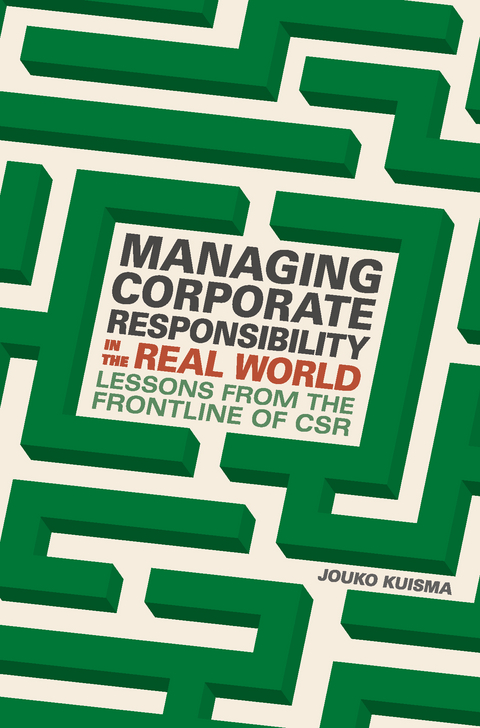
Managing Corporate Responsibility in the Real World (eBook)
XXIII, 247 Seiten
Springer International Publishing (Verlag)
978-3-319-54078-8 (ISBN)
This book is a comprehensive, road-tested framework for managing Corporate Social Responsibility (CSR) based on years of award winning performance in senior management roles in a multinational business.
The author shows why non-financial performance indicators are just as important as financial ones when it comes to delivering performance and securing long term shareholder value.
CSR is not window dressing, it is not a tiresome box ticking exercise and it is not a cost centre. Done properly, CSR is a cost-saving, simple everyday process that adds value to your business. While most companies already have suitable founding values and have carried out some basic CSR measures, many lack the systematics for managing the issue holistically across the business.
Beginning with a CSR briefing paper for managers new to the area (or for providing to senior management who may need convincing) Managing Corporate Responsibility in the Real World goes on to provide a fully integrated framework for delivering a corporate responsibility programme in your organization. Drawing on real world examples and stories, Jouko Kuisma shows how to start with the political practicalities of setting up an internal steering group to analysis of your firm's value chain and management principles before drawing up an action plan and set of performance criteria on which to be measured.
Jouko Kuisma spent thirty years as a senior manager at Kesko Corporation, a publicly listed retail group Northern and Eastern Europe with a turnover of 9 billion euros, rising to Head of Corporate Responsibility, reporting directly to the Deputy CEO. While at Kesko, Jouko steered the group to an enviable position in the CSR world, winning the UNEP/ICC Business Award for Sustainable Partnerships, in 2002 and consistently earning places on all te leading Corporate Responsible listings including DJSI, FTSE4Good, STOXX Globale ESG Leaders, Ethibel and the Global 100 Most Sustainable Corporations list where Kesko was the best retail company of Global 100. Since stepping from his role in 2007 Jouko has been a regular speaker and lecturer on CSR issues in Finland and abroad, and he has consulted over 20 companies in developing corporate responsibility.
Jouko Kuisma spent thirty years as a senior manager at Kesko Corporation, a publicly listed retail group Northern and Eastern Europe with a turnover of 9 billion euros, rising to Head of Corporate Responsibility, reporting directly to the Deputy CEO. While at Kesko, Jouko steered the group to an enviable position in the CSR world, winning the UNEP/ICC Business Award for Sustainable Partnerships, in 2002 and consistently earning places on all te leading Corporate Responsible listings including DJSI, FTSE4Good, STOXX Globale ESG Leaders, Ethibel and the Global 100 Most Sustainable Corporations list where Kesko was the best retail company of Global 100. Since stepping from his role in 2007 Jouko has been a regular speaker and lecturer on CSR issues in Finland and abroad, and he has consulted over 20 companies in developing corporate responsibility.
Managing Corporate Responsibility in the Real World 3
Foreword 5
Acknowledgements 8
Contents 9
About the Authors 16
List of Figures 18
List of Tables 19
1 The Lay of the Land 20
1.1 Responsibility Ensures and Improves Profits 20
1.2 Four Stages of Stakeholder Influence 22
1.2.1 Believe Me, When I Say 22
1.2.2 Tell Me, When I Ask 22
1.2.3 Prove Your Claims 22
1.2.4 Involve Me 23
1.3 New Concepts for Management 23
1.3.1 ‘Triple Bottom Line’ Covers More Than the Traditional Income Statement 23
1.3.2 Terms Are Still a Bit Lost 25
1.4 Plenty of Subjects in the Public Eye 26
1.4.1 Climate Change, Carbon Footprint 27
1.4.2 ?Energy Efficiency 29
1.4.3 ?Material Efficiency 29
1.4.4 ?Water Footprint 30
1.4.5 ?Responsible Supply Chain 31
1.4.6 ?Human Rights 31
1.4.7 ?Tax Footprint 32
1.4.8 ?Chemicals 33
1.4.9 ?Well-Being at Work 34
1.4.10 Corruption, Bribery and the Grey Economy 35
1.4.11 Animal Welfare 35
1.5 Plenty of Organizations Involved 36
1.5.1 The United Nations 36
1.5.2 ?The UN Global Compact 39
1.5.2.1 Human Rights 39
1.5.2.2 Labour Standards 39
1.5.2.3 Environment 39
1.5.2.4 Anti-Corruption 40
1.5.3 UN Guiding Principles on Business and Human Rights 40
1.5.4 ?ILO and Other UN Suborganizations 41
1.5.5 ?The UN Principles for Responsible Investment 42
1.5.6 Global Reporting Initiative 43
1.5.7 OECD 44
1.5.8 International Organization for Standardization (ISO) 45
1.5.9 The International Chamber of Commerce 45
1.5.10 European Union 47
1.5.10.1 EU Commission and EU Parliament 47
1.5.11 BusinessEurope, CSR Europe 50
1.5.12 Finland as a Country Case 51
1.5.12.1 Finnish Government and Ministries 51
1.6 How to Follow the Development of Corporate Responsibility 52
1.7 Features of a Responsible Company 54
2 Developing a Management Model for Corporate Responsibility 56
2.1 A Simplified Model for Managing Corporate Responsibility 57
2.2 Setting up a Steering Group 58
2.2.1 Members of the Steering Group 58
2.2.2 Working Programme of the Steering Group 59
2.2.3 Timing of the Steering Group’s Work 60
2.2.4 The CR Organization After the Development Project Phase 60
2.3 Overall Basis for CR Management 62
2.3.1 Corporate Values 62
2.3.1.1 ?How Should Values Be Defined? 63
2.3.1.2 ?Values Are Promises That Need to Be Measured 64
2.3.1.3 ?Summary of Values as Basis for Managing Corporate Responsibility 65
2.3.2 Vision of Corporate Responsibility 66
2.3.2.1 ?Weak Signals in Outlining Visions 67
2.3.2.2 ?The Finnish Strategy for Natural Resources Used Weak Signals and Mini-Scenarios 68
2.3.3 Corporate Responsibility in Corporate Strategy 69
2.4 Stakeholder Assessment 71
2.4.1 Identifying the Key Stakeholders 71
2.4.2 Examining the Stakeholders’ Expectations and Requirements 72
2.4.3 Company’s Own Actions in Response to the Expectations and Requirements 73
2.4.4 Indicators for Monitoring the Success of the Actions 73
2.4.5 Our Expectations of the Stakeholders 74
2.4.6 Indicators for Measuring Success of Stakeholder Cooperation 74
2.5 Risk Assessment 75
2.6 SWOT Analysis 79
2.7 Evaluation of Own Present State and Comparison with Competitors 79
2.8 Identifying Material Aspects of Own Responsibility 81
2.8.1 Materiality Assessment, Defining the Boundaries 83
2.8.1.1 ?Defining the Boundaries 83
2.8.2 The Order of Importance of Performance Indicators 85
2.8.3 Essential Issues in Materiality Assessment 86
3 Economic Responsibility 88
3.1 Economic Value Generated and Distributed to Stakeholders (EC1) 89
3.2 Financial Implications and Other Risks and Opportunities Due to Climate Change (EC2) 91
3.3 Standard Entry Level Wage by Gender Compared to Local Minimum Wage (EC5) 91
3.4 Proportion of Spending on Local Suppliers at Significant Locations of Operation (EC9) 92
4 Environmental Responsibility 95
4.1 Materials used (EN1), Share of Recycled Materials (EN2) 96
4.1.1 Reporting on Materials Used is Still Small-Scale 97
4.1.2 Chemicals Should Be Included 97
4.2 Use of Energy, Energy Efficiency, Greenhouse Gas Emissions (EN3EN7, EN15–19) 98
4.2.1 Energy Companies Are Too Slow in Counting Their Environmental Profile 100
4.2.2 It Makes Sense to Calculate Your Own Emissions 101
4.2.3 How Carbon-Free Is the So-Called ‘Carbon-Free Electricity’ 102
4.2.4 Environmental Label for Electricity 103
4.2.5 Carbon Compensations 104
4.2.6 Reducing Emissions 105
4.2.7 The Material on Climate Change is Endless on the Internet 107
4.3 Biodiversity Issues 107
4.4 Use, Recycling, Reuse of Water EN8–10, Water Discharge EN22 108
4.5 Other Significant Air Emissions EN20 and EN21 108
4.6 Handling of Waste and Hazardous Waste EN23 and EN25, Significant Spills EN24 109
4.7 Environmental Impacts of Products and Services EN27–28 111
4.7.1 More Thorough Information for Professionals 111
4.7.2 Easy-to-Adopt Environmental Labels for Consumers 112
4.7.3 Results Through Product Development 113
4.8 Carbon and Water Footprint in Product Labelling 115
4.8.1 Carbon Footprint 115
4.8.2 Water Footprint 118
4.8.3 Environmental Criteria in Public Procurement 119
4.9 Transport of Materials, Products and Employees EN30 119
4.9.1 Purchase Delivery Transport 120
4.9.2 Delivery Transport 120
4.9.3 Transport Is Only Part of the Life Cycle 122
4.10 Screening of Suppliers Using Environmental Criteria EN32 and EN33 123
5 Responsible Managing of Own Human Resources 125
5.1 Job Satisfaction 126
5.1.1 Job Satisfaction Indicators 127
5.2 Basic Data About Employees (LA1) 128
5.3 Employee Turnover (Part of LA1) 129
5.4 Health and Safety (LA6) 130
5.4.1 Sick Days 130
5.4.2 Accidents 131
5.4.3 GRI Indicators Emphasize Injuries at Work 132
5.5 Training (LA9), Skills Management, Lifelong Learning (LA10) 132
5.6 Performance and Career Development Reviews (LA11) 134
5.7 Equal Remuneration for Women and Men (LA13) 134
5.8 Labour/Management Relations (LA4), Health and Safety Committees (LA5) 135
5.9 The Company’s Attractiveness as a Workplace 136
5.10 Other HR Indicators of GRI 136
6 Responsible Supply Chain 138
6.1 In the European Union the Workers’ Rights Are Respected – at Least in Theory 139
6.2 In Developing Countries the Control of Labour Legislation is Insufficient 140
6.3 The Partners Have to Obey the National Laws and ILO Conventions – Nothing Special in That! 141
6.4 Minimum Requirements for Working Conditions and Terms 142
6.4.1 Freedom of Association and Right to Collective Bargaining 142
6.4.2 Equality, Discrimination, Treatment of Employees 145
6.4.3 Working Hours 145
6.4.4 Remuneration 146
6.4.5 The Importance of a Living Wage 147
6.4.6 Health and Safety at Work 150
6.4.7 Child Labour 151
6.4.8 Forced Labour and Disciplinary Measures 152
6.4.9 Controlling Must Be Plausible 153
6.5 Social Auditing Schemes 155
6.5.1 Social Accountability SA 8000 Standard (www.sa-intl.org) 155
6.5.2 Ethical Trading Initiative (ETI), SEDEX Database (www.ethicaltrade.org, www.sedexglobal.com) 156
6.5.3 Business Social Compliance Initiative (BSCI) (www.bsci-intl.org) 157
6.5.4 Fair Wear Foundation (FWF) (www.fairwear.org) 158
6.5.5 Fair Trade Labelling (www.fairtrade.net) 158
6.5.6 Other Schemes for Monitoring Labour Rights 159
6.6 Summary of Responsible Sourcing 161
6.7 How to Proceed in Developing Responsible Sourcing? 163
6.7.1 GRI’s Instructions for Screening Suppliers Are Non-specific 167
6.8 Human Rights Related to Sourcing 168
7 Social Impacts 171
7.1 Relations with Local Community SO1, SO2 171
7.2 Corruption and Bribery SO3–5 172
7.3 Political Contributions SO6 175
7.3.1 A Company as a Political Donator 176
7.4 Breaches of Legislation 176
8 Product Responsibility 178
9 Materiality Assessment in a Matrix 180
10 Management Principles Guiding Corporate Responsibility 183
10.1 Public Management Principles Are Important 183
10.1.1 ?Code of Conduct 185
10.1.2 ?International Commitments of Corporate Responsibility 186
10.2 Environmental Policy 186
10.2.1 ?HR Policy 187
10.2.2 ?Principles of Responsible Sourcing 188
10.2.3 ?Principles of Risk Management 189
10.2.4 ?Product Policy, Product Statements 190
10.2.5 ?Communications Policy 191
10.2.6 ?Sponsoring Principles 191
10.3 Standards Assisting Management Principles 192
10.3.1 ?Product Certifications 196
11 Drawing up the CR Action Plan 197
12 Reporting on Performance 201
12.1 Outline of the GRI Guidelines 201
12.1.1 Standard Disclosures of the GRI Recommendations 203
12.1.2 Fundamental Issues of Management 205
12.1.3 The Pain of Starting the Reporting 205
12.1.4 Reporting Software Saves Work 206
12.1.5 Profitability Aspects Are Worth Taking Along 206
12.1.6 Indicator Protocols 208
12.1.7 Style of Reporting 209
12.1.8 So, Who Would Read the CR Reports? 210
12.1.9 Assurance of the Report 212
12.1.10 ?GRI Content Index 213
12.1.11 ?How to Use the Report 214
12.2 The Future of CR Reporting 215
12.2.1 EU Directive on Non-Financial Reporting 215
12.2.2 Next Steps for GRI 217
12.2.3 Integrated Reporting 218
13 Communicating Corporate Responsibility 222
13.1 Corporate Responsibility on the Company’s Website 222
13.2 Communicating to Stakeholders 225
13.3 Introduce Persons in Charge 226
13.4 Corporate Responsibility in Marketing 227
14 Stakeholder Cooperation Revisited 229
14.1 Typical Weaknesses of Stakeholder Cooperation 231
14.1.1 ?Stakeholder Definitions Are Too Narrow 231
14.1.2 ?No Balance Has Been Found Between ‘Defence’ (Complying with the Norms) and ‘Offence’ (Strategic Opportunities) 232
14.1.3 ?The Company Takes the Defensive Position Too Early 232
14.1.4 ?Own Efforts Are Concealed 232
14.1.5 ?Communications Fail 233
15 New Year Resolutions 234
15.1 Spend Quality Time with Friends 234
15.2 Learn New and Exciting Skills 234
15.3 Lose Weight 235
15.4 Be more Honest 235
15.5 Get Rid of Old Bad Habits 235
15.6 Improve Grades 235
15.7 Become More Organized 235
15.8 Reduce Stress 236
15.9 Save Money 236
16 Summary 237
List of interviewees 239
List of useful web pages 240
United Nations 240
Other continents 240
Auditing/consulting companies 240
Social auditing of suppliers 240
CR Management Principles 240
Introducing persons in charge 240
CR News, articles, discussions 240
List of people I have quoted in my book 249
Essential issues in materiality assessment 240
New Year’s Resolutions 240
Index 251
| Erscheint lt. Verlag | 31.8.2017 |
|---|---|
| Zusatzinfo | XXIII, 247 p. 28 illus. |
| Verlagsort | Cham |
| Sprache | englisch |
| Themenwelt | Geisteswissenschaften ► Philosophie ► Allgemeines / Lexika |
| Wirtschaft ► Betriebswirtschaft / Management ► Unternehmensführung / Management | |
| Schlagworte | Corporate Social Responsibility • CSR • Management • Managers • Reputation • Responsibility |
| ISBN-10 | 3-319-54078-5 / 3319540785 |
| ISBN-13 | 978-3-319-54078-8 / 9783319540788 |
| Informationen gemäß Produktsicherheitsverordnung (GPSR) | |
| Haben Sie eine Frage zum Produkt? |
 PDF (Wasserzeichen)
DRM: Digitales Wasserzeichen
Dieses eBook enthält ein digitales Wasserzeichen und ist damit für Sie personalisiert. Bei einer missbräuchlichen Weitergabe des eBooks an Dritte ist eine Rückverfolgung an die Quelle möglich.
Dateiformat: PDF (Portable Document Format)
Mit einem festen Seitenlayout eignet sich die PDF besonders für Fachbücher mit Spalten, Tabellen und Abbildungen. Eine PDF kann auf fast allen Geräten angezeigt werden, ist aber für kleine Displays (Smartphone, eReader) nur eingeschränkt geeignet.
Systemvoraussetzungen:
PC/Mac: Mit einem PC oder Mac können Sie dieses eBook lesen. Sie benötigen dafür einen PDF-Viewer - z.B. den Adobe Reader oder Adobe Digital Editions.
eReader: Dieses eBook kann mit (fast) allen eBook-Readern gelesen werden. Mit dem amazon-Kindle ist es aber nicht kompatibel.
Smartphone/Tablet: Egal ob Apple oder Android, dieses eBook können Sie lesen. Sie benötigen dafür einen PDF-Viewer - z.B. die kostenlose Adobe Digital Editions-App.
Buying eBooks from abroad
For tax law reasons we can sell eBooks just within Germany and Switzerland. Regrettably we cannot fulfill eBook-orders from other countries.
aus dem Bereich