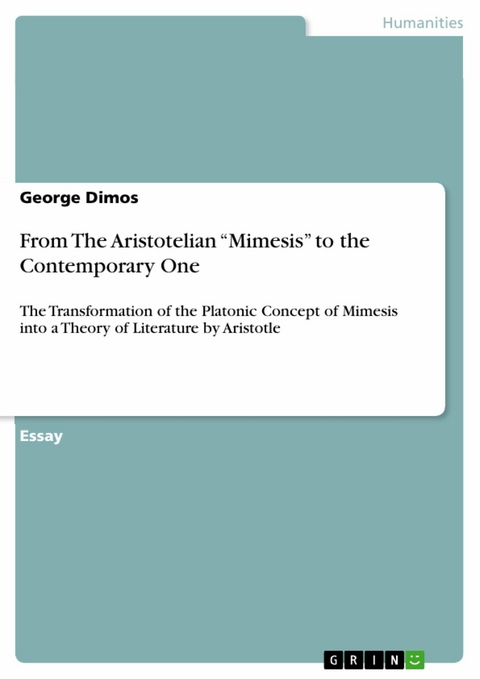
From The Aristotelian “Mimesis” to the Contemporary One (eBook)
38 Seiten
GRIN Publishing (Verlag)
9783668504974 (ISBN)
When dealing with the “Poetics” of Aristotle, we can select (as a tool through which we will better analyse the concept of literature which he has produced) between the analysis of some standard – basic concepts which are found in his treatise; for example the concept of hamartia, the concept of katharsis, the concept of simple and complex tragedy, the concept of mimesis or to analyze the tragic character as it is presented in Aristotle.
I chose to use the concept of mimesis since, it is a more technical concept (or at least semi-technical) and in this way it is more related to the technical analysis of the contemporary literary criticism.
I also chose this tool in order to check if the theory of mimesis in Aristotle and in Plato coincide or not (some authors take it as synonymous).
The text is divided into six parts.
- The first part will deal with a fictional presentation (view) of when the concept of imitation first appeared.
- The second part I will deal with the duplicity of the ‘mimeisthai’ in Plato’s works.
- In the third part I will present two basic differences in the way Aristotle and Plato conceive the concept of mimesis .
- In the fourth part I’ll deal with the basic concepts of Aris-totle’s method (formal analysis).
- In the fifth part I will examine the concept of pleasure in Aristotle’s Poetics.
- The sixth part will deal with theories which tried to bring something of the technicalities and the spirit of the Aristotelian analysis in our century. I will also present the modern schools of literary criticism which make much of what Plato disqualifies in mimesis: the mask, the disappearance of the author, the simulacrum, anonymity, apocryphal textuality and so on.
| Erscheint lt. Verlag | 16.8.2017 |
|---|---|
| Verlagsort | München |
| Sprache | englisch |
| Themenwelt | Geisteswissenschaften ► Philosophie ► Geschichte der Philosophie |
| Geisteswissenschaften ► Philosophie ► Philosophie Altertum / Antike | |
| Schlagworte | Aeschylus • Aesthetics • Aristotle • ART • Arthur Danto • black aesthetics • catharsis • Chicago School • Collingwood • Cratylus • David Daiches • Deconstructive Criticism • Dissemination • Emotion • ethics • Euripides • Feminist criticism • Gilbert Ryle • G.M.A. Grube • Greek Philosophy • Greek tragedy • hamartia • Hamlet • H.D.F. Kitto • Hellenistic • hermeneutics • Illusion • Imitation • Irony • Jacques Derrida • Leftist Criticism • Literary criticism • Literary Structuralism • Literature • magical art • Metaphysics • Mimesis • Myth Criticism • Necessity • New Criticism • New York (Jewish) Intellectuals • Northrop Frye • Pericles • Phaedrus • Phenomenological and Existential Criticism • Philosophy • Plato • Platonic Forms • Pleasure • Poetics • Poetry • Possibility • Psychology • Reader – response Criticism • Representation • Republic • Semiotics • Sophist • Sophocles • Stephen Halliwell • UNITY • universals • Vincent B. Leitch • Ηirsch |
| ISBN-13 | 9783668504974 / 9783668504974 |
| Informationen gemäß Produktsicherheitsverordnung (GPSR) | |
| Haben Sie eine Frage zum Produkt? |
 PDF (Ohne DRM)
Digital Rights Management: ohne DRM
Dieses eBook enthält kein DRM oder Kopierschutz. Eine Weitergabe an Dritte ist jedoch rechtlich nicht zulässig, weil Sie beim Kauf nur die Rechte an der persönlichen Nutzung erwerben.
Dateiformat: PDF (Portable Document Format)
Mit einem festen Seitenlayout eignet sich die PDF besonders für Fachbücher mit Spalten, Tabellen und Abbildungen. Eine PDF kann auf fast allen Geräten angezeigt werden, ist aber für kleine Displays (Smartphone, eReader) nur eingeschränkt geeignet.
Systemvoraussetzungen:
PC/Mac: Mit einem PC oder Mac können Sie dieses eBook lesen. Sie benötigen dafür einen PDF-Viewer - z.B. den Adobe Reader oder Adobe Digital Editions.
eReader: Dieses eBook kann mit (fast) allen eBook-Readern gelesen werden. Mit dem amazon-Kindle ist es aber nicht kompatibel.
Smartphone/Tablet: Egal ob Apple oder Android, dieses eBook können Sie lesen. Sie benötigen dafür einen PDF-Viewer - z.B. die kostenlose Adobe Digital Editions-App.
Buying eBooks from abroad
For tax law reasons we can sell eBooks just within Germany and Switzerland. Regrettably we cannot fulfill eBook-orders from other countries.
aus dem Bereich