


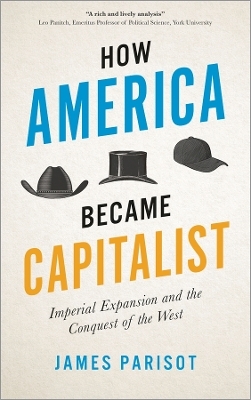
How America Became Capitalist
Imperial Expansion and the Conquest of the West
Seiten
2019
Pluto Press (Verlag)
978-0-7453-3787-6 (ISBN)
Pluto Press (Verlag)
978-0-7453-3787-6 (ISBN)
An epic history spanning 500 years of the formation of American capitalism, as viewed through the prisms of gender, race and Empire. Parisot debunks the myth that America is 'naturally' capitalistic through an intelligent reading of its history.
Has America always been capitalist? Today, the US sees itself as the heartland of the international capitalist system, its society and politics intertwined deeply with its economic system. This book looks at the history of North America from the founding of the colonies to debunk the myth that America is 'naturally' capitalist.
From the first white-settler colonies, capitalist economic elements were apparent, but far from dominant, and did not drive the early colonial advance into the West. Society, too, was far from homogeneous - as the role of the state fluctuated. Racial identities took time to imprint, and slavery, whilst at the heart of American imperialism, took both capitalist and less-capitalist forms. Additionally, gender categories and relations were highly complex, as standards of `manhood' and `womanhood' shifted over time to accommodate capitalism, and as there were always some people challenging this binary.
By looking at this fascinating and complex picture, James Parisot weaves a groundbreaking historical materialist perspective on the history of American expansion.
Has America always been capitalist? Today, the US sees itself as the heartland of the international capitalist system, its society and politics intertwined deeply with its economic system. This book looks at the history of North America from the founding of the colonies to debunk the myth that America is 'naturally' capitalist.
From the first white-settler colonies, capitalist economic elements were apparent, but far from dominant, and did not drive the early colonial advance into the West. Society, too, was far from homogeneous - as the role of the state fluctuated. Racial identities took time to imprint, and slavery, whilst at the heart of American imperialism, took both capitalist and less-capitalist forms. Additionally, gender categories and relations were highly complex, as standards of `manhood' and `womanhood' shifted over time to accommodate capitalism, and as there were always some people challenging this binary.
By looking at this fascinating and complex picture, James Parisot weaves a groundbreaking historical materialist perspective on the history of American expansion.
James Parisot is an affiliate faculty member in Sociology at Drexel University. He has published articles in a variety of scholarly journals, is co-editor of the book American Hegemony and the Rise of Emerging Powers: Cooperation or Conflict? (Routledge, 2017), and is the author of How America Became Capitalist: Imperial Expansion and the Conquest of the West (Pluto, 2019).
Introduction: The United States as an Empire
1. The Origins of Colonial Society
2. The Expansion of Empire
3. Kentucky and Ohio
4. Slavery and Capitalism
5. The Progress of Empire
6. The Consolidation of the American Capitalism
Conclusion: Capital and the Conquest of Space
References
| Erscheinungsdatum | 25.02.2019 |
|---|---|
| Verlagsort | London |
| Sprache | englisch |
| Maße | 135 x 215 mm |
| Themenwelt | Geisteswissenschaften ► Geschichte ► Regional- / Ländergeschichte |
| Wirtschaft ► Volkswirtschaftslehre ► Wirtschaftspolitik | |
| ISBN-10 | 0-7453-3787-2 / 0745337872 |
| ISBN-13 | 978-0-7453-3787-6 / 9780745337876 |
| Zustand | Neuware |
| Informationen gemäß Produktsicherheitsverordnung (GPSR) | |
| Haben Sie eine Frage zum Produkt? |
Mehr entdecken
aus dem Bereich



aus dem Bereich
die Geschichte meiner Urgroßmutter
Buch | Hardcover (2025)
C.H.Beck (Verlag)
CHF 32,15


