Critical Thinking (eBook)
John Wiley & Sons (Verlag)
978-1-119-02937-3 (ISBN)
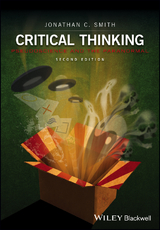
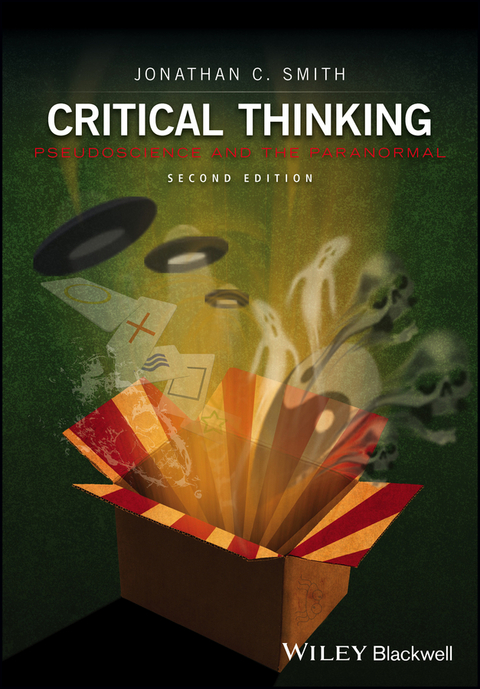
Comprehensive and engaging, this extensively revised edition of a student and instructor favorite introduces the basics of critical thinking using the claims of pseudoscience and the paranormal.
- Guides readers through the critical thinking process by considering different types of support (sources, logic, and scientific observation) and ruling out alternative explanations
- Allows students to practice and apply their new critical thinking skills on claims of extraordinary cures including energy treatments, complementary/alternative medicine and faith healing as well as four paranormal claims of consequence: astrology, spiritualism and the afterlife, parapsychology, and creationism.
- Couples a conversational, nontechnical narrative with student-friendly pedagogical tools, including critical thinking questions and a study guide for each chapter.
- Provides clear and open-minded discussions of the paranormal spectrum, belief justification surveys, the placebo effect, and the relationship between religion and critical thinking
JONATHAN C. SMITH is a Professor of Psychology at Roosevelt University, Founding Director of the Roosevelt University Stress Institute, and Head of the Pseudoscience and Paranormal Laboratory. He has published 23 books and has written numerous articles on critical thinking, advanced relaxation and mindfulness theory and practice, stress management, and spirituality and skepticism. In 1984 he founded the Roosevelt University Stress Institute primarily to combat pseudoscience in the field. He has created classroom and online classes specifically designed to teach critical thinking skills and evaluate extraordinary claims of the paranormal.
JONATHAN C. SMITH is a Professor of Psychology at Roosevelt University, Founding Director of the Roosevelt University Stress Institute, and Head of the Pseudoscience and Paranormal Laboratory. He has published 23 books and has written numerous articles on critical thinking, advanced relaxation and mindfulness theory and practice, stress management, and spirituality and skepticism. In 1984 he founded the Roosevelt University Stress Institute primarily to combat pseudoscience in the field. He has created classroom and online classes specifically designed to teach critical thinking skills and evaluate extraordinary claims of the paranormal.
Acknowledgments ix
Part I Introduction 1
1 Critical Thinking: Your Survival Kit 3
2 The Paranormal Spectrum 13
3 What's the Harm? Why Study These Things? 25
Part II The Critical Thinker's Toolkit 47
4 Sources 49
5 Logic (Bonus: The Big Four Informal Logical Fallacies) 61
6 Logic and Language: Fallacies of Ambiguity 79
7 Science 93
Part III Alternative Explanations 115
8 Oddities of Nature and the World of Numbers 117
9 Perceptual Error and Trickery 135
10 Memory Errors 155
11 The Placebo Effect 167
12 Sensory Phenomena, Hallucinations, and Psychiatric Conditions 189
Part IV Paranormal Challenges 211
13 Claims of Extraordinary Cures 213
14 From the Paranormal Sampler: Four Claims of Consequence 229
Appendix A: Why Do You Believe? 255
Appendix B: Belief Justification Survey 261
Notes 271
References 273
Index 295
1
Critical Thinking: Your Survival Kit
OUTLINE
- Critical Thinking Defined: Critical thinking is the process of (1) evaluating a claim about objective reality and identifying support, and (2) considering alternative hypotheses.
- Stating a Claim, Identifying Types of Support
- Appropriate sources
- Logic and clear language
- Science
- Alternative Hypotheses: Going Beyond Immediate Personal Experience and Intuition
- Oddities in nature and the world of statistics
- Perceptual error or trickery
- Memory error
- Placebo effect
- Sensory phenomena, hallucinations, and psychiatric conditions
- Stating a Claim, Identifying Types of Support
- Bats, Balls, and Mind‐Reading: Intuitive vs. Reflective Cognitive Thinking Styles
- The Time and Place for Critical Thinking
- Finding a Safe Practice Arena
- The Four Challenges of the Open‐Minded Critical Thinker
- Have the Courage to Pause and Reflect
- Question Fearlessly and Honestly
- Recognize that There May Be More to the World than Meets the Eye
- Admit You Might Be Totally Mistaken
Figure 1.1 What’s in your Pandora’s Box?.
Reproduced with kind permission of Shutterstock
Life can be a Pandora’s box of problems and mysteries. This includes all things great and small. Everyday challenges like starting college, dating, and finding work. Threats to society, like war, poverty, disease, and environmental disaster. Yes, even frantic internet exposés of mind‐controlling psychics, flesh‐eating vampires, and invasions from other universes. In a world full of troubles, every student needs one important survival kit – a toolbox of powerful critical thinking skills.
Consider Alex, a college student who faces a rather complicated dating dilemma. The first few dates went well. What to do next? Please study this carefully:
I think I’m ready for sex. I’m dating Jesse, who is fun to be with. But I doubt Jesse has any interest in romance. I’m not quite sure what I want.
I want to take Jesse to an art museum this weekend. There are two exhibits. I’ve seen both. Which has the more beautiful art?
I’m getting closer to both Jesse and Riley. I’ve gone out with both. It almost feels like I’m dating two people. Is that OK? Should I drop one and date the other? And what about Jamie, someone interesting I just met?
What does God want me to do? How can I tell the difference between God’s will and my wishes?
Julian, my roommate wants me to take a drink he obtained from a store that specializes in alternative medicine. Citing personal experience, Julian says it works and will help me make choices more decisively. Should I try it?
All these questions! Last night I had a dream that I dropped out of school and took a hike on a long mountain path to clear my head. Out of nowhere, a sage on a vintage Harley rumbled to a dramatic stop in front of me. I was struck by what this person was wearing – a glowing ruby eye earring, delicate flowered silk scarf, and steel‐studded leather arm band. As the dust settled, my Biker Sage whispered: “Think clearly!” blew me a kiss, and roared away. Should I take this premonition seriously?
Critical Thinking Defined
Fortunately, Alex is taking a course in critical thinking and hopes he can find some answers. He begins with some popular definitions. For example, his very first Google hit (out of 53,100,000 results) is a very popular definition:
Critical thinking is the intellectually disciplined process of actively and skillfully conceptualizing, applying, analyzing, synthesizing, and/or evaluating information gathered from, or generated by, observation, experience, reflection, reasoning, or communication, as a guide to belief and action. In its exemplary form, it is based on universal intellectual values that transcend subject matter divisions: clarity, accuracy, precision, consistency, relevance, sound evidence, good reasons, depth, breadth, and fairness.
(Scriven & Paul, 2014)
Such definitions are abstract and global and can be applied to a wide range of life’s challenges. Think “clearly.” Conceptualize “consistently.” Evaluate “fairly.” You could use these with just about any issue, whether it be one of romance, beauty, creativity, morality, God, science, the deeper mysteries of life, or even sex.
However, the majority of texts on critical thinking take a more focused approach. Put very simply, critical thinking boils down to two very simple questions:
What are the facts? How do we know they’re true?
To elaborate:
Critical thinking is the process of (1) evaluating a claim about objective reality and identifying support, and (2) considering alternative hypotheses.
This needs a little unpacking. Let’s examine each part of our definition.
Stating a Claim, Identifying Types of Support
First, critical thinking involves stating and testing reality claims against three types of support:
- Appropriate sources such as other people, groups, or institutions (Chapter 4);
- Correct use of the tools of logic and clear language (Chapter 5, Chapter 6); and
- Science (Chapter 7).
Alternative Hypotheses: Going Beyond Immediate Personal Experience and Intuition
Appropriate sources, logic and clear language, and scientific observation prompt us to be open to the possibility that there may be more than meets the eye, more to reality than what is apparent. They may suggest five alternative hypotheses. A mistaken conclusion that a paranormal claim is factual may be the result of:
- Oddities in nature and the world of statistics (Chapter 8);
- Perceptual error or trickery (Chapter 9);
- Memory error (Chapter 10);
- Placebo effect (Chapter 11);
- Sensory phenomena, hallucinations, and psychiatric conditions (Chapter 12).
This definition provides an outline of our text.
Critical thinking is reality checking. Thinking that masquerades as critical thinking, pretends to identify support, and fails to openly question personal experience and intuition is pseudoscientific thinking. A different way of looking at this is to consider the objectives. Is your goal to discover the facts (critical thinking) or protect your preconceived notions (pseudoscientific thinking)? Is your goal to put aside political, social, religious, or personal objectives in pursuit of the truth (critical thinking)? Or is it to “keep controversy alive” by sowing needless doubt and confusion in order to pursue another political, social, religious, or personal agenda (Oreskes & Conway, 2010)?
Figure 1.2 Bats and ball.
Reproduced with kind permission of Gettyimages.
Bats, Balls, and Mind‐Reading: Intuitive vs. Reflective Cognitive Thinking Styles
Stepping back, our definition is based on an important idea: the critical thinker takes pause and recognizes there may be more than immediate personal experience and intuition. First impressions and hunches, no how matter how vivid, may be misleading. One important area of cognitive research illustrates this idea. Consider these curious studies on the price of bats and balls.
An intuitive thinking style involves automatically going with one’s first instinct. A reflective thinking style involves questioning such first instincts and considering other possibilities (Frederick, 2005; Stanovich & West, 1998). An intuitive thinker accepts what immediately seems to be true. A reflective thinker takes pause, questions first instincts, and considers other possibilities. As such, reflective thinking allows for counterintuitive conclusions. Importantly, a reflective thinker can suppress an intuitive and spontaneous wrong answer in pursuit of a less obvious answer that may be correct.
The Cognitive Reflection Test (CRT; Frederick, 2005) is a remarkably powerful and brief test that measures reflective and intuitive cognitive thinking styles. It consists of only three questions. Try this frequently cited example: “A bat and a ball cost $1.10 in total. The bat costs $1.00 more than the ball. How much does the ball cost?”
Is your answer $0.10? This is the intuitive answer, but it is incorrect. Reflective thinkers tend to suppress this automatic and intuitive answer because they are suspicious of the first thing that comes to mind. As a result, they are more likely to come up with the right answer, $0.05. (Ball = $0.05. Bat = $1.05. Bat + Ball total cost = $1.10. The bat costs $1.00 more than the ball; $1.05 – 0.05 = $1.00. Put differently, if the ball costs $0.10, and the bat costs a full $1.00 more than that, then the bat alone would have to cost $1.10. So the cost in total would have to be $1.10 + $0.10 or $1.20, not $1.10.)
Those who think intuitively are more likely to apply an emotionally appealing and immediately...
| Erscheint lt. Verlag | 26.7.2017 |
|---|---|
| Sprache | englisch |
| Themenwelt | Geisteswissenschaften ► Psychologie ► Allgemeines / Lexika |
| Schlagworte | Afterlife • Alternative medicine • Astrology • complementary medicine • Creationism • energy treatments • faith healing • Logic • Logical Fallacies • memory errors • Parapsychology • perception • perceptual error • Placebo Effect • Pseudowissenschaft • Psychological Methods, Research & Statistics • Psychologie • Psychologische Methoden, Forschung u. Statistik • Psychology • Research methods • Spiritualism |
| ISBN-10 | 1-119-02937-6 / 1119029376 |
| ISBN-13 | 978-1-119-02937-3 / 9781119029373 |
| Informationen gemäß Produktsicherheitsverordnung (GPSR) | |
| Haben Sie eine Frage zum Produkt? |
 EPUB (Adobe DRM)
Kopierschutz: Adobe-DRM
Adobe-DRM ist ein Kopierschutz, der das eBook vor Mißbrauch schützen soll. Dabei wird das eBook bereits beim Download auf Ihre persönliche Adobe-ID autorisiert. Lesen können Sie das eBook dann nur auf den Geräten, welche ebenfalls auf Ihre Adobe-ID registriert sind.
Details zum Adobe-DRM
Dateiformat: EPUB (Electronic Publication)
EPUB ist ein offener Standard für eBooks und eignet sich besonders zur Darstellung von Belletristik und Sachbüchern. Der Fließtext wird dynamisch an die Display- und Schriftgröße angepasst. Auch für mobile Lesegeräte ist EPUB daher gut geeignet.
Systemvoraussetzungen:
PC/Mac: Mit einem PC oder Mac können Sie dieses eBook lesen. Sie benötigen eine
eReader: Dieses eBook kann mit (fast) allen eBook-Readern gelesen werden. Mit dem amazon-Kindle ist es aber nicht kompatibel.
Smartphone/Tablet: Egal ob Apple oder Android, dieses eBook können Sie lesen. Sie benötigen eine
Geräteliste und zusätzliche Hinweise
Buying eBooks from abroad
For tax law reasons we can sell eBooks just within Germany and Switzerland. Regrettably we cannot fulfill eBook-orders from other countries.
aus dem Bereich