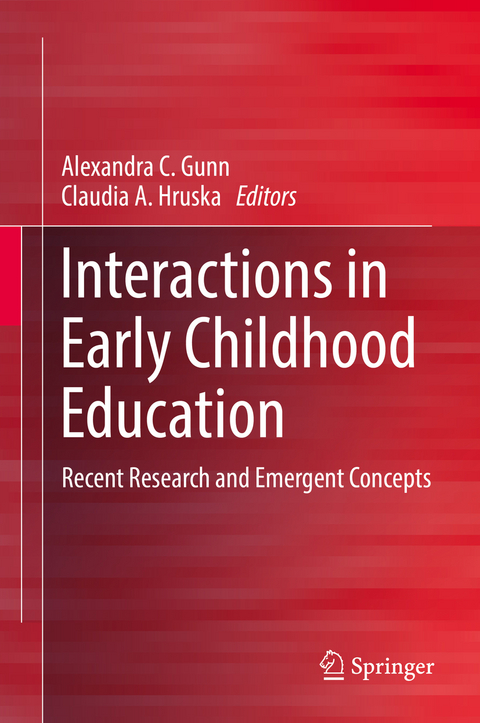
Interactions in Early Childhood Education (eBook)
VII, 170 Seiten
Springer Singapore (Verlag)
978-981-10-4879-1 (ISBN)
This book provides new insights into how interactions in early childhood education are being studied, and into what these studies' findings mean for improving the quality of early childhood education. The editors examine the methods, ethics, practices, and questions arising from such close work with children, families and educators, and have brought together a collection that highlights interactions research and practical implications for early childhood education and research, with the ultimate aim of shaping quality practices.
Starting with an overview of interaction research and its pedagogical value in early childhood education the book subsequently introduces new interaction studies in early childhood from Europe and Australasia. Drawing from a range of perspectives and using different conceptual and methodological tools the contributors use their interactions research to comment collectively on process quality in early childhood education, and its relationship to the phenomenon of pedagogical interactions. The work as a whole bridges the gap between practice and research by addressing quality interactions for early learning (for practitioners) and providing researchers valuable information on methods for studying interactions within the everyday contexts of early childhood education.
Claudia A. Hruska is a Professor of Early Childhood Development and Education. She has fundamental expertise in quantitative educational research, (neuro-)psychological and more recently, qualitative research methods. Her work extends across the subject areas of learning, language, development, and quality in early childhood education. She was in the core team NUBBEK (National Study of education and care), which conducted a nation-wide study on quality in home environments and early childhood educational settings in Germany from 2007 to 2013. She recently joined the Leipzig Research Center for Early Child Development.
Alexandra C. Gunn is a Senior Lecturer and Associate Dean of Teacher Education at the University of Otago College of Education. Formerly an early childhood teacher who worked with children from birth to school age and their families in not-for-profit early childhood education, Alex now researches, writes and teaches in initial teacher education and general education. Her interests include various aspects of inclusion, assessment, gender/sexualities, social justice, and teachers' beliefs and practices. She co-edited Sexual Cultures in Aotearoa/New Zealand Education (2015) with the Otago University Press and Te Aotūroa Tātaki - Inclusive Early Childhood Education: Perspectives on social justice and equity from Aotearoa New Zealand (NZCER Press, 2012).
This book provides new insights into how interactions in early childhood education are being studied, and into what these studies' findings mean for improving the quality of early childhood education. The editors examine the methods, ethics, practices, and questions arising from such close work with children, families and educators, and have brought together a collection that highlights interactions research and practical implications for early childhood education and research, with the ultimate aim of shaping quality practices.Starting with an overview of interaction research and its pedagogical value in early childhood education the book subsequently introduces new interaction studies in early childhood from Europe and Australasia. Drawing from a range of perspectives and using different conceptual and methodological tools the contributors use their interactions research to comment collectively on process quality in early childhood education, and its relationship to the phenomenon of pedagogical interactions. The work as a whole bridges the gap between practice and research by addressing quality interactions for early learning (for practitioners) and providing researchers valuable information on methods for studying interactions within the everyday contexts of early childhood education.
Claudia A. Hruska is a Professor of Early Childhood Development and Education. She has fundamental expertise in quantitative educational research, (neuro-)psychological and more recently, qualitative research methods. Her work extends across the subject areas of learning, language, development, and quality in early childhood education. She was in the core team NUBBEK (National Study of education and care), which conducted a nation-wide study on quality in home environments and early childhood educational settings in Germany from 2007 to 2013. She recently joined the Leipzig Research Center for Early Child Development.Alexandra C. Gunn is a Senior Lecturer and Associate Dean of Teacher Education at the University of Otago College of Education. Formerly an early childhood teacher who worked with children from birth to school age and their families in not-for-profit early childhood education, Alex now researches, writes and teaches in initial teacher education and general education. Her interests include various aspects of inclusion, assessment, gender/sexualities, social justice, and teachers’ beliefs and practices. She co-edited Sexual Cultures in Aotearoa/New Zealand Education (2015) with the Otago University Press and Te Aotūroa Tātaki – Inclusive Early Childhood Education: Perspectives on social justice and equity from Aotearoa New Zealand (NZCER Press, 2012).
Contents 5
Contributors 7
Chapter 1: Interactions and Learning: Overview and Introduction 8
What Do We Mean by ‘Interactions’? 9
A Shifting Gaze in the Science of Teaching and Learning 9
Why Should Those Invested in Early Years Education Pay Attention to Interactions? 10
This Book’s Chapters 11
References 13
Chapter 2: A Conceptual Framework for Early Education: What Micro-sociology Can Contribute to a Theoretically and Empirically Well-Founded Didactic in Early Education 14
Concluding Discussion 22
References 24
Chapter 3: Sensitive Responsiveness: An Approach to the Analysis and Improvement of Teacher-Child Interactions in Early Childhood Settings 25
Introduction 25
Theoretical Background 26
The Concept of Sensitive Responsiveness 27
Research Methods 29
Results 32
Reciprocity of Teacher’s Sensitive Responsiveness and Children’s Involvement in Interactions 34
Children Can Influence Teacher’s Interaction Behaviour 36
A Low Level of Sensitive Responsiveness May Turn Children Away 36
Implications for Early Childhood Education 38
Questions for Reflection 39
References 39
Chapter 4: Children’s Use of Objects in Their Storytelling 43
Storytelling in the Early Years 43
Links to ECE Curriculum: Te Wh?riki 44
The Role of Objects in the Early Years 44
The Research 45
Storytelling with Objects 47
Story Shells: Co-producing a Story with Objects as Support 50
Technology Mediating Storytelling 53
Discussion 56
Appendix: CA Transcription Conventions 57
References 58
Chapter 5: Young Children’s Participation in a New Language Context: A Synthesising Analysis for a Holistic Perspective 60
Introduction 60
Young Children’s Participation in ECE 61
Theorising Participation and Learning 63
Empirical Investigation 63
Synthesising Analysis 64
Findings 65
Discussion and Conclusion 69
References 71
Chapter 6: Shaping Gender Relations in Early Childhood Education: Children’s Interactions and Learning About Gender 74
Introduction 74
Traditional Gender Theories and Early Childhood Education 75
The Research Project 77
Counting Boys and Girls 79
Analysis 81
Discussion 82
Conclusion 83
References 84
Chapter 7: A Dialogic Approach to Understanding Infant Interactions 86
Introduction 86
Understanding Interaction as a Dialogic Event 87
Re-probing Interviews 92
Coding and Interpreting Interactions 93
An Example of Interaction as an Event-of-Co-Being 96
Implications for Infant Interactions in ECEC 101
Glossary 102
References 102
Chapter 8: Enhancing Interactions: Understanding Family Pedagogy and Funds of Knowledge “on Their Turf” 104
Introduction 104
Family and Community as a Key Curriculum Principle 105
Family Pedagogy 105
Funds of Knowledge 106
Home Visits in Early Childhood Education 107
Research Design and the Home Visit to Zoe’s Family 109
Findings About Family Pedagogy and Funds of Knowledge 110
After the Home Visit: Enhancing Teacher-Child Interactions at Small Kauri 111
The Value of Visiting Families “on Their Turf” 112
Enhanced Insights into Family Pedagogy and Funds of Knowledge 113
Improved Pedagogical Interactions and Responses 113
The Transformative Power of Visiting Children and Families on Their Turf 114
Conclusion 115
Epilogue 116
References 116
Chapter 9: “That’s Not Fair!”: Concepts of Fairness in New Zealand and Japanese Early Childhood Education 118
Introduction 118
Methodology 119
What Is Fairness? 121
Play and Learning in New Zealand and Japanese Early Childhood Settings 121
Food as Cultural Ideology 123
Children Assuming the Role of Leader 124
Playing Fair 126
Negotiating Creative Interactions 127
Conclusion 129
References 130
Chapter 10: Strategies for Teacher Learning and Development Over Child-Adult Interactions in ECE Settings 133
Communication and Its Emphasis in ECE Settings 133
The Situation in Germany 134
An Interactional Approach to Supporting Children’s Communication and Language Competence 135
Reflection About Theo’s Development and Learning During the Period of 6 Months 142
How Theo’s Teacher improves her own and His Positive Interactions? 143
How to Develop Competencies by Analysing Interactions? 143
Conclusion 146
References 147
Chapter 11: The Importance of Professional Knowledge for Learning Support in German ECEC Settings 149
Interactions in Early Childhood Education and Care (ECEC) Settings 149
The BIKE-Study 151
Methods of the BIKE-Study 151
Results and Conclusions: How Good was the Interaction Quality in the Observed ECEC Centres? 154
Implications of the BIKE Results for Practice Transfer and Professionalisation 156
Implementation in Practical Action 157
Language Support Strategies 157
Cognitive Support Strategies 158
Results and Conclusions: How about Competences in Planning Language Support? 158
Limitations and Implications for Research 161
References 161
Chapter 12: Using Insights from Interactions Research to Improve Policy and Practice in Early Childhood Education 165
Why Study Learning Interactions? 165
Methods of Studying Learning Interactions 169
Where to Next? 172
References 174
| Erscheint lt. Verlag | 18.7.2017 |
|---|---|
| Zusatzinfo | VII, 170 p. 14 illus. |
| Verlagsort | Singapore |
| Sprache | englisch |
| Themenwelt | Geisteswissenschaften ► Psychologie ► Pädagogische Psychologie |
| Sozialwissenschaften ► Pädagogik ► Vorschulpädagogik | |
| Sozialwissenschaften ► Soziologie | |
| Schlagworte | Conversational Analysis • early childhood settings • Early Years Education • Early Years Research • Educational interaction • Interactional Research • Japanese early childhood education • Learning and Instruction • micro-sociology • New Zealand Early Childhood Education • Research Methods in Education • teacher-child-interactions |
| ISBN-10 | 981-10-4879-7 / 9811048797 |
| ISBN-13 | 978-981-10-4879-1 / 9789811048791 |
| Informationen gemäß Produktsicherheitsverordnung (GPSR) | |
| Haben Sie eine Frage zum Produkt? |
 PDF (Wasserzeichen)
DRM: Digitales Wasserzeichen
Dieses eBook enthält ein digitales Wasserzeichen und ist damit für Sie personalisiert. Bei einer missbräuchlichen Weitergabe des eBooks an Dritte ist eine Rückverfolgung an die Quelle möglich.
Dateiformat: PDF (Portable Document Format)
Mit einem festen Seitenlayout eignet sich die PDF besonders für Fachbücher mit Spalten, Tabellen und Abbildungen. Eine PDF kann auf fast allen Geräten angezeigt werden, ist aber für kleine Displays (Smartphone, eReader) nur eingeschränkt geeignet.
Systemvoraussetzungen:
PC/Mac: Mit einem PC oder Mac können Sie dieses eBook lesen. Sie benötigen dafür einen PDF-Viewer - z.B. den Adobe Reader oder Adobe Digital Editions.
eReader: Dieses eBook kann mit (fast) allen eBook-Readern gelesen werden. Mit dem amazon-Kindle ist es aber nicht kompatibel.
Smartphone/Tablet: Egal ob Apple oder Android, dieses eBook können Sie lesen. Sie benötigen dafür einen PDF-Viewer - z.B. die kostenlose Adobe Digital Editions-App.
Buying eBooks from abroad
For tax law reasons we can sell eBooks just within Germany and Switzerland. Regrettably we cannot fulfill eBook-orders from other countries.
aus dem Bereich