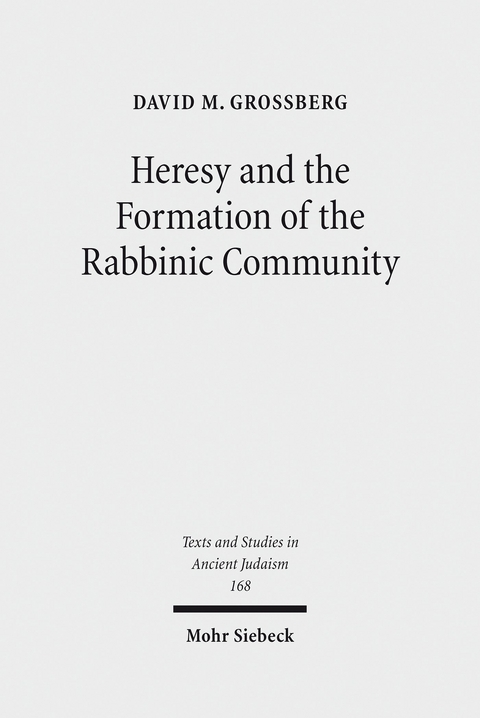
Heresy and the Formation of the Rabbinic Community (eBook)
287 Seiten
Mohr Siebeck (Verlag)
9783161553349 (ISBN)
Born 1965; PhD from Princeton University; currently Visiting Scholar, Cornell University, Ithaca.
Cover 1
Contents 8
Acknowledgements 10
Introduction: The Formation of the Rabbinic Community 12
I. Yavneh and the Myth of Origins 15
II. The Sage Idea and the Development of a Collective 19
III. Heresy and the Formation of Community 25
IV. A Note on Style and Method 30
Chapter 1: The Meaning and End of Heresy in Rabbinic Literature 38
I. Heresy in Rabbinic Literature? 39
II. Heresy as a Category 43
III. Heresy as hairesis 48
IV. Heresy as Heresiological Discourse 52
V. Heresy and Boundary Rhetoric in the Ancient World 59
Chapter 2: Varieties of Minim in the Second Temple and Rabbinic Period 61
I. Heresy and Minut 62
II. Minim as Insiders in the Late Second Temple and Early Rabbinic Periods 68
III. Minim as Hybrids in the Early Christian Period 83
IV. Minim as Outsiders in the Late Rabbinic Period 99
Chapter 3: Co-opting the Sinners of Israel 103
I. The Sinners of Israel and the Sinners of the Nations of the World 103
II. Sinners, Pomegranates, and Good Deeds 109
III. An Israelite Who Sins 117
IV. All Israel Have a Portion in the World to Come 121
Chapter 4: Meshummadim Who Provoke the Rabbis 127
I. Meshummadim, Apostates, and “The Time of Persecutions” 128
II. Flagrant Meshummadim 138
III. Meshummadim From Appetite and To Provoke 143
IV. Provoking the Torah and the Rabbis 150
Chapter 5: Apiqorsim Who Disrespect the Rabbis 155
I. Epicureans, Sadducees, and Divine Providence 156
II. Disrespecting the Rabbis 163
III. Apiqorsim and Irreverence 167
IV. Apiqorsim, minim, and Dangerous Verses 169
V. Know How to Avoid an Apiqoros 173
Chapter 6: Two Powers and the Ascent of Rabbi Elisha 178
I. Elisha ben Abuyah as an Absolute Other 179
II. Elisha ben Abuyah as a Failed Rabbi 182
III. Elisha’s Ascent and Divine Multiplicity 187
IV. Metatron’s Transgression and Heavenly Proscriptions 196
V. Elisha’s Transgression and the Heavenly Voice 198
Chapter 7: The Failed Rabbi and Those Who Cause the Public to Sin 204
I. The Mechanics of Atonement in Rabbinic Tradition 205
II. Gehazi as a Failed Rabbi 211
III. The Failed Rabbi in the Babylonian Talmud 217
Conclusion: Boundary Rhetoric, Community Formation, and Rabbinic Judaism 228
Appendix: Synoptic Presentation of b. Hagigah 15a and 3 Enoch for Chapter Six 236
Bibliography 238
Index of Primary Sources 260
I. Hebrew Bible 260
II. Second Temple Period Jewish Literature 261
III. New Testament 262
IV. Rabbinic Literature 262
Mishnah 263
Tannaitic Midrash 264
Palestinian Talmud 265
Classical Palestinian Midrash 266
Later Midrash 269
V. Greco-Roman and Early Christian Literature 270
VI. Hekhalot and Medieval Jewish Literature 270
Index of Modern Authors 272
Index of Subjects 277
| Erscheint lt. Verlag | 1.7.2017 |
|---|---|
| Sprache | englisch |
| Themenwelt | Geschichte ► Allgemeine Geschichte ► Altertum / Antike |
| Geisteswissenschaften ► Religion / Theologie ► Judentum | |
| ISBN-13 | 9783161553349 / 9783161553349 |
| Informationen gemäß Produktsicherheitsverordnung (GPSR) | |
| Haben Sie eine Frage zum Produkt? |
 PDF (Adobe DRM)
Größe: 3,0 MB
Kopierschutz: Adobe-DRM
Adobe-DRM ist ein Kopierschutz, der das eBook vor Mißbrauch schützen soll. Dabei wird das eBook bereits beim Download auf Ihre persönliche Adobe-ID autorisiert. Lesen können Sie das eBook dann nur auf den Geräten, welche ebenfalls auf Ihre Adobe-ID registriert sind.
Details zum Adobe-DRM
Dateiformat: PDF (Portable Document Format)
Mit einem festen Seitenlayout eignet sich die PDF besonders für Fachbücher mit Spalten, Tabellen und Abbildungen. Eine PDF kann auf fast allen Geräten angezeigt werden, ist aber für kleine Displays (Smartphone, eReader) nur eingeschränkt geeignet.
Systemvoraussetzungen:
PC/Mac: Mit einem PC oder Mac können Sie dieses eBook lesen. Sie benötigen eine
eReader: Dieses eBook kann mit (fast) allen eBook-Readern gelesen werden. Mit dem amazon-Kindle ist es aber nicht kompatibel.
Smartphone/Tablet: Egal ob Apple oder Android, dieses eBook können Sie lesen. Sie benötigen eine
Geräteliste und zusätzliche Hinweise
Buying eBooks from abroad
For tax law reasons we can sell eBooks just within Germany and Switzerland. Regrettably we cannot fulfill eBook-orders from other countries.
aus dem Bereich