


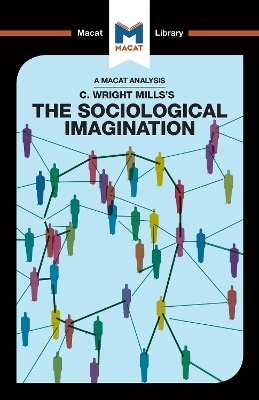
An Analysis of C. Wright Mills's The Sociological Imagination
Seiten
2017
Macat International Limited (Verlag)
978-1-912303-80-9 (ISBN)
Macat International Limited (Verlag)
978-1-912303-80-9 (ISBN)
The Sociological Imagination provoked hostile reaction when it appeared for its hard-hitting attack on how sociology was practiced, and on several leading sociologists.
C. Wright Mills’s 1959 book The Sociological Imagination is widely regarded as one of the most influential works of post-war sociology.
At its heart, the work is a closely reasoned argument about the nature and aims of sociology, one that sets out a manifesto and roadmap for the field. Its wide acceptance and popular reception is a clear demonstration of the rhetorical power of Wright’s strong reasoning skills.
In critical thinking, reasoning involves the creation of an argument that is strong, balanced, and, of course, persuasive. In Mills’s case, this core argument makes a case for what he terms the “sociological imagination”, a particular quality of mind capable of analyzing how individual lives fit into, and interact with, social structures. Only by adopting such an approach, Mills argues, can sociologists see the private troubles of individuals as the social issues they really are.
Allied to this central argument are supporting arguments for the need for sociology to maintain its independence from corporations and governments, and for social scientists to steer away from ‘high theory’ and focus on the real difficulties of everyday life. Carefully organized, watertight and persuasive, The Sociological Imagination exemplifies reasoned argument at its best.
C. Wright Mills’s 1959 book The Sociological Imagination is widely regarded as one of the most influential works of post-war sociology.
At its heart, the work is a closely reasoned argument about the nature and aims of sociology, one that sets out a manifesto and roadmap for the field. Its wide acceptance and popular reception is a clear demonstration of the rhetorical power of Wright’s strong reasoning skills.
In critical thinking, reasoning involves the creation of an argument that is strong, balanced, and, of course, persuasive. In Mills’s case, this core argument makes a case for what he terms the “sociological imagination”, a particular quality of mind capable of analyzing how individual lives fit into, and interact with, social structures. Only by adopting such an approach, Mills argues, can sociologists see the private troubles of individuals as the social issues they really are.
Allied to this central argument are supporting arguments for the need for sociology to maintain its independence from corporations and governments, and for social scientists to steer away from ‘high theory’ and focus on the real difficulties of everyday life. Carefully organized, watertight and persuasive, The Sociological Imagination exemplifies reasoned argument at its best.
Puga, Ismael; Easthope, Robert
Ways in to the Text Who was C. Wright Mills? What does The Sociological Imagination Say? Why does The Sociological Imagination Matter? Section 1: Influences Module 1: The Author and the Historical Context Module 2: Academic Context Module 3: The Problem Module 4: The Author's Contribution Section 2: Ideas Module 5: Main Ideas Module 6: Secondary Ideas Module 7: Achievement Module 8: Place in the Author's Work Section 3: Impact Module 9: The First Responses Module 10: The Evolving Debate Module 11: Impact and Influence Today Module 12: Where Next? Glossary of Terms People Mentioned in the Text Works Cited
| Erscheinungsdatum | 26.07.2017 |
|---|---|
| Reihe/Serie | The Macat Library |
| Verlagsort | London |
| Sprache | englisch |
| Maße | 129 x 198 mm |
| Gewicht | 360 g |
| Themenwelt | Geisteswissenschaften ► Psychologie ► Allgemeine Psychologie |
| Sozialwissenschaften ► Pädagogik | |
| Sozialwissenschaften ► Soziologie | |
| Wirtschaft ► Volkswirtschaftslehre | |
| ISBN-10 | 1-912303-80-9 / 1912303809 |
| ISBN-13 | 978-1-912303-80-9 / 9781912303809 |
| Zustand | Neuware |
| Informationen gemäß Produktsicherheitsverordnung (GPSR) | |
| Haben Sie eine Frage zum Produkt? |
Mehr entdecken
aus dem Bereich

aus dem Bereich
Paket bestehend aus »Das Patienten-Manual« und »Das Trainer-Manual«
Buch | Softcover (2025)
Schattauer (Verlag)
CHF 125,95


