


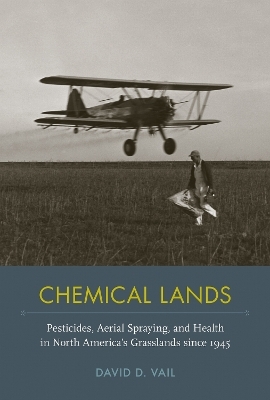
Chemical Lands
Pesticides, Aerial Spraying, and Health in North America's Grasslands Since 1945
Seiten
2017
The University of Alabama Press (Verlag)
978-0-8173-1973-1 (ISBN)
The University of Alabama Press (Verlag)
978-0-8173-1973-1 (ISBN)
- Titel z.Zt. nicht lieferbar
- Versandkostenfrei
- Auch auf Rechnung
- Artikel merken
An exploration of the relationship between farmers, aerial sprayers, agriculturalists, crop pests, chemicals, and the environment. David D. Vail’s analysis reveals a strong ethic in the North American grasslands where practitioners sought to deploy insecticides by designing local scientific experiments, engineering more precise aircraft sprayers, and developing more narrowly specific chemicals.
An exploration of the elaborate relationship between farmers, aerial sprayers, agriculturalists, crop pests, chemicals, and the environment. The controversies in the 1960s and 1970s that swirled around indiscriminate use of agricultural chemicals–their long-term ecological harm versus food production benefits–were sparked and clarified by biologist Rachel Carson's Silent Spring (1962). This seminal publication challenged long-held assumptions concerning the industrial might of American agriculture while sounding an alarm for the damaging persistence of pesticides, especially chlorinated hydrocarbons such as DDT, in the larger environment. In Chemical Lands: Pesticides, Aerial Spraying, and Health in North America's Grasslands since 1945 David D. Vail shows, however, that a distinctly regional view of agricultural health evolved. His analysis reveals a particularly strong ethic in the North American grasslands where practitioners sought to understand and deploy insecticides and herbicides by designing local scientific experiments, engineering more precise aircraft sprayers, developing more narrowly specific chemicals, and planting targeted test crops. Their efforts to link the science of toxicology with environmental health reveal how the practitioners of pesticides evaluated potential hazards in the agricultural landscape while recognizing the production benefits of controlled spraying. Chemical Lands adds to a growing list of books on toxins in the American landscape. This study provides a unique Grasslands perspective of the Ag pilots, weed scientists, and farmers who struggled to navigate novel technologies for spray planes and in the development of new herbicides/insecticides while striving to manage and mitigate threats to human health and the environment.
An exploration of the elaborate relationship between farmers, aerial sprayers, agriculturalists, crop pests, chemicals, and the environment. The controversies in the 1960s and 1970s that swirled around indiscriminate use of agricultural chemicals–their long-term ecological harm versus food production benefits–were sparked and clarified by biologist Rachel Carson's Silent Spring (1962). This seminal publication challenged long-held assumptions concerning the industrial might of American agriculture while sounding an alarm for the damaging persistence of pesticides, especially chlorinated hydrocarbons such as DDT, in the larger environment. In Chemical Lands: Pesticides, Aerial Spraying, and Health in North America's Grasslands since 1945 David D. Vail shows, however, that a distinctly regional view of agricultural health evolved. His analysis reveals a particularly strong ethic in the North American grasslands where practitioners sought to understand and deploy insecticides and herbicides by designing local scientific experiments, engineering more precise aircraft sprayers, developing more narrowly specific chemicals, and planting targeted test crops. Their efforts to link the science of toxicology with environmental health reveal how the practitioners of pesticides evaluated potential hazards in the agricultural landscape while recognizing the production benefits of controlled spraying. Chemical Lands adds to a growing list of books on toxins in the American landscape. This study provides a unique Grasslands perspective of the Ag pilots, weed scientists, and farmers who struggled to navigate novel technologies for spray planes and in the development of new herbicides/insecticides while striving to manage and mitigate threats to human health and the environment.
David D. Vail is an assistant professor of environmental and agricultural history at the University of Nebraska at Kearney.
| Erscheinungsdatum | 06.02.2018 |
|---|---|
| Reihe/Serie | NEXUS: New Histories of Science, Technology, the Environment, Agriculture, and Medicine |
| Zusatzinfo | 9 black & white figures, 1 map |
| Verlagsort | Alabama |
| Sprache | englisch |
| Maße | 154 x 231 mm |
| Gewicht | 480 g |
| Themenwelt | Sachbuch/Ratgeber ► Geschichte / Politik ► Allgemeines / Lexika |
| Geisteswissenschaften ► Archäologie | |
| Geschichte ► Allgemeine Geschichte ► Neuzeit (bis 1918) | |
| Geisteswissenschaften ► Geschichte ► Regional- / Ländergeschichte | |
| Naturwissenschaften ► Biologie ► Ökologie / Naturschutz | |
| ISBN-10 | 0-8173-1973-5 / 0817319735 |
| ISBN-13 | 978-0-8173-1973-1 / 9780817319731 |
| Zustand | Neuware |
| Informationen gemäß Produktsicherheitsverordnung (GPSR) | |
| Haben Sie eine Frage zum Produkt? |
Mehr entdecken
aus dem Bereich



aus dem Bereich
Geschichte einer wilden Handlung
Buch | Hardcover (2024)
C.H.Beck (Verlag)
CHF 47,60


