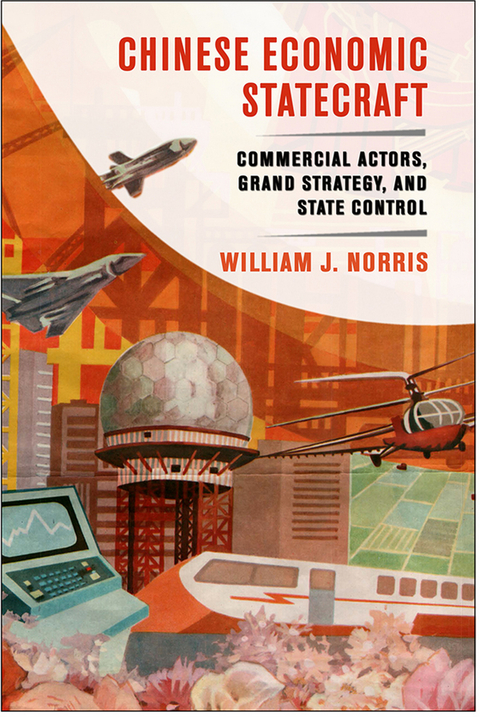
Chinese Economic Statecraft (eBook)
318 Seiten
Cornell University Press (Verlag)
978-1-5017-0402-4 (ISBN)
In Chinese Economic Statecraft, William J. Norris introduces an innovative theory that pinpoints how states employ economic tools of national power to pursue their strategic objectives. Norris shows what Chinese economic statecraft is, how it works, and why it is more or less effective.
In Chinese Economic Statecraft, William J. Norris introduces an innovative theory that pinpoints how states employ economic tools of national power to pursue their strategic objectives. Norris shows what Chinese economic statecraft is, how it works, and why it is more or less effective. Norris provides an accessible tool kit to help us better understand important economic developments in the People's Republic of China. He links domestic Chinese political economy with the international ramifications of China's economic power as a tool for realizing China's strategic foreign policy interests. He presents a novel approach to studying economic statecraft that calls attention to the central challenge of how the state is (or is not) able to control and direct the behavior of economic actors.
Norris identifies key causes of Chinese state control through tightly structured, substate and crossnational comparisons of business-government relations. These cases range across three important arenas of China's grand strategy that prominently feature a strategic role for economics: China's efforts to secure access to vital raw materials located abroad, Mainland relations toward Taiwan, and China's sovereign wealth funds. Norris spent more than two years conducting field research in China and Taiwan during which he interviewed current and former government officials, academics, bankers, journalists, advisors, lawyers, and businesspeople. The ideas in this book are applicable beyond China and help us to understand how states exercise international economic power in the twenty-first century.
In Chinese Economic Statecraft, William J. Norris introduces an innovative theory that pinpoints how states employ economic tools of national power to pursue their strategic objectives. Norris shows what Chinese economic statecraft is, how it works, and why it is more or less effective. Norris provides an accessible tool kit to help us better understand important economic developments in the People's Republic of China. He links domestic Chinese political economy with the international ramifications of China’s economic power as a tool for realizing China’s strategic foreign policy interests. He presents a novel approach to studying economic statecraft that calls attention to the central challenge of how the state is (or is not) able to control and direct the behavior of economic actors.Norris identifies key causes of Chinese state control through tightly structured, substate and crossnational comparisons of business-government relations. These cases range across three important arenas of China’s grand strategy that prominently feature a strategic role for economics: China’s efforts to secure access to vital raw materials located abroad, Mainland relations toward Taiwan, and China’s sovereign wealth funds. Norris spent more than two years conducting field research in China and Taiwan during which he interviewed current and former government officials, academics, bankers, journalists, advisors, lawyers, and businesspeople. The ideas in this book are applicable beyond China and help us to understand how states exercise international economic power in the twenty-first century.
William J. Norris is an Assistant Professor in the Bush School of Government and Public Service at Texas A&M University.
Part I ON ECONOMIC STATECRAFT
1. What Is Economic Statecraft?
2. The Challenge of State Control
3. Economics and China's Grand Strategy
Part II SECURING STRATEGIC RAW MATERIALS
4. "Going Out" and China’s Search for Energy Security
5. Rio Tinto and the (In)visible Hand of the State Part III CROSS-STRAIT ECONOMIC STATECRAFT
6. Coercive Leverage across the Taiwan Strait
7. Interest Transformation across the Taiwan Strait Part IV CHINA’S SOVEREIGN WEALTH FUNDS
8. State Administration of Foreign Exchange
9. What Right Looks Like
10. The China Investment Corporation Concluding Implications
| Erscheint lt. Verlag | 1.3.2016 |
|---|---|
| Zusatzinfo | 10 b&w line drawings |
| Verlagsort | Ithaca |
| Sprache | englisch |
| Maße | 150 x 150 mm |
| Gewicht | 28 g |
| Themenwelt | Sachbuch/Ratgeber ► Beruf / Finanzen / Recht / Wirtschaft ► Wirtschaft |
| Geisteswissenschaften ► Geschichte ► Regional- / Ländergeschichte | |
| Sozialwissenschaften ► Politik / Verwaltung ► Europäische / Internationale Politik | |
| Wirtschaft ► Volkswirtschaftslehre ► Wirtschaftspolitik | |
| Schlagworte | economic developments, Chinese political economy, foreign policy, national power |
| ISBN-10 | 1-5017-0402-8 / 1501704028 |
| ISBN-13 | 978-1-5017-0402-4 / 9781501704024 |
| Informationen gemäß Produktsicherheitsverordnung (GPSR) | |
| Haben Sie eine Frage zum Produkt? |
 EPUB (Adobe DRM)
Kopierschutz: Adobe-DRM
Adobe-DRM ist ein Kopierschutz, der das eBook vor Mißbrauch schützen soll. Dabei wird das eBook bereits beim Download auf Ihre persönliche Adobe-ID autorisiert. Lesen können Sie das eBook dann nur auf den Geräten, welche ebenfalls auf Ihre Adobe-ID registriert sind.
Details zum Adobe-DRM
Dateiformat: EPUB (Electronic Publication)
EPUB ist ein offener Standard für eBooks und eignet sich besonders zur Darstellung von Belletristik und Sachbüchern. Der Fließtext wird dynamisch an die Display- und Schriftgröße angepasst. Auch für mobile Lesegeräte ist EPUB daher gut geeignet.
Systemvoraussetzungen:
PC/Mac: Mit einem PC oder Mac können Sie dieses eBook lesen. Sie benötigen eine
eReader: Dieses eBook kann mit (fast) allen eBook-Readern gelesen werden. Mit dem amazon-Kindle ist es aber nicht kompatibel.
Smartphone/Tablet: Egal ob Apple oder Android, dieses eBook können Sie lesen. Sie benötigen eine
Geräteliste und zusätzliche Hinweise
Buying eBooks from abroad
For tax law reasons we can sell eBooks just within Germany and Switzerland. Regrettably we cannot fulfill eBook-orders from other countries.
aus dem Bereich