Building China (eBook)
216 Seiten
Ilr Press (Verlag)
978-1-5017-0171-9 (ISBN)
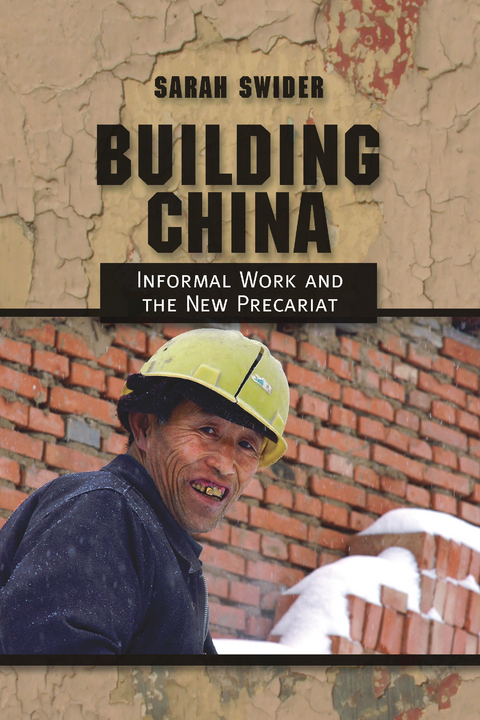
In Building China, Sarah Swider draws on her research in Beijing, Guangzhou, and Shanghai between 2004 and 2012, including living in an enclave, working on construction jobsites, and interviews with eighty-three migrants, managers, and labor contractors. Her ethnography focuses on the work, family, and social lives of construction workers in China.
Roughly 260 million workers in China have participated in a mass migration of peasants moving into the cities, and construction workers account for almost half of them. In Building China, Sarah Swider draws on her research in Beijing, Guangzhou, and Shanghai between 2004 and 2012, including living in an enclave, working on construction jobsites, and interviews with eighty-three migrants, managers, and labor contractors. This ethnography focuses on the lives, work, family, and social relations of construction workers. It adds to our understanding of China's new working class, the deepening rural-urban divide, and the growing number of undocumented migrants working outside the protection of labor laws and regulation. Swider shows how these migrants—members of the global "precariat," an emergent social force based on vulnerability, insecurity, and uncertainty—are changing China's class structure and what this means for the prospects for an independent labor movement.The workers who build and serve Chinese cities, along with those who produce goods for the world to consume, are mostly migrant workers. They, or their parents, grew up in the countryside; they are farmers who left the fields and migrated to the cities to find work. Informal workers—who represent a large segment of the emerging workforce—do not fit the traditional model of industrial wage workers. Although they have not been incorporated into the new legal framework that helps define and legitimize China's decentralized legal authoritarian regime, they have emerged as a central component of China's economic success and an important source of labor resistance.
Roughly 260 million workers in China have participated in a mass migration of peasants moving into the cities, and construction workers account for almost half of them. In Building China, Sarah Swider draws on her research in Beijing, Guangzhou, and Shanghai between 2004 and 2012, including living in an enclave, working on construction jobsites, and interviews with eighty-three migrants, managers, and labor contractors. This ethnography focuses on the lives, work, family, and social relations of construction workers. It adds to our understanding of China's new working class, the deepening rural-urban divide, and the growing number of undocumented migrants working outside the protection of labor laws and regulation. Swider shows how these migrants—members of the global "precariat," an emergent social force based on vulnerability, insecurity, and uncertainty—are changing China's class structure and what this means for the prospects for an independent labor movement.
The workers who build and serve Chinese cities, along with those who produce goods for the world to consume, are mostly migrant workers. They, or their parents, grew up in the countryside; they are farmers who left the fields and migrated to the cities to find work. Informal workers—who represent a large segment of the emerging workforce—do not fit the traditional model of industrial wage workers. Although they have not been incorporated into the new legal framework that helps define and legitimize China's decentralized legal authoritarian regime, they have emerged as a central component of China's economic success and an important source of labor resistance.
Sarah Swider is Assistant Professor of Sociology at Wayne State University.
1. Building China and the Making of a New Working Class2. The Hukou System, Migration, and the Construction Industry3. Mediated Employment: A City of Walls4. Embedded Employment: A City of Villages5. Individual Employment: A City of Violence6. Protest and Organizing among Informal Workers under Restrictive Regimes7. Informal Precarious Workers, Protests, and Precarious AuthoritarianismAppendix A. Methods, Sampling, and Access
Appendix B. List of Construction Sites
Appendix C. List of InterviewsNotes
References
Index
| Erscheint lt. Verlag | 19.2.2016 |
|---|---|
| Zusatzinfo | 8 halftones, 2 line figures, 9 tables |
| Verlagsort | Ithaca |
| Sprache | englisch |
| Maße | 150 x 150 mm |
| Gewicht | 28 g |
| Themenwelt | Sachbuch/Ratgeber ► Beruf / Finanzen / Recht / Wirtschaft ► Geld / Bank / Börse |
| Geisteswissenschaften ► Geschichte ► Regional- / Ländergeschichte | |
| Sozialwissenschaften ► Politik / Verwaltung ► Staat / Verwaltung | |
| Sozialwissenschaften ► Soziologie ► Mikrosoziologie | |
| Technik ► Bauwesen | |
| Wirtschaft ► Volkswirtschaftslehre ► Makroökonomie | |
| Schlagworte | Chinese society, Beijing, Guangzhou, Shanghai, China’s new working class, New precariat, informal work, construction workers, migrant workers, labor market, independent labor movement, urbanization, China’s class structure, labor resistance |
| ISBN-10 | 1-5017-0171-1 / 1501701711 |
| ISBN-13 | 978-1-5017-0171-9 / 9781501701719 |
| Informationen gemäß Produktsicherheitsverordnung (GPSR) | |
| Haben Sie eine Frage zum Produkt? |
 EPUB (Adobe DRM)
Kopierschutz: Adobe-DRM
Adobe-DRM ist ein Kopierschutz, der das eBook vor Mißbrauch schützen soll. Dabei wird das eBook bereits beim Download auf Ihre persönliche Adobe-ID autorisiert. Lesen können Sie das eBook dann nur auf den Geräten, welche ebenfalls auf Ihre Adobe-ID registriert sind.
Details zum Adobe-DRM
Dateiformat: EPUB (Electronic Publication)
EPUB ist ein offener Standard für eBooks und eignet sich besonders zur Darstellung von Belletristik und Sachbüchern. Der Fließtext wird dynamisch an die Display- und Schriftgröße angepasst. Auch für mobile Lesegeräte ist EPUB daher gut geeignet.
Systemvoraussetzungen:
PC/Mac: Mit einem PC oder Mac können Sie dieses eBook lesen. Sie benötigen eine
eReader: Dieses eBook kann mit (fast) allen eBook-Readern gelesen werden. Mit dem amazon-Kindle ist es aber nicht kompatibel.
Smartphone/Tablet: Egal ob Apple oder Android, dieses eBook können Sie lesen. Sie benötigen eine
Geräteliste und zusätzliche Hinweise
Buying eBooks from abroad
For tax law reasons we can sell eBooks just within Germany and Switzerland. Regrettably we cannot fulfill eBook-orders from other countries.
aus dem Bereich