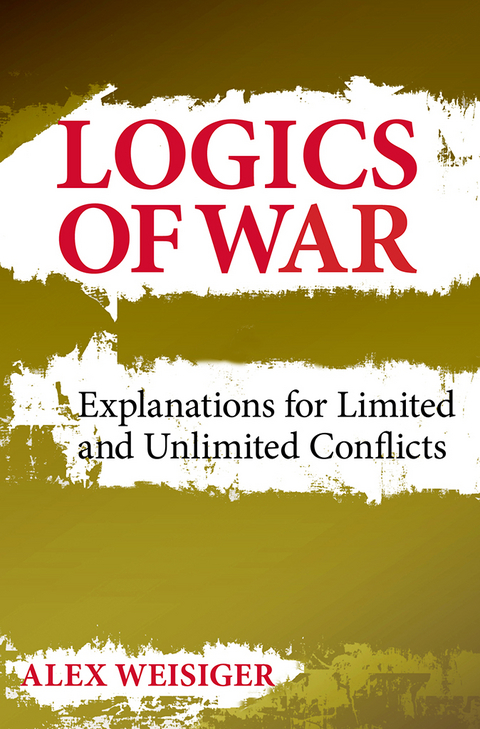
Logics of War (eBook)
296 Seiten
Cornell University Press (Verlag)
978-0-8014-6816-2 (ISBN)
Alex Weisiger tests three explanations for a nation's decision to go to war and continue fighting regardless of the costs. He combines sharp statistical analysis of interstate wars over the past two centuries with nine narrative case studies.
Most wars between countries end quickly and at relatively low cost. The few in which high-intensity fighting continues for years bring about a disproportionate amount of death and suffering. What separates these few unusually long and intense wars from the many conflicts that are far less destructive? In Logics of War, Alex Weisiger tests three explanations for a nation's decision to go to war and continue fighting regardless of the costs. He combines sharp statistical analysis of interstate wars over the past two centuries with nine narrative case studies. He examines both well-known conflicts like World War II and the Persian Gulf War, as well as unfamiliar ones such as the 1864–1870 Paraguayan War (or the War of the Triple Alliance), which proportionally caused more deaths than any other war in modern history.
When leaders go to war expecting easy victory, events usually correct their misperceptions quickly and with fairly low casualties, thereby setting the stage for a negotiated agreement. A second explanation involves motives born of domestic politics; as war becomes more intense, however, leaders are increasingly constrained in their ability to continue the fighting. Particularly destructive wars instead arise from mistrust of an opponent's intentions. Countries that launch preventive wars to forestall expected decline tend to have particularly ambitious war aims that they hold to even when fighting goes poorly. Moreover, in some cases, their opponents interpret the preventive attack as evidence of a dispositional commitment to aggression, resulting in the rejection of any form of negotiation and a demand for unconditional surrender. Weisiger's treatment of a topic of central concern to scholars of major wars will also be read with great interest by military historians, political psychologists, and sociologists.
Most wars between countries end quickly and at relatively low cost. The few in which high-intensity fighting continues for years bring about a disproportionate amount of death and suffering. What separates these few unusually long and intense wars from the many conflicts that are far less destructive? In Logics of War, Alex Weisiger tests three explanations for a nation's decision to go to war and continue fighting regardless of the costs. He combines sharp statistical analysis of interstate wars over the past two centuries with nine narrative case studies. He examines both well-known conflicts like World War II and the Persian Gulf War, as well as unfamiliar ones such as the 1864–1870 Paraguayan War (or the War of the Triple Alliance), which proportionally caused more deaths than any other war in modern history. When leaders go to war expecting easy victory, events usually correct their misperceptions quickly and with fairly low casualties, thereby setting the stage for a negotiated agreement. A second explanation involves motives born of domestic politics; as war becomes more intense, however, leaders are increasingly constrained in their ability to continue the fighting. Particularly destructive wars instead arise from mistrust of an opponent's intentions. Countries that launch preventive wars to forestall expected decline tend to have particularly ambitious war aims that they hold to even when fighting goes poorly. Moreover, in some cases, their opponents interpret the preventive attack as evidence of a dispositional commitment to aggression, resulting in the rejection of any form of negotiation and a demand for unconditional surrender. Weisiger’s treatment of a topic of central concern to scholars of major wars will also be read with great interest by military historians, political psychologists, and sociologists.
Alex Weisiger is Assistant Professor of Political Science at the University of Pennsylvania.
Introduction1. Explanations for Limited and Unlimited Wars2. Research Strategy and Statistical Tests3. War to the Death in Paraguay4. World War II: German Expansion and Allied Response5. Additional Commitment Problem Cases: The Crimean, Pacific, and Iran-Iraq Wars6. Short Wars of Optimism: Persian Gulf and Anglo-Iranian7. The Limits on Leaders: The Falklands War and the Franco-Turkish WarConclusion: Recapitulations, Implications, and PrognosticationsNotes
Bibliography
Index
| Erscheint lt. Verlag | 15.3.2013 |
|---|---|
| Reihe/Serie | Cornell Studies in Security Affairs | Cornell Studies in Security Affairs |
| Zusatzinfo | 9 halftones, 5 tables, 4 charts, 2 maps, 4 line drawings |
| Verlagsort | Ithaca |
| Sprache | englisch |
| Maße | 160 x 160 mm |
| Themenwelt | Sachbuch/Ratgeber ► Geschichte / Politik ► Allgemeines / Lexika |
| Geschichte ► Teilgebiete der Geschichte ► Militärgeschichte | |
| Sozialwissenschaften ► Politik / Verwaltung ► Europäische / Internationale Politik | |
| Schlagworte | mechanisms of war, military history, war's destruction, cost of war, world war II, persian gulf war, paraguayan war, modern warfare, wartime casualties, major wars |
| ISBN-10 | 0-8014-6816-7 / 0801468167 |
| ISBN-13 | 978-0-8014-6816-2 / 9780801468162 |
| Informationen gemäß Produktsicherheitsverordnung (GPSR) | |
| Haben Sie eine Frage zum Produkt? |
 EPUB (Adobe DRM)
Kopierschutz: Adobe-DRM
Adobe-DRM ist ein Kopierschutz, der das eBook vor Mißbrauch schützen soll. Dabei wird das eBook bereits beim Download auf Ihre persönliche Adobe-ID autorisiert. Lesen können Sie das eBook dann nur auf den Geräten, welche ebenfalls auf Ihre Adobe-ID registriert sind.
Details zum Adobe-DRM
Dateiformat: EPUB (Electronic Publication)
EPUB ist ein offener Standard für eBooks und eignet sich besonders zur Darstellung von Belletristik und Sachbüchern. Der Fließtext wird dynamisch an die Display- und Schriftgröße angepasst. Auch für mobile Lesegeräte ist EPUB daher gut geeignet.
Systemvoraussetzungen:
PC/Mac: Mit einem PC oder Mac können Sie dieses eBook lesen. Sie benötigen eine
eReader: Dieses eBook kann mit (fast) allen eBook-Readern gelesen werden. Mit dem amazon-Kindle ist es aber nicht kompatibel.
Smartphone/Tablet: Egal ob Apple oder Android, dieses eBook können Sie lesen. Sie benötigen eine
Geräteliste und zusätzliche Hinweise
Buying eBooks from abroad
For tax law reasons we can sell eBooks just within Germany and Switzerland. Regrettably we cannot fulfill eBook-orders from other countries.
aus dem Bereich