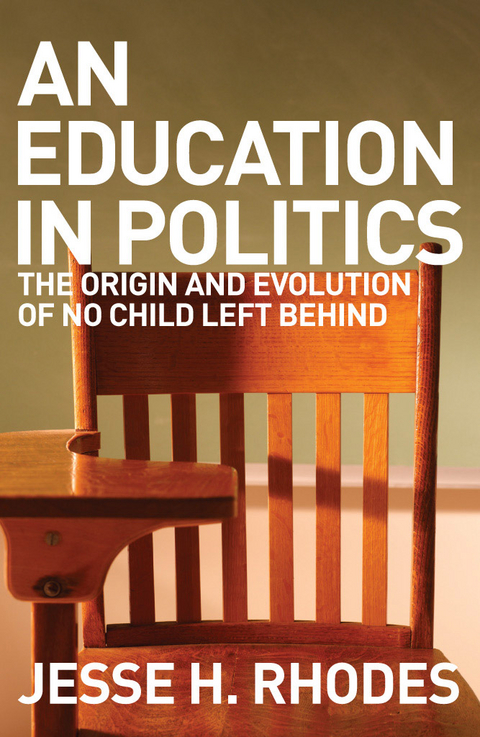
An Education in Politics (eBook)
264 Seiten
Cornell University Press (Verlag)
978-0-8014-6466-9 (ISBN)
In this work, Jesse H. Rhodes shows how the No Child Left Behind Act of 2002 and its prescriptive policies arose out of the dynamic of decentralized authority established in the American federal system.
Since the early 1990s, the federal role in education—exemplified by the controversial No Child Left Behind Act (NCLB)—has expanded dramatically. Yet states and localities have retained a central role in education policy, leading to a growing struggle for control over the direction of the nation's schools. In An Education in Politics, Jesse H. Rhodes explains the uneven development of federal involvement in education. While supporters of expanded federal involvement enjoyed some success in bringing new ideas to the federal policy agenda, Rhodes argues, they also encountered stiff resistance from proponents of local control. Built atop existing decentralized policies, new federal reforms raised difficult questions about which level of government bore ultimate responsibility for improving schools.
Rhodes's argument focuses on the role played by civil rights activists, business leaders, and education experts in promoting the reforms that would be enacted with federal policies such as NCLB. It also underscores the constraints on federal involvement imposed by existing education policies, hostile interest groups, and, above all, the nation's federal system. Indeed, the federal system, which left specific policy formation and implementation to the states and localities, repeatedly frustrated efforts to effect changes: national reforms lost their force as policies passed through iterations at the state, county, and municipal levels. Ironically, state and local resistance only encouraged civil rights activists, business leaders, and their political allies to advocate even more stringent reforms that imposed heavier burdens on state and local governments. Through it all, the nation's education system made only incremental steps toward the goal of providing a quality education for every child.
Since the early 1990s, the federal role in education—exemplified by the controversial No Child Left Behind Act (NCLB)—has expanded dramatically. Yet states and localities have retained a central role in education policy, leading to a growing struggle for control over the direction of the nation's schools. In An Education in Politics, Jesse H. Rhodes explains the uneven development of federal involvement in education. While supporters of expanded federal involvement enjoyed some success in bringing new ideas to the federal policy agenda, Rhodes argues, they also encountered stiff resistance from proponents of local control. Built atop existing decentralized policies, new federal reforms raised difficult questions about which level of government bore ultimate responsibility for improving schools.
Rhodes's argument focuses on the role played by civil rights activists, business leaders, and education experts in promoting the reforms that would be enacted with federal policies such as NCLB. It also underscores the constraints on federal involvement imposed by existing education policies, hostile interest groups, and, above all, the nation’s federal system. Indeed, the federal system, which left specific policy formation and implementation to the states and localities, repeatedly frustrated efforts to effect changes: national reforms lost their force as policies passed through iterations at the state, county, and municipal levels. Ironically, state and local resistance only encouraged civil rights activists, business leaders, and their political allies to advocate even more stringent reforms that imposed heavier burdens on state and local governments. Through it all, the nation’s education system made only incremental steps toward the goal of providing a quality education for every child.
Jesse H. Rhodes is Associate Professor of Political Science at the University of Massachusetts Amherst.
Introduction: Explaining the Development of American Education Policymaking1. The Structure of American Education Policy before 19802. A New Direction in American Education Policy, 1980–19883. Federal School Reform Builds Momentum, 1989–19924. A New Federal Role Is Born, 1993–19945. The Road to No Child Left Behind, 1995–20026. "Yes We Can" Improve America's Schools? From No Child Left Behind to President Obama's Education Initiatives, 2003–2011Conclusion: Institutionally Bounded Entrepreneurship and the Future of American Education PolicymakingList of Abbreviations
Notes
Index
| Reihe/Serie | American Institutions and Society | American Institutions and Society |
|---|---|
| Zusatzinfo | 1 table, 4 charts/graphs |
| Verlagsort | Ithaca |
| Sprache | englisch |
| Maße | 160 x 160 mm |
| Gewicht | 28 g |
| Themenwelt | Schulbuch / Wörterbuch ► Lektüren / Interpretationen |
| Geschichte ► Allgemeine Geschichte ► Neuzeit (bis 1918) | |
| Geisteswissenschaften ► Geschichte ► Regional- / Ländergeschichte | |
| Sozialwissenschaften ► Pädagogik ► Bildungstheorie | |
| Sozialwissenschaften ► Politik / Verwaltung ► Staat / Verwaltung | |
| Schlagworte | education legislation, policy, history of education, political science, federal education, federal inference in education, influences on education |
| ISBN-10 | 0-8014-6466-8 / 0801464668 |
| ISBN-13 | 978-0-8014-6466-9 / 9780801464669 |
| Informationen gemäß Produktsicherheitsverordnung (GPSR) | |
| Haben Sie eine Frage zum Produkt? |
 EPUB (Adobe DRM)
Kopierschutz: Adobe-DRM
Adobe-DRM ist ein Kopierschutz, der das eBook vor Mißbrauch schützen soll. Dabei wird das eBook bereits beim Download auf Ihre persönliche Adobe-ID autorisiert. Lesen können Sie das eBook dann nur auf den Geräten, welche ebenfalls auf Ihre Adobe-ID registriert sind.
Details zum Adobe-DRM
Dateiformat: EPUB (Electronic Publication)
EPUB ist ein offener Standard für eBooks und eignet sich besonders zur Darstellung von Belletristik und Sachbüchern. Der Fließtext wird dynamisch an die Display- und Schriftgröße angepasst. Auch für mobile Lesegeräte ist EPUB daher gut geeignet.
Systemvoraussetzungen:
PC/Mac: Mit einem PC oder Mac können Sie dieses eBook lesen. Sie benötigen eine
eReader: Dieses eBook kann mit (fast) allen eBook-Readern gelesen werden. Mit dem amazon-Kindle ist es aber nicht kompatibel.
Smartphone/Tablet: Egal ob Apple oder Android, dieses eBook können Sie lesen. Sie benötigen eine
Geräteliste und zusätzliche Hinweise
Buying eBooks from abroad
For tax law reasons we can sell eBooks just within Germany and Switzerland. Regrettably we cannot fulfill eBook-orders from other countries.
aus dem Bereich