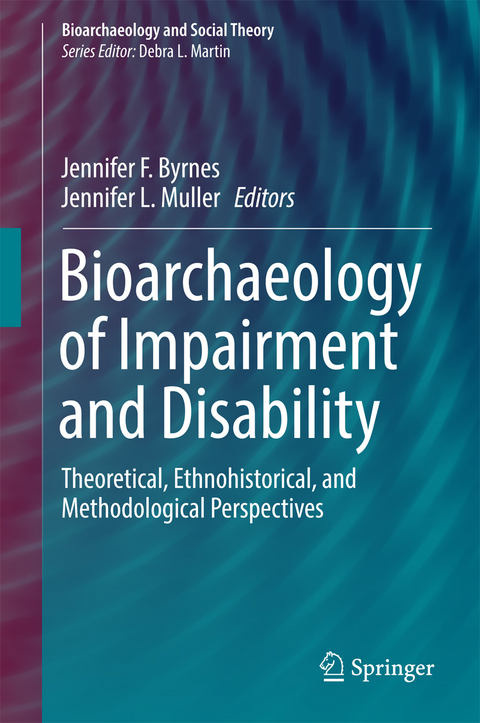
Bioarchaeology of Impairment and Disability (eBook)
XI, 292 Seiten
Springer International Publishing (Verlag)
978-3-319-56949-9 (ISBN)
This volume has three goals: The first goal of this edited volume is to present theoretical and methodological discussions on impairment and disability. The second goal of this volume is to emphasize the necessity of interdisciplinarity in discussions of impairment and disability within bioarchaeology. The third goal of the volume is to present various methodological approaches to quantifying impairment in skeletonized and mummified remains.
This volume serves to engage scholars from many disciplines in our exploration of disability in the past, with particular emphasis on the bioarchaeological context.Jennifer F. Byrnes is an Assistant Professor in the Division of the Social Sciences at the University of Hawaiʻi - West Oʻahu, USA. She received her B.S. in Biology from the State University of New York College at Geneseo (2006), and M.A. (2009) and Ph.D. (2015) in Anthropology from the State University of New York at Buffalo. She has received training in bioarchaeology and forensic anthropology. She co-organized a symposium, of which this volume is a product of, entitled Embodying Impairment: Towards a Bioarchaeology of Disability at the American Association of Physical Anthropology 2015 Annual Meeting. She has most recently published articles in the Journal of Forensic Sciences on a collaborate project with the Defense POW/MIA Accounting Agency as well as another research article which presented the practical considerations of portable X-ray fluorescence with osseous materials. She has ongoing research investigating the traumatic injuries and paleopathology of the adult skeletal remains exhumed from the Erie County Poorhouse in Buffalo, NY.
Jennifer F. Byrnes is an Assistant Professor in the Division of the Social Sciences at the University of Hawaiʻi – West Oʻahu, USA. She received her B.S. in Biology from the State University of New York College at Geneseo (2006), and M.A. (2009) and Ph.D. (2015) in Anthropology from the State University of New York at Buffalo. She has received training in bioarchaeology and forensic anthropology. She co-organized a symposium, of which this volume is a product of, entitled Embodying Impairment: Towards a Bioarchaeology of Disability at the American Association of Physical Anthropology 2015 Annual Meeting. She has most recently published articles in the Journal of Forensic Sciences on a collaborate project with the Defense POW/MIA Accounting Agency as well as another research article which presented the practical considerations of portable X-ray fluorescence with osseous materials. She has ongoing research investigating the traumatic injuries and paleopathology of the adult skeletal remains exhumed from the Erie County Poorhouse in Buffalo, NY. Jennifer L. Muller is an Associate Professor in the Department of Anthropology, Ithaca College, Ithaca, Nw York, USA. She received her PhD from the Department of Anthropology, State University of New York at Buffalo in 2006. Muller’s research embraces the holism of anthropological study, integrating theoretical perspectives and methodologies from the cultural, biological, and archaeological subfields of the discipline. Her research has specifically focused on how discrimination-based inequities impact human biology in African diasporic populations and among the institutionalized poor. Foundational to this research is the understanding that the body is both biological and social, and that the insidious and pervasive attributes of structural violence may assault the body in a multitude of ways. Muller also examines postmortem structural violence; the idea that discriminatory practices continue to harm the poor and marginalized after death. Muller’s dissertation focused on the relationships between traumatic injuries and inequity in the W. Montague Cobb Human Skeletal Collection housed at Howard University in the District of Columbia, USA. Her research on the institutionalized poor has included bioarchaeological and/or historical analysis from New York State poorhouses, including: the Monroe County Poorhouse, Rochester; the Erie County Poorhouse, Buffalo; and the St. Lawrence County Poorhouse, Canton.
1 Mind the Gap: Bridging Disability Studies and Bioarchaeology - An Introduction.- Part ITheoretical Perspectives on Impairment and Disability.- 2 Accommodating Critical Disability Studies in Bioarchaeology.- 3 Consideration of Disability from the Perspective of the Medical Model.- 4 Historiography of Disablement and the South Asian context: The case of Shah Daula’s chuhas.- Part II Ethnohistorical Interpretations: Ability, Disability, and Alternate Ability.- 5 Differently Abled: Africanisms, Disability and Power in the Age of Transatlantic Slavery.- 6 Kojo’s Dis/ability: The Interpretation of Spinal Pathology in the Context of an 18th-Century Jamaican Maroon Community.- 7 Rendered unfit: “Defective” children in the Erie County Poorhouse.- Part III Quantitative Methods in Impairment and Disability: Bioarchaeological Approaches.- 8 The Bioarchaeology of Back Pain.- 9 Using Population Health Constructs to Explore Impairment and Disability in Knee Osteoarthritis.- 10 Quantifying Impairment and Disability in Bioarchaeological Assemblages.- 11 Injuries, Impairment, and Intersecting Identities: The Poor in Buffalo, NY 1851-1913.- Part IV Case Studies of Impairment and Disability in the Past.- 12 Impairment, Disability, and Identity in the Middle Woodland Period: Life at the Juncture of Achondroplasia, Pregnancy, and Infection.- 13 Attempting to Distinguish Impairment from Disability in the Bioarchaeological Record: An Example from DeArmond Mound (40RE12) in East Tennessee.- 14 Anglo-Saxon Concepts of Dis/ability: Placing Disease at Great Chesterford in its Wider Context.
| Erscheint lt. Verlag | 28.6.2017 |
|---|---|
| Reihe/Serie | Bioarchaeology and Social Theory | Bioarchaeology and Social Theory |
| Zusatzinfo | XI, 292 p. 30 illus., 15 illus. in color. |
| Verlagsort | Cham |
| Sprache | englisch |
| Themenwelt | Geschichte ► Allgemeine Geschichte ► Altertum / Antike |
| Schlagworte | distinction in use of terms impairment and disability • formulation and use of methods to quantify impairment • historical and biological causes of disability • legal factors driving disability studies within bioarchaeology • social theories of impairment and disability in the past |
| ISBN-10 | 3-319-56949-X / 331956949X |
| ISBN-13 | 978-3-319-56949-9 / 9783319569499 |
| Informationen gemäß Produktsicherheitsverordnung (GPSR) | |
| Haben Sie eine Frage zum Produkt? |
 PDF (Wasserzeichen)
DRM: Digitales Wasserzeichen
Dieses eBook enthält ein digitales Wasserzeichen und ist damit für Sie personalisiert. Bei einer missbräuchlichen Weitergabe des eBooks an Dritte ist eine Rückverfolgung an die Quelle möglich.
Dateiformat: PDF (Portable Document Format)
Mit einem festen Seitenlayout eignet sich die PDF besonders für Fachbücher mit Spalten, Tabellen und Abbildungen. Eine PDF kann auf fast allen Geräten angezeigt werden, ist aber für kleine Displays (Smartphone, eReader) nur eingeschränkt geeignet.
Systemvoraussetzungen:
PC/Mac: Mit einem PC oder Mac können Sie dieses eBook lesen. Sie benötigen dafür einen PDF-Viewer - z.B. den Adobe Reader oder Adobe Digital Editions.
eReader: Dieses eBook kann mit (fast) allen eBook-Readern gelesen werden. Mit dem amazon-Kindle ist es aber nicht kompatibel.
Smartphone/Tablet: Egal ob Apple oder Android, dieses eBook können Sie lesen. Sie benötigen dafür einen PDF-Viewer - z.B. die kostenlose Adobe Digital Editions-App.
Buying eBooks from abroad
For tax law reasons we can sell eBooks just within Germany and Switzerland. Regrettably we cannot fulfill eBook-orders from other countries.
aus dem Bereich